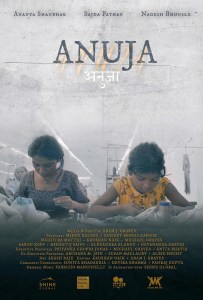
An Indian film with English subtitles, Anuja is a 22-minute meditation on childhood, resilience, and the precarious balance between sacrifice and aspiration. Shot in the bustling streets and shadowed factories of New Delhi, director Adam J. Graves crafts a narrative that is both intimate and unflinching—a story of a young girl whose mathematical brilliance offers her an escape. But at what cost?
Sajda Pathan delivers a remarkable performance as Anuja, a girl barely ten yet already hardened by factory work. Her sister Palak (Ananya Shanbhag) shoulders the burden of both sibling and surrogate mother, navigating their meager existence with an almost defiant warmth. Their relationship—rooted in playfulness, yet shadowed by necessity—forms the film’s emotional core. And in that relationship, the film finds a subtle poetry: Anuja is not just a name. In Sanskrit, it means “younger sister”—one born after, one who follows. It is a name that carries with it the weight of inheritance, of lives shaped by those who came before. The story, too, echoes this meaning, tracing the invisible thread of duty that binds the sisters together.
The cinematography by Akash Raje amplifies this intimacy. Close-ups linger on the sisters’ quiet moments, the camera embracing their laughter as tightly as their struggles. The streets of New Delhi pulse with life, textured with grime, movement, and light. Without relying on CGI or over-stylization, the film captures the city in all its raw immediacy—both a place of suffocating limitation and distant possibility.
The supporting cast deepens the film’s authenticity. Nagesh Bhonsle embodies a familiar villain—the paan-chewing factory boss whose indifference to child labor is as habitual as his spitting. But the film’s most intriguing tension comes from the well-meaning but transactional Mr. Mishra (Gulshan Walia), whose offer of an elite boarding school education dangles between salvation and disruption.
Yet Anuja is more than a social issue film. Graves, a philosopher-turned-filmmaker, resists sentimentality. The story unfolds with restraint, letting the audience absorb the unspoken: the weight of decisions, the pull of familial duty, the uneasy space between opportunity and abandonment. Anuja is a child, but also a symbol—a girl who, for one fleeting moment, holds two futures in her hands.
Despite its many strengths, the film’s brevity leaves certain depths unexplored. Palak’s character, in particular, could have been given more room to develop beyond her selflessness. And while Anuja avoids heavy-handed messaging, some viewers may find its understated approach too restrained, yearning for a more definitive resolution.
Still, Anuja lingers. It is a story of two roads diverging—not just for one girl, but for countless others like her. The choice is hers, yet not entirely. And perhaps that is the film’s quiet tragedy.
Anuja has garnered critical acclaim, culminating in a nomination for Best Live Action Short Film at the 97th Academy Awards. The film is available for streaming on Netflix.
 RMS INSIGHTS ✍🏾