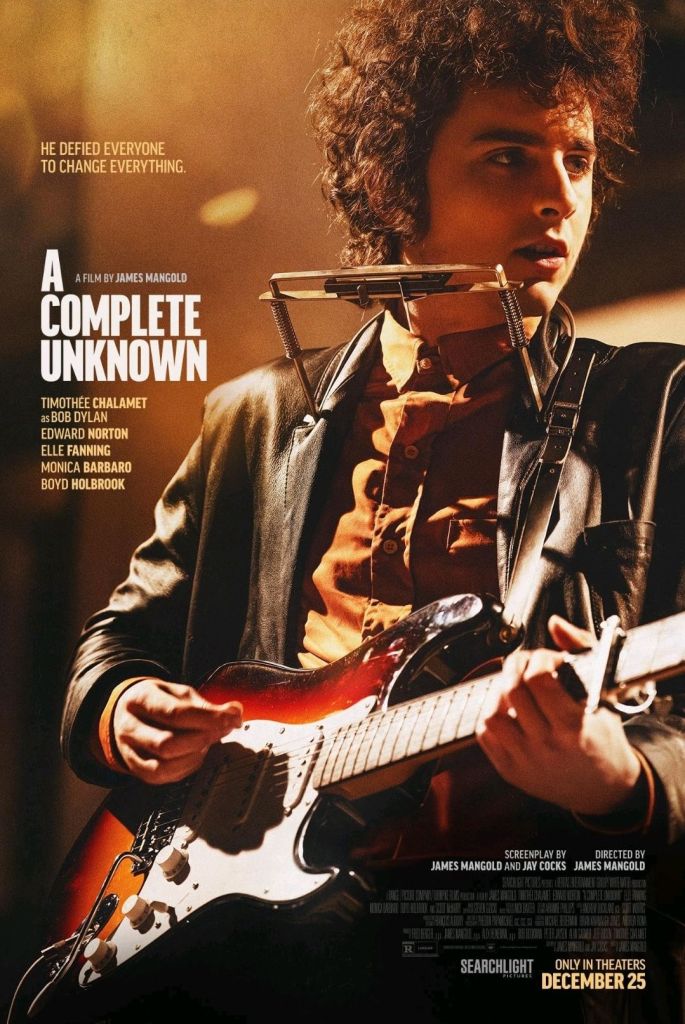
Bob Dylan once said, “I accept chaos, I’m not sure whether it accepts me.” James Mangold’s A Complete Unknown embraces that very chaos, painting Dylan not as a single man but as a shifting idea—a force that refuses to be pinned down. This is not a conventional biopic. It is a meditation on reinvention, expectation, and the artistic defiance that fueled one of the most enigmatic figures in music history.
Set during Dylan’s formative years in the early 1960s, the film captures his rise from an unknown folk singer in Greenwich Village to a cultural icon who disrupted the very movement that had elevated him. With Timothée Chalamet delivering a striking performance as Dylan and Edward Norton lending quiet gravity to Pete Seeger, A Complete Unknown walks a delicate line between myth and reality, much like Dylan himself. Some creative liberties are taken, but what emerges is a film that feels, at its core, emotionally true.
Yet what makes this film more than just a portrait of Dylan is its ability to capture the zeitgeist—the restless energy of a generation standing at the crossroads of tradition and revolution. Folk music wasn’t just a genre in the early 1960s—it was a political statement, a battle cry, and a fractured movement fighting for its identity. The film understands this, and through its direction, cinematography, and sonic choices, it immerses us in an era where music was more than entertainment—it was a means of protest, of identity, and of change.
The Story: A Collision of Truth and Myth
“You don’t need a weatherman to know which way the wind blows.” Dylan’s early career was a storm of influences, borrowed lines, and artistic reinvention. A Complete Unknown wisely narrows its focus to his arrival in New York and his rapid ascent within the folk movement, culminating in the 1965 Newport Folk Festival, where he famously “went electric” and ignited controversy.
However, Mangold plays with history, reshaping events to serve the film’s themes. One of the most striking fictionalized moments occurs when Dylan appears on a radio and TV show hosted by Pete Seeger alongside Jesse Moffette, a fictional blues musician played by real-life guitarist Big Bill Morganfield (son of Muddy Waters). Their performance of Down in My Heart is electric—an intimate, powerful rendering of folk and blues colliding in real-time. It never happened, but it feels like it could have, embodying the creative exchange that defined Dylan’s evolution.
Similarly, the film dramatizes Dylan’s relationship with Woody Guthrie by portraying Guthrie’s harmonica as a symbolic passing of the torch—an object Dylan cherishes before eventually rejecting, mirroring his growing need to break free from folk orthodoxy. In reality, Dylan visited Guthrie at a hospital in New Jersey, drawing immense inspiration from him but never receiving such an object. The moment is an invention, but its sentiment rings true: Dylan revered Guthrie, yet his nature was always to move forward.
Timothée Chalamet as Dylan: A Performance of Transformation
Timothée Chalamet delivers a performance that transcends mere imitation. His Dylan is not a caricature but a living, breathing paradox—brilliant yet restless, charismatic yet aloof, a poet constantly wrestling with his own myth.
What makes Chalamet’s performance remarkable is its restraint. He captures Dylan’s quiet intensity, his occasional arrogance, and, most notably, his discomfort with being seen as a leader. The way he listens in conversations, how he subtly shifts between charm and deflection—these small choices make Dylan feel unknowable yet deeply human.
Chalamet also takes on Dylan’s music, a daunting task for any actor. His voice does not perfectly replicate Dylan’s, but it carries the same searching quality—a nasal, raw, yet expressive force that feels like an honest attempt rather than a mere impression. The live performances, unpolished and immediate, bring a rare authenticity to the film, avoiding the artificiality that plagues many music biopics.
But the true strength of Chalamet’s performance lies in his ability to capture Dylan’s fundamental contradiction: a young artist desperate to be heard, yet unwilling to be defined by what people think they’ve heard.
Edward Norton as Pete Seeger: A Performance in Restraint
While Chalamet’s Dylan is the film’s storm, Edward Norton’s Pete Seeger is its stillness—a steady presence watching history unfold, torn between admiration and concern.
Seeger has often been reduced to a one-note purist in Dylan’s mythology, particularly regarding the infamous Newport Folk Festival incident. A Complete Unknown resists this simplification, offering a Seeger who is neither Dylan’s antagonist nor his enforcer, but rather a mentor trying to reconcile his love for folk traditions with the undeniable brilliance of this young upstart.
Norton plays Seeger with an understated authority. He does not lecture or grandstand. Instead, his disappointment is conveyed through glances, through the way he holds himself in conversations with Dylan, through a quiet sadness that suggests he knows he is watching something change forever. His presence in the film gives depth to the cultural tension surrounding Dylan’s shift, making it clear that the controversy was not just about electric guitars but about a movement struggling with its own identity.
Monica Barbaro as Joan Baez: The Voice of an Era
Joan Baez was more than just Dylan’s contemporary—she was, for a time, the voice of folk music. A Complete Unknown gives Baez her due, thanks to a striking performance by Monica Barbaro.
Barbaro’s Baez is luminous, capturing both the warmth and quiet frustration of a woman who saw Dylan as both a collaborator and a complicated enigma. Their relationship, as portrayed in the film, is not framed as a grand love story but as an artistic partnership strained by Dylan’s ever-growing distance.
In the scenes where Baez and Dylan perform together, Barbaro channels Baez’s clarity and conviction, highlighting why their voices once blended so perfectly. But she also excels in the quieter moments—the way she watches Dylan slip away, the unspoken realization that he is already moving toward something beyond her.
Baez represented the purity of folk—music as a moral force for change. Dylan, by contrast, represented folk’s mutation into something more personal, abstract, and ultimately, disruptive. This tension, which plays out in their relationship, mirrors the larger struggle within the folk world itself.
Direction, Cinematography & The Fractured Folk Movement
James Mangold directs A Complete Unknown with a sensitivity that avoids sentimentality. His approach is observational rather than declarative, allowing Dylan’s world to unfold without forcing a singular interpretation onto his character.
Yet what makes the film more than just a personal story is its ability to capture the era’s fractured folk movement. The early 1960s were a time of upheaval—civil rights protests, anti-war demonstrations, and a folk revival that saw itself as the voice of change but was internally divided.
The Traditionalists: Seeger and others who saw folk as a communal, historical art form.
The Protest Singers: Baez and Phil Ochs, who saw folk as a political weapon.
The Shape-Shifters: Dylan, who broke away from both and redefined what folk could be.
The film does not take sides but captures the weight of the moment. Dylan wasn’t just changing—he was forcing folk music to redefine itself or fade into nostalgia.
Verdict: A Folk Ballad on Film
A Complete Unknown is not a definitive portrait of Bob Dylan—because such a thing is impossible. Instead, it offers a lyrical, often mesmerizing look at an artist in the process of becoming.
Yet its greatest strength lies in how it captures not just Dylan, but the world that shaped him. Folk music was splintering, caught between nostalgia and revolution, and Dylan walked right through the middle of it, refusing to be claimed by any side.
Like Dylan himself, A Complete Unknown refuses to be confined. It bends history, plays with memory, and embraces contradiction. It does not seek to explain Bob Dylan—it simply reminds us why he still matters
 RMS INSIGHTS ✍🏾