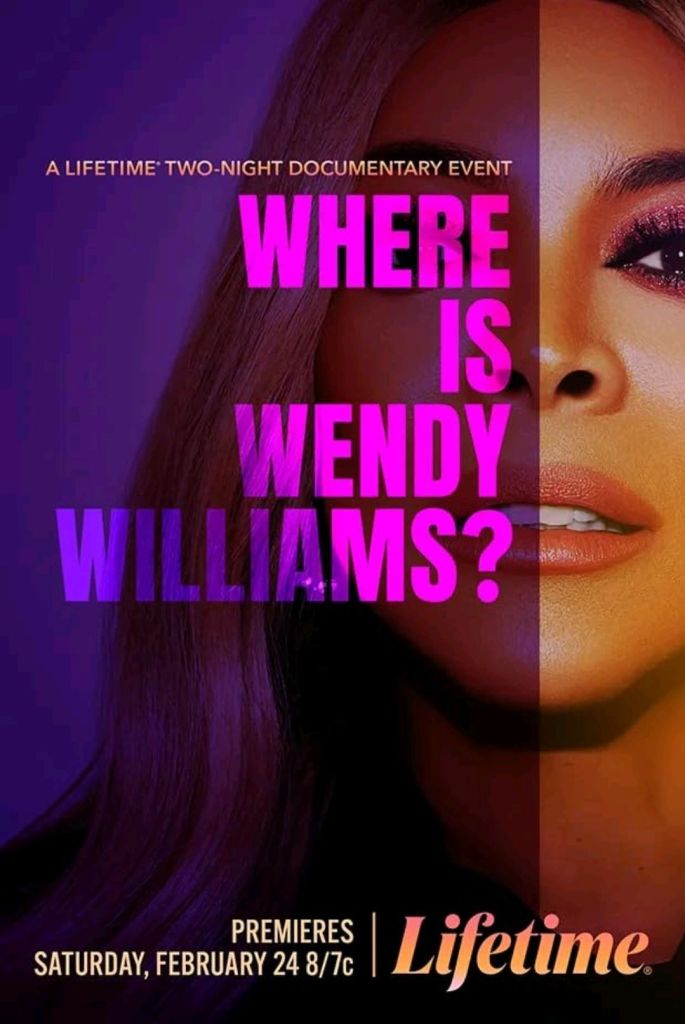
Documentary: Where is Wendy Williams? (Lifetime, 2024)
Director: Carlos King
Genre: Biographical / Investigative
IMDb Link: https://www.imdb.com/title/tt31597004/
Wendy Williams made a career out of baring the secrets of others. But now, her life — fractured, chaotic, and painfully public — has become the story. Directed by Carlos King, Where is Wendy Williams? attempts to uncover the mystery surrounding her disappearance from public life. Yet instead of offering clarity, the series stumbles into sensationalism, trapping viewers in a haze of confusion — the very haze Wendy seems to be living in.
The four-episode series — “I’m Not a Crier,” “I Really Want to Be Back on Television,” “I Love Being Famous,” and “I Am Gorgeous” — attempts to capture Wendy’s unraveling. Instead, it leaves viewers watching a woman drift away from herself.
Episode Breakdown & Critique
Episode 1: “I’m Not a Crier”
The series opens with Wendy’s familiar bravado — bold, brash, untouchable. Archival footage reminds viewers of her sharp tongue and larger-than-life presence. But that’s not the Wendy we see now.
Now, she’s hollow. Like a house long abandoned — empty, quiet, and fading by the day.
The camera lingers on Wendy’s blank stares, her unsteady words, her frail frame. Her claim that she’s “not a crier” feels less like defiance and more like denial. The episode teases empathy but veers into exploitation. Instead of inviting reflection, it holds Wendy under a magnifying glass, exposing her vulnerability without truly exploring it.
Episode 2: “I Really Want to Be Back on Television”
This episode feels cruel. Wendy’s desperate attempts to return to TV play out like a performance she’s no longer equipped to manage.
“I want to be back,” she says, her voice distant. “I miss it.”
But the documentary makes her longing feel pitiful — not powerful. Moments that could have revealed Wendy’s resilience instead turn her into a shadow — stumbling through half-finished thoughts and memories splintered like broken glass.
The editing — sharp, jarring — amplifies her confusion. Tension replaces tenderness. Curiosity overshadows compassion.
Episode 3: “I Love Being Famous”
Here, Wendy’s lifelong pursuit of fame becomes the focus. Fame — her constant companion, her greatest addiction. She craved attention, chased headlines, and played the role of gossip queen with glee.
But now? Now fame has devoured her — chewing her up, spitting her out, and leaving her stranded in its wake.
The episode attempts to explore Wendy’s toxic relationship with celebrity culture but rarely digs deep enough. Instead, it fixates on her erratic behavior — slurred speech, jumbled thoughts, unsettling laughter. The story drifts from thoughtful reflection to voyeuristic discomfort. Wendy’s pain becomes a sideshow.
Episode 4: “I Am Gorgeous”
The series closes with Wendy staring into a mirror, clinging to her reflection.
“I’m gorgeous,” she whispers.
It’s meant to feel triumphant. It doesn’t.
Instead, it feels like Wendy is clutching at smoke — chasing reflections of a life slipping further from reach. The episode tries to frame this as empowerment, but it feels like surrender. By now, viewers have seen too much — too much confusion, too much exploitation, too much of Wendy unraveling. The series ends without closure, leaving viewers with the same unsettling emptiness that seems to define Wendy’s life now.
Strengths
For all its flaws, Where is Wendy Williams? has moments that resonate. When the series steps back — when the camera stops reaching for spectacle — we glimpse Wendy’s humanity. Her warmth. Her humor. Her love for her family. These brief flashes remind us why Wendy Williams became a cultural force — and why her decline feels so tragic.
The archival footage — rich with Wendy’s sharp wit and electric presence — offers a powerful contrast to her current state. In these moments, Wendy’s fall feels devastatingly real.
The documentary also succeeds in illustrating fame’s dark underbelly — the way attention, once intoxicating, can become inescapable. Wendy Williams wanted to be famous. Now, she can’t escape it.
Weaknesses
The documentary’s greatest failing is its obsession with Wendy’s confusion. The series lingers too long on her dazed expressions, her disjointed speech, her vacant stares. Instead of offering understanding, it exploits her pain.
Carlos King’s background in reality TV drives the tone — manipulative cuts, dramatic pauses, manufactured tension. The pacing feels engineered to build suspense rather than reveal truth. Wendy’s story isn’t just told — it’s teased. The result feels voyeuristic, reducing Wendy’s suffering to spectacle.
Worse still, the documentary barely addresses the deeper issues it hints at — her legal battles, her declining health, her ongoing guardianship. These complex topics are mentioned, then abandoned. Viewers are left with fragments of a story that feels incomplete.
Comparative Analysis
Where is Wendy Williams? inevitably invites comparisons to Amy (2015) and Robin’s Wish (2020) — two documentaries that explored mental decline with grace and depth. Unlike those films, Wendy’s story is handled clumsily. While Amy used home footage to humanize its subject, Where is Wendy Williams? feels colder — more fascinated with Wendy’s unraveling than her humanity.
Cultural Relevance
The documentary accidentally reveals a hard truth: in today’s media landscape, celebrity decline is entertainment. Wendy Williams once built her career by exposing others, but now she finds herself consumed by the same machine. The documentary never fully confronts this irony — instead, it unwittingly becomes part of the cycle.
Filmmaker’s Context
Carlos King’s reality TV instincts overwhelm the documentary. His tendency to prioritize drama over depth leaves the series feeling exploitative. Instead of crafting a compassionate portrait of Wendy’s struggles, King packages her pain for consumption.
Verdict
Where is Wendy Williams? is more tabloid than tribute. While there are moments of tenderness — glimpses of Wendy’s warmth and humor — they’re drowned out by manipulative editing and relentless focus on her confusion. The series promises answers but offers none.
For those hoping to understand Wendy Williams, the documentary leaves you feeling like Wendy herself — adrift, uncertain, and unsettled.
Reflections
Wendy Williams built her career on boldness — saying what others wouldn’t, pushing boundaries, embracing controversy. But now, her voice is fading.
Lost. Alone. Forgotten.
Her story feels unfinished — like a song trailing off mid-note, the melody fading before the final chord can play.
 RMS INSIGHTS ✍🏾