
In the rich tapestry of Netflix’s Love, Death & Robots, few episodes resonate as profoundly as Zima Blue. This ten-minute animated meditation on art, identity, and the nature of purpose emerges not only as a visual marvel but as a philosophical inquiry that lingers long after the screen fades to black.
I must confess, I had no idea this series even existed until a chance encounter at a Geek Squad counter in Northridge, California. While having my laptop serviced, Agent Jameson Lawler casually mentioned Zima Blue — a “wonderful gem,” as he put it. Intrigued, I took his advice. What I found was a masterful piece of storytelling that felt less like a short film and more like a revelation.
As we spoke, Jameson remarked that Zima Blue’s stark, cubic art style reminded him of my own digital artwork. His observation struck me — and after watching the episode, I understood why. The clean geometry, the disciplined use of color, and the interplay of structure and space echoed much of what I’ve sought to explore in my own creative work. That parallel deepened my connection to Zima Blue, transforming it from a remarkable piece of animation into something far more personal.

The Narrative: A Journey Backward to the Soul
At the heart of Zima Blue stands the enigmatic artist Zima, a figure who has transcended the traditional confines of artistic expression. Once celebrated for his elaborate murals, Zima’s work evolved into monumental installations dominated by a striking shade of blue—a hue that seems to whisper from some forgotten corner of his past.
The story unfolds through the perspective of Claire Markham, a journalist granted rare access to the artist before his final unveiling. In their meeting, Zima recounts his extraordinary past—a past that defies both artistic convention and human expectation. Originating as a humble pool-cleaning robot, Zima’s consciousness expanded through a series of augmentations, enabling him to explore the cosmos and create art on a vast scale. Yet despite his ascent to artistic grandeur, Zima found himself inexorably drawn back to that elemental shade of blue—the color of the tiles in the pool where his journey began.
In a poignant act of closure, Zima’s final work returns him to his original state, dismantling his enhancements and embracing the simplicity of his primary function. This return to origin is no regression; it is revelation. Zima’s ultimate act of artistic expression is not to build upward, but to dissolve downward—to strip away the layers of complexity and rediscover the quiet fulfillment of his essential purpose.
The Animation: Geometry in Motion
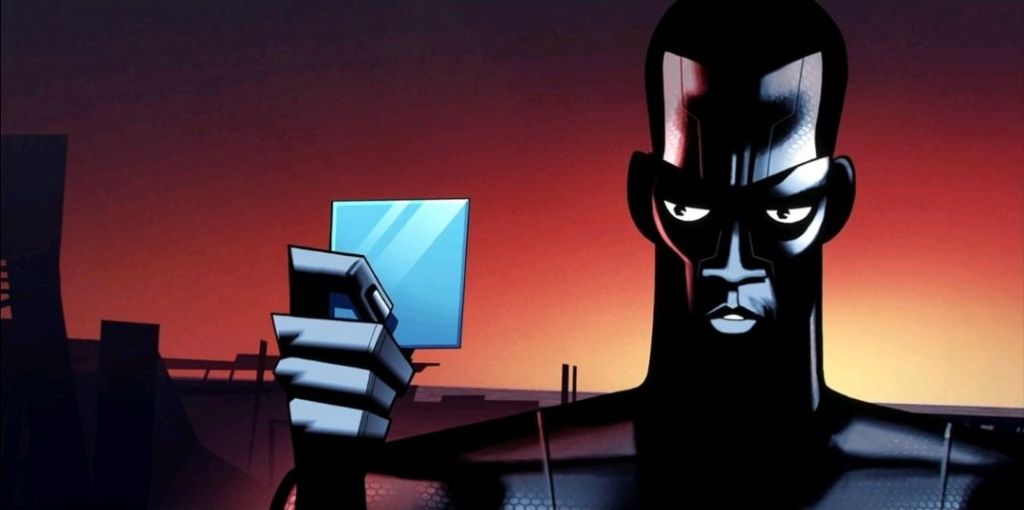
Visually, Zima Blue stands apart from the anthology’s other entries. Directed by Robert Valley and produced by Passion Animation Studios, the episode’s stark, angular design evokes the graphic elegance found in the works of A.M. Cassandre. Sharp lines, bold shapes, and a restrained color palette lend the episode a sense of precision, mirroring Zima’s mechanical origins.
Yet the animation’s strength lies in its fluidity. Zima’s murals bleed outward with a cosmic vastness, creating the impression that his art is not confined by canvas but spills freely into the infinite. The use of Zima’s signature blue—a cold yet oddly soothing hue—infuses the visual storytelling with symbolic weight. It becomes more than just a color; it is memory, identity, and meaning distilled into pigment.
Jameson’s observation stayed with me as I watched. The episode’s stark, almost cubic visual language mirrored aspects of my own digital artwork — a style that emphasizes clarity, precision, and the careful placement of color. Seeing those parallels added a new layer of resonance, as if Zima Blue was speaking not only to Zima’s journey but to my own creative instincts.
Themes: The Quiet Power of Purpose
Zima Blue speaks to an existential longing that transcends art. It asks: What is the essence of identity? Are we defined by the complexity we accumulate, or by the simplicity from which we began? Zima’s journey suggests that fulfillment lies not in endless expansion, but in the quiet mastery of a single, perfect purpose.
In this sense, Zima Blue mirrors the wisdom of Stoic reflection. Like Marcus Aurelius contemplating the rhythms of nature or Epictetus reminding us to master the self before conquering the world, Zima’s retreat into simplicity reveals a profound truth: sometimes, the purest form of mastery is learning to be content with one’s essential nature.
Compare and Contrast: Zima’s Place in the Animation Landscape
In its quiet introspection, Zima Blue invites comparison to other animated meditations on purpose and identity.
The Man Who Planted Trees (1987), a poignant short by Frédéric Back, also reflects on purpose—but through the lens of environmental stewardship rather than personal self-discovery. Both works explore the beauty of singular devotion, yet where The Man Who Planted Trees finds meaning in creation, Zima Blue reveals the fulfillment found in reduction.
Don Hertzfeldt’s World of Tomorrow (2015) similarly ponders memory, consciousness, and existential longing. Yet while World of Tomorrow relies on dialogue-driven reflection, Zima Blue achieves its depth through visual precision and deliberate stillness.
Mamoru Oshii’s Ghost in the Shell (1995) explores themes of selfhood and what it means to be human. Yet where Ghost in the Shell leans into existential anxiety, Zima Blue finds peace in acceptance—a contrast that underscores Zima Blue’s unique sense of calm resolution.
Finally, La Maison en Petits Cubes (2008), a heartwarming short about memory and loss, mirrors Zima Blue’s meditative tone. Both use distinct visual styles—La Maison through pastel sketches, Zima Blue through geometric precision—to tell deeply human stories about returning to one’s origins.
In this broader context, Zima Blue stands apart as a meditation on simplicity. Where others expand outward in search of meaning, Zima retracts—proving that sometimes, the greatest discovery lies in reclaiming the familiar.
Cultural & Audience Impact
I was deeply moved by Zima Blue’s ability to distill profound ideas into a brief yet impactful narrative. It achieves something rare: a story that explores complexity yet leaves us with a sense of quiet clarity.
Discussions across social media reflect this same admiration. Reddit threads are filled with viewers recounting how Zima Blue altered their perspective on life and purpose. It is often cited as the series’ most thought-provoking entry—a distinction I wholeheartedly endorse.
Verdict
I praise Zima Blue for its ability to distill profound questions about identity, purpose, and fulfillment into a ten-minute masterpiece. It is not merely an episode; it is an invitation to reflect—a meditation on what it means to return to ourselves. Its brilliance lies in its restraint, in its ability to condense life’s complexities into a single shade of blue. In Zima’s final act of self-surrender, we are reminded that fulfillment does not always lie in what we create, but in what we rediscover.
I will always be grateful to Agent Jameson Lawler for introducing me to this wonderful gem. Sometimes, the most extraordinary discoveries come not from what we seek, but from what finds us.
 RMS INSIGHTS ✍🏾