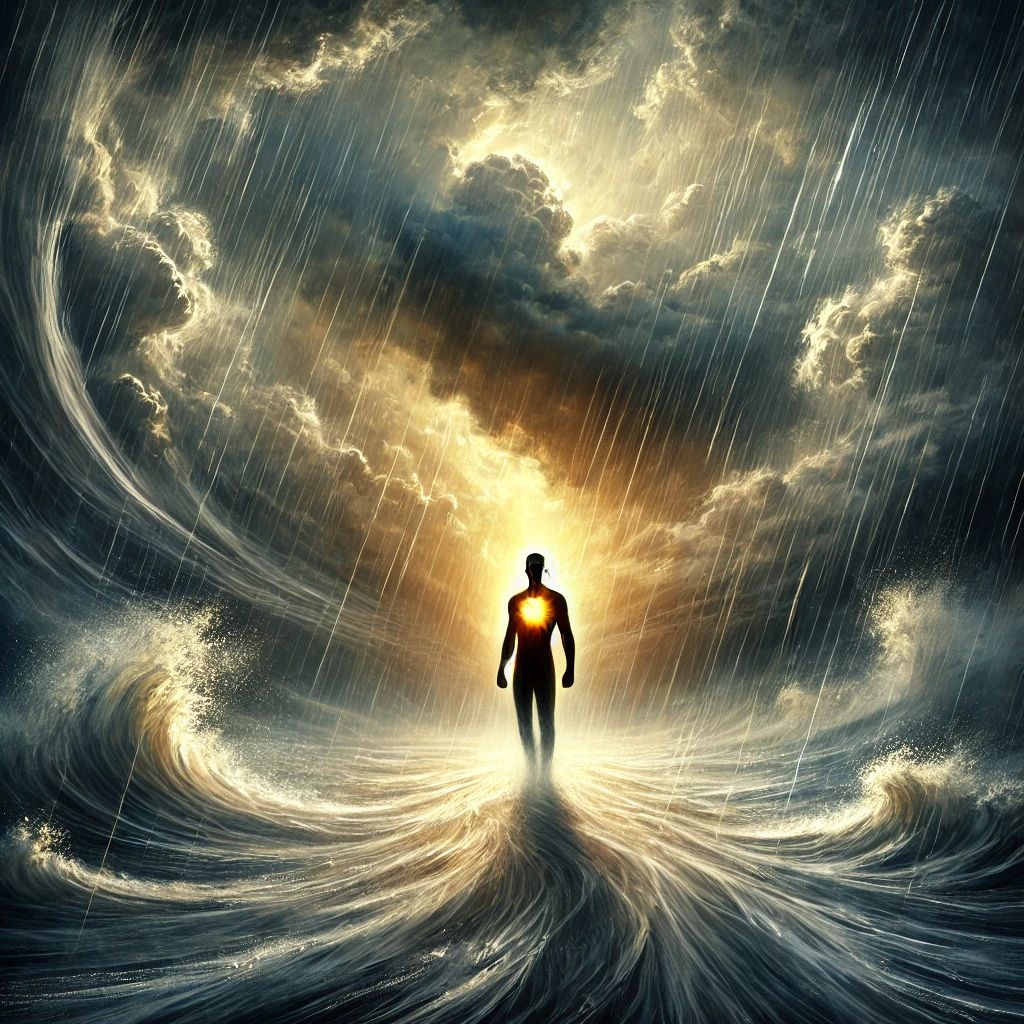
Title: The Unshaken Flame
Medium: Digital Art
Reflecting Randy Sydnor’s application of his unique technique, Mnephonics, this digital piece blends visual storytelling with symbolic language to evoke memory, learning, and reflection. The digital medium’s dynamic textures and layered contrasts enrich the symbolic depth of the composition.
Style of Art: Symbolism with elements of Surrealism
Dimensions: 1024 x 1024
Copyright: Randy Sydnor, The Mnephonist
Description
Resilience is not found in retreat, but in quiet defiance — the unyielding choice to stand firm while chaos swirls around you.
This image captures the tension between inner stability and external turmoil — a visual meditation on Epictetus’ timeless wisdom: “It’s not what happens to you, but how you react to it that matters.”
The lone figure stands in the eye of the storm — battered but unbowed — a testament to the enduring strength that arises when the mind refuses to yield.
Medium and Technique – The Artist’s Craft
The digital medium lends itself beautifully to the interplay of shadow and light. Layers of jagged rain, textured winds, and fractured skies swirl in violent motion, contrasting the figure’s calm stillness. Randy Sydnor’s Mnephonics technique enhances this symbolism, embedding visual metaphors that invite deeper reflection.
The warm glow emanating from the figure’s chest — an anchor of composure amid the tempest — reflects Mnephonics’ focus on memory and emotional resonance. The glow is not simply light; it is strength remembered, resilience recalled — a reminder that inner calm is often a lesson learned through hardship.
Central Figure or Focus – The Visual Heart of the Piece
The figure stands erect, unwavering, his face calm yet purposeful. His eyes are not closed in denial but fixed ahead — a silent declaration that no storm, no matter its force, will shake his resolve. The warm glow radiating from his chest carries symbolic weight — the enduring flame of self-possession, a quiet assertion of strength drawn from within.
The figure’s clothing — dark, rain-slicked, and heavy — clings to his body, yet there’s no hint of collapse. His shoulders square against the wind, a man who has accepted hardship yet refuses to crumble beneath its weight.
Supporting Elements – Symbolic Imagery and Details
The storm is no mere backdrop; it is a character in its own right — a living tempest that claws at the figure with jagged fingers of wind and rain. The clouds churn in frantic swirls, yet there is order within the chaos — a spiraling pattern that echoes the circular nature of hardship.
In the distance, faint rays of sunlight pierce the clouds — slender yet significant. They whisper that no storm, however violent, is eternal.
The storm represents uncertainty, hardship, and the inevitable unpredictability of life. The sunlight represents hope — quiet, understated, yet always present for those who endure long enough to see it.
Philosophical or Artistic Reflection – The Soul of the Piece
Epictetus wrote: “It’s not what happens to you, but how you react to it that matters.”
This piece captures that very spirit. A man struggles — debts, disappointments, and relentless anxiety — are the storm. His greatest challenge is not to control those forces, but to master his response. The figure’s inner glow embodies that mastery — the quiet, powerful decision to remain composed when life’s circumstances rage out of control.
Epictetus reminds us that hardship is not a choice, but suffering is. True strength lies not in eliminating discomfort, but in learning to face it without surrender.
This image urges viewers to ask: What light do I carry within me? And how brightly will it burn when the storm arrives?
Color and Composition – The Visual Language
The composition hinges on contrast — dark storm clouds dominate the scene, yet the figure’s glowing chest draws the eye like a beacon. This interplay of shadow and warmth reinforces the central idea: strength thrives in adversity.
The storm’s jagged edges — chaotic and untamed — surround the figure’s calm, upright stance, creating a visual tension that echoes the philosophical one: the world rages, yet the mind endures.
Closing Thought – Invitation to Reflect
Strength isn’t always loud. Sometimes it’s quiet — a flame that refuses to flicker out. This piece invites you to reflect not on what you’ve suffered, but on how you’ve responded — and to remember that your greatest power lies in that response.
© Randolph M. Sydnor
The Mnephonist
 RMS INSIGHTS ✍🏾