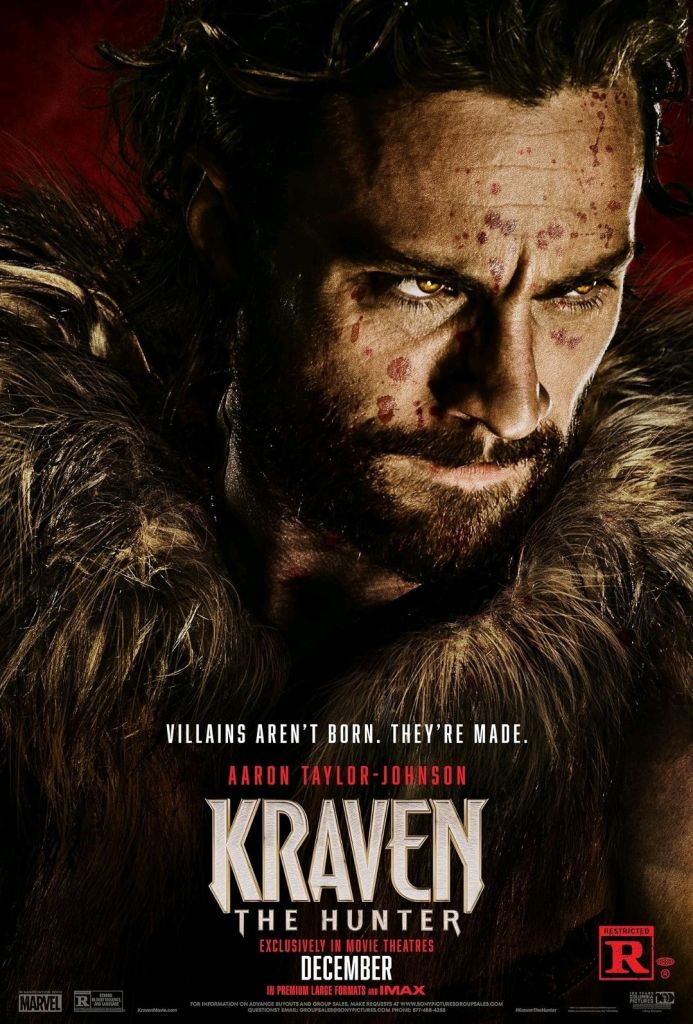
The modern superhero film no longer exists solely to entertain; it is now expected to interrogate its own mythology, deconstruct its archetypes, and deliver something deeper than mere spectacle. Kraven the Hunter (2024) positions itself within this darker tradition, attempting to strip away the polish of the Marvel formula in favor of something more primal—more brutal. Yet, despite its promise of visceral intensity and character-driven storytelling, the film hesitates when it should strike.
Directed by J.C. Chandor, Kraven the Hunter aims to be a feral revenge thriller, a psychological study of a man battling both his lineage and his own animal instincts. But it lacks the discipline to fully realize that vision. The result is a film that lunges toward greatness but ultimately pulls its punches, leaving it in the liminal space between ambition and execution.
Storyline & Themes
Kraven the Hunter reinvents the origin story of Sergei Kravinoff (Aaron Taylor-Johnson), a man forged by violence and abandoned by his father, Nikolai Kravinoff (Russell Crowe). Where the comic book version of Kraven is defined by his unparalleled hunting skills and strategic brilliance, this adaptation introduces a controversial change—imbuing him with supernatural abilities after an encounter with a lion’s blood. In doing so, the film undercuts the very essence of the character, turning a master tactician into something more akin to a beast-in-the-making.
Kraven’s vendetta against his father forms the emotional core of the film, with Nikolai representing a worldview built on dominance and survival of the fittest. As Sergei dismantles his father’s criminal empire, he is forced to confront his own identity—whether he is truly different from the man who shaped him, or if he is merely fulfilling a preordained cycle of violence.
Calypso (Ariana DeBose), a voodoo priestess with a history intertwined with Kraven’s, serves as a spiritual guide but remains frustratingly underdeveloped. In the comics, she plays a complex role in Kraven’s descent into madness, yet here she is reduced to offering cryptic warnings and fleeting moments of insight. The potential for her to be a true catalyst in Sergei’s journey is squandered.
Dmitri Smerdyakov (Fred Hechinger), Sergei’s half-brother, lurks in the background, his presence a subtle nod to his future as the Chameleon. While his role is largely expository, it lays the groundwork for potential sequels.
Aleksei Sytsevich (Alessandro Nivola), better known as Rhino, undergoes a grotesque transformation, abandoning the mechanical suit approach seen in The Amazing Spider-Man 2 in favor of a more organic, monstrous aesthetic. While visually striking, his introduction feels abrupt, as though inserted more for spectacle than storytelling.
Though the film teases weighty themes—inheritance, nature versus nurture, the illusion of control—it never fully commits to exploring them. Instead, it prioritizes its kinetic action sequences, leaving its philosophical inquiries as mere subtext. Had the film spent as much time sharpening its themes as it did its knives, Kraven the Hunter might have had more bite.
Strengths & Weaknesses
Aaron Taylor-Johnson delivers a physically commanding performance, embodying Kraven’s feral energy. His presence is magnetic, though the script does not always give him enough to work with. Russell Crowe dominates as Nikolai Kravinoff, exuding a cold, patriarchal menace that looms over the entire film. The action sequences are unflinchingly brutal, providing a level of violence rarely seen in modern superhero cinema. Cinematography and practical effects create a tactile, grounded aesthetic, distancing Kraven from its more polished Marvel counterparts.
Yet, despite these strengths, the film is weighed down by missteps. Calypso (Ariana DeBose) is underutilized, failing to leave a meaningful impact despite her narrative significance. The decision to grant Kraven supernatural abilities undermines the essence of his character, making him feel less like a hunter and more like an enhanced predator. Dmitri Smerdyakov (Fred Hechinger) and Rhino (Alessandro Nivola) are included more for setup than substance, their roles feeling more like placeholders for future developments. The film struggles to maintain a consistent tone, wavering between revenge thriller and heightened comic book spectacle.
Production Design & Performances
The film trades the lush jungles associated with Kraven’s legacy for an urban battlefield, opting for a setting that feels more grounded in modern crime drama than traditional comic book fare. While this choice enhances the film’s realism, it also limits its visual distinctiveness, making it feel interchangeable with other dark, city-based action films.
Performances:
Aaron Taylor-Johnson is physically convincing as Kraven, though the script does not allow him to fully explore the character’s inner turmoil. Russell Crowe imbues Nikolai Kravinoff with gravitas, his presence elevating every scene he inhabits. Ariana DeBose struggles to make an impact as Calypso, constrained by an underwritten role. Fred Hechinger sets up future developments as Dmitri Smerdyakov but remains largely in the background. Alessandro Nivola’s Rhino is visually impressive but narratively thin, appearing too late to be a true antagonist.
Comparative Analysis
Similar Films:
Logan (2017) – A masterclass in blending action with character study, offering what Kraven aims for but never fully achieves.
Venom (2018) – Another Sony antihero film, though Kraven attempts a more serious, less comedic tone.
The Batman (2022) – Shares a similarly dark aesthetic, but where The Batman meticulously constructs its world, Kraven feels thematically unfocused.
Longevity & Genre Impact:
While Kraven the Hunter introduces a more violent, stripped-down aesthetic to the Marvel landscape, it fails to carve out a unique identity. It neither redefine the genre, nor does it offer a character study compelling enough to stand apart from the growing sea of antihero narratives.
Verdict
Kraven the Hunter is a film at odds with itself. It has the raw ingredients of a brutal, psychologically complex character study, yet it hesitates to fully embrace that identity. Instead, it straddles the line between grounded realism and heightened spectacle, never quite mastering either.
The film’s action sequences deliver the promised savagery, and Russell Crowe’s commanding presence provides moments of gravitas, but an underdeveloped supporting cast, an inconsistent tone, and a fundamental misunderstanding of Kraven’s essence prevent it from rising above mediocrity.
While Kraven the Hunter is not a failure, it is also not the definitive take on the character that many had hoped for. Instead of a film that stalks its prey with precision, it pounces too soon, leaving it somewhere in the middle of the cinematic food chain—fierce but unfocused, powerful but not fully realized.
Final Score:
Letter Grade: B-
4.0 Scale: 2.8/4
Percentage: 78%
 RMS INSIGHTS ✍🏾