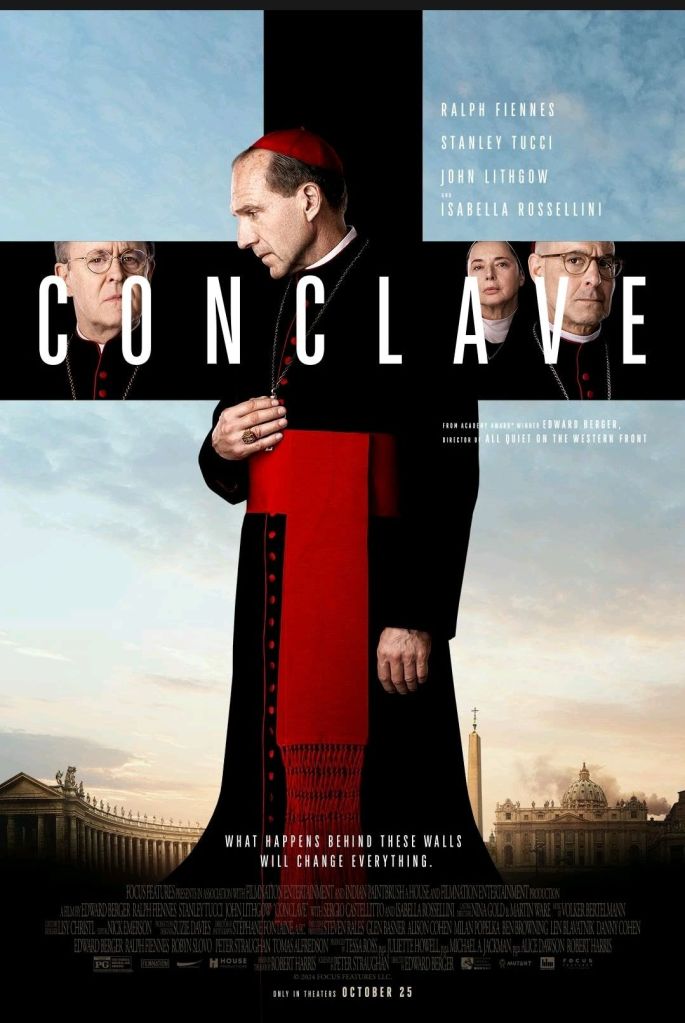
Few films capture the labyrinthine politics of faith with such quiet intensity as Conclave (2024). Directed by Edward Berger — known for All Quiet on the Western Front — this adaptation of Robert Harris’s novel delves into the veiled world of Vatican power. Rather than relying on heightened theatrics, Berger crafts a contemplative thriller, one that thrives on whispered confessions, unspoken rivalries, and the shadow of spiritual compromise.
While comparisons to The Two Popes are inevitable, Conclave feels less personal and more procedural — a methodical examination of power disguised as humility. It is a film that demands patience, rewarding those willing to listen to what is not said as much as what is spoken.
Overview
The film begins with the sudden death of Pope Gregory XVII, sending the College of Cardinals into an immediate conclave to elect his successor. The process unfolds within the Sistine Chapel’s closed doors, where no communication with the outside world is permitted. Cardinal Thomas Lawrence (Ralph Fiennes), the Dean of the College, assumes responsibility for guiding the conclave.
From the outset, tensions emerge among the leading candidates:
Cardinal Aldo Bellini (Stanley Tucci) — A liberal American whose progressive ideals align with the late Pope’s reforms.
Cardinal Joshua Adeyemi (Sergio Castellitto) — A Nigerian conservative advocating for traditional Church values.
Cardinal Joseph Tremblay (John Lithgow) — A rigid Canadian traditionalist seeking to restore the Church’s more austere past.
Cardinal Goffredo Tedesco (Isabella Rossellini) — An outspoken Italian figure known for opposing modernizing efforts.
The conclave’s atmosphere tightens when an unexpected figure arrives: Archbishop Vincent Benítez (Clifton Collins Jr.), a missionary recently appointed as cardinal in secret by the late Pope. His presence sparks suspicion and unease.
As the voting process continues, rivalries deepen. Whispered alliances form behind closed doors, each faction maneuvering to secure power. The political nature of the conclave becomes increasingly evident — votes are exchanged like currency, and ambition slowly overshadows humility.
Midway through the film, shocking revelations emerge. Benítez is revealed to be the late Pope’s biological son, the result of a long-hidden relationship. This scandal sends ripples of disbelief throughout the College of Cardinals, challenging the Church’s core principles of celibacy and purity. Some members see Benítez’s presence as a stain on the Vatican’s moral standing; others view it as a sign of God’s mysterious will.
Despite the turmoil, Cardinal Lawrence pushes for calm. In a powerful sequence, Lawrence’s internal conflict reaches its peak as he kneels in a candlelit chapel, whispering a confession: “I no longer know if I am serving God or myself.” The moment captures the weight of conscience and the burden of leadership — a man navigating faith in the shadow of doubt.
The final ballot proves decisive. In a moment of profound tension, the urn lid creaks open to reveal that Benítez has been elected as Pope. He takes the name Innocent XIV, a choice that carries profound irony and significance.
Symbolism & Subtext
1. The Turtle Motif
Archbishop Benítez’s connection to turtles reflects resilience and patience — qualities that define his arc. Turtles symbolize quiet endurance; they move slowly yet persist despite obstacles. Benítez’s emergence as Pope signals the Vatican’s own slow evolution — a symbolic reminder that change, while delayed, remains inevitable.
2. The Innocent Paradox
Benítez’s decision to adopt the papal name Innocent XIV invites immediate reflection. The term “innocence” — a symbol of purity — contrasts with his controversial origins as the Pope’s son. Yet his election also hints at redemption: an institution marred by politics and deceit finds hope in a man defined by grace under scrutiny.
3. The Crucifix Scene
Cardinal Tremblay’s trembling crucifix — gripped tightly in the heat of argument — reflects faith under siege. The symbol of Christ’s sacrifice becomes an emblem of doubt and panic, underscoring Tremblay’s weakening resolve as his influence slips away.
4. The Candlelit Confession
Cardinal Lawrence’s whispered prayer — “I no longer know if I am serving God or myself” — occurs under flickering candlelight. The wavering flame mirrors Lawrence’s inner turmoil, symbolizing the fragile balance between spiritual clarity and self-interest.
5. The Final Ballot
The urn lid’s creak in the climactic vote becomes a metaphor for the Church’s burdened history — a reminder that power is never achieved without consequence. The moment’s silence is deafening, as if the weight of centuries hangs in the air.
Memorable Moments & Key Details
The closing shot — Benítez, cloaked in papal white, standing in quiet reflection — lingers in the mind. His expression is serene yet shadowed by uncertainty, reinforcing the film’s suggestion that leadership often invites more questions than answers.
The corridor procession — a crimson wave of cardinals moving beneath towering frescoes — embodies the weight of tradition, each step a march toward either renewal or regression.
Strengths & Weaknesses
Berger’s direction thrives on restraint. The film’s meditative pacing echoes the solemnity of the conclave itself — a space where power is wielded quietly, yet with seismic consequence. While some viewers may find its quiet intensity demanding, those willing to engage will discover a narrative rich in depth and meaning.
Ralph Fiennes embodies Cardinal Lawrence with understated dignity, capturing a man burdened by duty and haunted by self-doubt. Stanley Tucci’s Cardinal Bellini blends charm with calculated manipulation, while John Lithgow’s Cardinal Tremblay embodies the desperation of a man clinging to fading influence.
Production Design & Costumes
The film’s visual language evokes both reverence and foreboding. The Vatican’s grand interiors — bathed in muted gold and shadow — reinforce the theme of power concealed beneath layers of ritual. Costume designer Lisy Christl’s meticulous work ensures each cardinal’s garments reflect their ideological stance: Bellini’s relaxed attire suggests adaptability, while Tremblay’s tightly drawn robes mirror his inflexible worldview.
Writing Style & Literary Devices
Peter Straughan’s screenplay marries precision with restraint. Dialogue carries a ritualistic cadence, heightening the film’s meditative tone. The absence of excessive dialogue creates space for the symbolic language to emerge — a quiet yet powerful commentary on faith, ambition, and deception.
Comparative Analysis
Where The Two Popes humanized Church leaders through dialogue, Conclave emphasizes quiet manipulation and political maneuvering. Its moral complexity aligns it with Spotlight, yet it sidesteps outright condemnation in favor of exploring power’s quieter manipulations.
Verdict
Conclave offers a contemplative meditation on power and spiritual fragility. Its measured pacing and symbolic richness demand patience, but for those willing to listen, the film reveals profound insights about faith’s delicate balance with politics.
Final Score: 3.8/4.0 (A-)
Legacy Factor: Conclave lingers as a reflection on leadership burdened by compromise — a reminder that in matters of faith and power, truth often remains shrouded in silence.
 RMS INSIGHTS ✍🏾