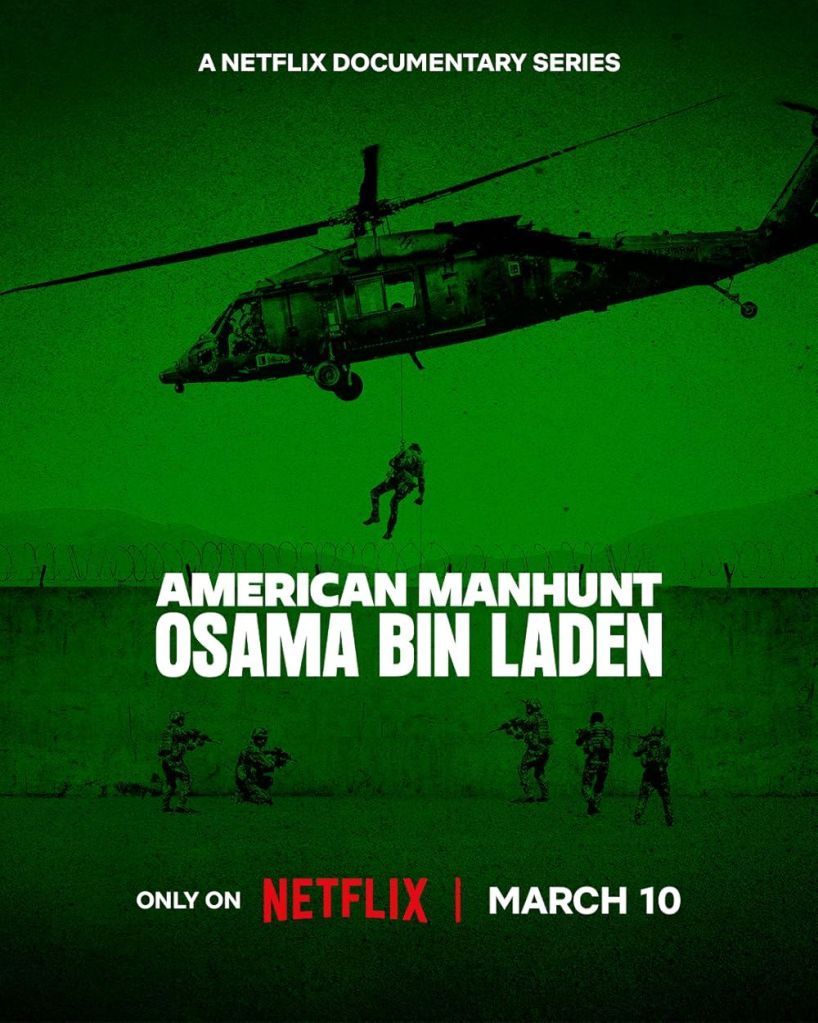
No empire ends quietly, and no enemy dies alone. Osama bin Laden—specter of September 11, avatar of asymmetric warfare, and the most hunted man in modern history—was not merely a fugitive. He was a dark reflection, the lens through which America saw its anguish, its outrage, and its almost theological need for vindication. Netflix’s American Manhunt: The Search for Osama bin Laden does not embellish this pursuit, but it reanimates it with arresting lucidity—resisting bombast while embracing complexity.
Directed by Mor Loushy and Daniel Sivan, the documentary threads together a sprawling narrative with surgical clarity. The story is retold not through narration or omniscient commentary, but through the fractured and sometimes contradictory testimonies of those who were there—CIA operatives, military commanders, national security advisors, and the President who sanctioned the raid with a gambler’s nerve and a philosopher’s burden. There is no choreography here, no flourishes of self-congratulation. Only the tightening thread of obsession, of moral compromise, and of sacrifice.
President Barack Obama, famously cerebral, anchors the film’s moral undertow. His decision to authorize Operation Neptune Spear is not portrayed as muscular or dramatic; it is quiet, deliberate, solitudinous. We see him in the Situation Room—not so much directing as absorbing—flanked by then-CIA Director Leon Panetta, Secretary of State Hillary Clinton, Defense Secretary Robert Gates, Admiral Mike Mullen, National Security Advisor Tom Donilon, Counterterrorism Advisor John Brennan, and Vice President Joe Biden. Each speaks a different dialect of caution. None possess certainty. The President proceeds anyway.
And this is where the film begins to rise: in the friction between confidence and conjecture. The CIA analysts, especially Maya (a pseudonym), part of the so-called “Sisterhood”—Cindy Storer, Nada Bakos, and others—are presented not as heroes but as haunted professionals. Their pursuit of Abu Ahmed al-Kuwaiti, the courier, is an exercise in attrition and intellect, intuition and exhaustion. They are as much cartographers of doubt as they are agents of discovery.
Abbottabad is introduced not with flair but with dread: a drab compound with high walls, opaque habits, and architectural whispers of secrecy. That this suburban fortress existed undisturbed for so long is less a testament to Pakistani duplicity (though that shadow lingers) than to the stubborn ambiguity of intelligence. The compound itself becomes a character—mute, suspicious, and strangely inert. The drama is in its stillness.
When the operation begins—stealth helicopters slicing the darkness—the tempo of the film changes, but not with cinematic bravado. Instead, we are given uncertainty. One of the helicopters crashes. The team adapts. In the control rooms of Langley and the West Wing, nerves strain under silence. These are not men and women reveling in retribution. They are holding their breath. The SEALs—anonymous, meticulous—move through the compound not with swagger, but precision. Bin Laden is shot. His body is photographed. DNA confirms what instinct already knew.
And yet, as the documentary reminds us, closure is elusive.
The strength of American Manhunt lies not in its archival footage or its tight pacing—though both are superb—but in its refusal to pretend that this act of surgical vengeance was tidy. The intelligence community had failed catastrophically on 9/11. For nearly a decade, they labored under the crushing weight of that failure. And this success, though spectacular, was not catharsis—it was a question mark.
What did America gain? What did it lose?
We hear from the families of those who searched for bin Laden for years, including analysts whose marriages dissolved under the pressure of obsession. We glimpse the moral fog surrounding targeted killings, the drone campaigns that metastasized after bin Laden’s death, the way violence institutionalizes itself in a bureaucracy. No one in the film pretends this was a storybook ending. Instead, it was the closing of one chapter in an epic that refuses to finish.
The cinematic tone, then, is elegiac rather than triumphant. Mor Loushy and Daniel Sivan avoid the trap of mythmaking. They lean instead into the ragged truths: that intelligence is imperfect, that leadership is lonely, that war never ends the way it begins. American Manhunt honors the skill of the SEALs, the doggedness of the analysts, and the gravity of Obama’s decision—but it never flinches from the ethical gray. It dares to ask whether vengeance ever truly satisfies a wounded empire.
And perhaps that is the film’s deepest contribution. It re-centers bin Laden not as a cartoon villain or diabolical mastermind, but as a man whose death raised as many moral specters as it laid to rest. It asks whether the hunt changed America more than the attack did. Whether, in vanquishing the enemy, we also distorted ourselves.
In the final moments, we see President Obama address the nation with calm restraint. There is no gloating, only gravity. He speaks to justice—not revenge. But the images that follow—the celebrations in the streets, the chants of USA—tell a different story. We were not ready to reflect. We were hungry to win.
Verdict: American Manhunt is not just a documentary about an operation. It is a meditation on obsession, on memory, on the thin line between justice and revenge. It is a reckoning cloaked in restraint, a chronicle of triumph shadowed by doubt. And in that doubt lies its brilliance.
R.M. Sydnor
 RMS INSIGHTS ✍🏾