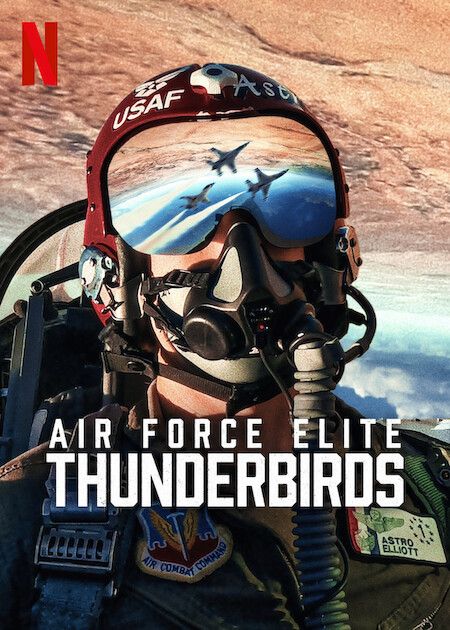
No one trains to be forgotten. And yet, paradoxically, the highest-performing individuals in uniform often exist to vanish. They fly in formation, answer to call signs, and leave no personal imprint upon the clouds. Netflix’s The Thunderbirds documentary disrupts this design—briefly—offering a controlled detonation of the myth, the machine, and the men and women behind the visor.
At first glance, the film feels like a polished salute: gleaming F-16s, desert blue skies, an air show anthem steeped in nostalgia. But beneath that polished canopy lies a subtler provocation: Can elite performance still mean something in a culture where spectacle swallows substance? Where visibility dominates value, but mastery requires invisibility?
The Thunderbirds don’t simply fly—they signify. They embody a choreography of national pride, war-forged discipline, and airborne artistry. Yet The Thunderbirds resists jingoistic reduction. It opens with noise and pageantry, yes, but slows its shutter speed to reveal the relentless human work beneath the titanium.
The Thunderbirds originated in the crucible of the Cold War, when America needed to perform its principles in airspace, not just in policy. Formed in 1953, they carried a silent message: freedom, ordered and symmetrical. Like the Blue Angels or Olympic gymnasts, they turned danger into display, risk into ritual. Their maneuvers weren’t merely impressive—they were declarations.
Director Luke Korem understands restraint. He avoids flourishes that draw attention to himself. Instead, his lens breathes with reverence. Aerial cinematography captures the violence of motion smoothed into grace. Transitions cut not to dazzle but to decelerate. The pacing echoes the precision it documents: nothing wasted, everything earned.
He relies on narrative rhythm over editorial bravado. There are no omniscient narrators, no intrusive voiceovers. The story unfolds through cockpit footage, unguarded interviews, and familial reflection. In this quiet, the geometry becomes audible.
Central to the documentary is the idea of certification—not triumph, not ego, but passage through fire. We witness pilots in training, their muscle memory not yet fully formed, their instincts under surveillance. A flight evaluation feels more surgical than theatrical. There are no second takes.
The camera follows Maj. Lauren “Mad” Schlichting as she studies her flight tapes frame by frame. She doesn’t radiate swagger. She radiates precision. The first female Thunderbird to fly the lead solo position, Schlichting flies not for glory, but for execution. Her call sign, Mad, reflects not temperament, but tribute—to mentors, to perseverance, to control at supersonic speed.
Around her, a constellation of teammates defines the discipline:
Lt. Col. Justin “Hasard” Elliott, commander and flight leader, carries the responsibility of legacy. His calm masks the cognitive overload of leading six jets through impossible geometries.
Maj. Kyle “Gumbo” Oliver, the narrator and slot pilot, bridges the team and the audience. His voice—measured, rhythmic—translates risk into reverence.
Maj. Zane “Strobe” Taylor, right wing pilot, rides inches from the leader. His steadiness becomes its own form of poetry.
Maj. Jeff “Shaka” Downie, left wing, anchors the formation with a stoic presence that reads more like a monk than a maverick.
Maj. Jason “Stork” Markzon, opposing solo, complements Schlichting in midair duels that dazzle crowds and challenge physics.
Each pilot enters not as hero, but as practitioner. They confess to errors, fear, fatigue. One recalls the silence that follows the loss of a fellow flyer. Another recounts the surreal dissonance between standing ovations and personal grief.
And always, the machine hums beneath the myth.
The F-16 Fighting Falcon, the aircraft of choice, is no tame beast. It pulls nine Gs, accelerates vertically, and demands a pilot’s full neural bandwidth. One degree off, one millisecond late, and geometry unravels into disaster.
We see that mastery doesn’t rely on adrenaline. It relies on repetition, on muscle memorization, on calibrating instinct until instinct becomes a system.
And still—beneath the gear and gauges—parents sit in bleachers, squinting into sun. A mother admits she never understood flying until she saw her daughter vanish into a vertical roll. A father says he doesn’t sleep well on show days. These are not sentimental inserts. They remind us: even angels of the air have anchors on the ground.
The film crescendos, inevitably, at the air show.
The crowd rustles beneath sun-scorched skies. Children hold miniature planes; veterans wear jackets stitched with past campaigns. The jets scream overhead—low enough to rattle the sternum, fast enough to blur recognition. Loops, rolls, splits, reconvergence. It’s combat geometry turned into ballet.
But Korem withholds glory shots. He focuses not on applause but on the debrief. The moment after. The checklist. The knowing glances in the hangar. For every second in the air, there are hours of discipline unseen.
In this, the Thunderbirds resemble monks more than warriors. Their flight paths are not flourishes; they are meditations. Their rituals, not ego-fueled exhibitions, but acts of liturgy.
To some, the Thunderbirds may still resemble propaganda—a polished display masking deeper ambiguities. But the documentary does not argue for militarism. It argues for mastery.
In a culture addicted to shortcuts, their message lands with force: skill takes time. Skill takes silence. Skill takes loss.
In contrast to stylized military films (Top Gun: Maverick) or extreme-sport documentaries (Free Solo), The Thunderbirds anchors its thrill in process, not personality. No breathless narration. No Hollywood arcs. Just the repetition of return.
It’s not a film about jets.
It’s a film about those who choose to submit themselves to structure, to submission itself, in pursuit of collective excellence.
About how real power flows not from dominance, but from alignment.
About how symmetry still matters in an asymmetrical world.
What lingers, ultimately, is not the roar—but the reverence.
This film doesn’t merely salute the Thunderbirds. It honors the unseen cadence of those who return, again and again, not to be celebrated, but to be correct. Not to be watched, but to be worthy.
R. M. Sydnor
 RMS INSIGHTS ✍🏾