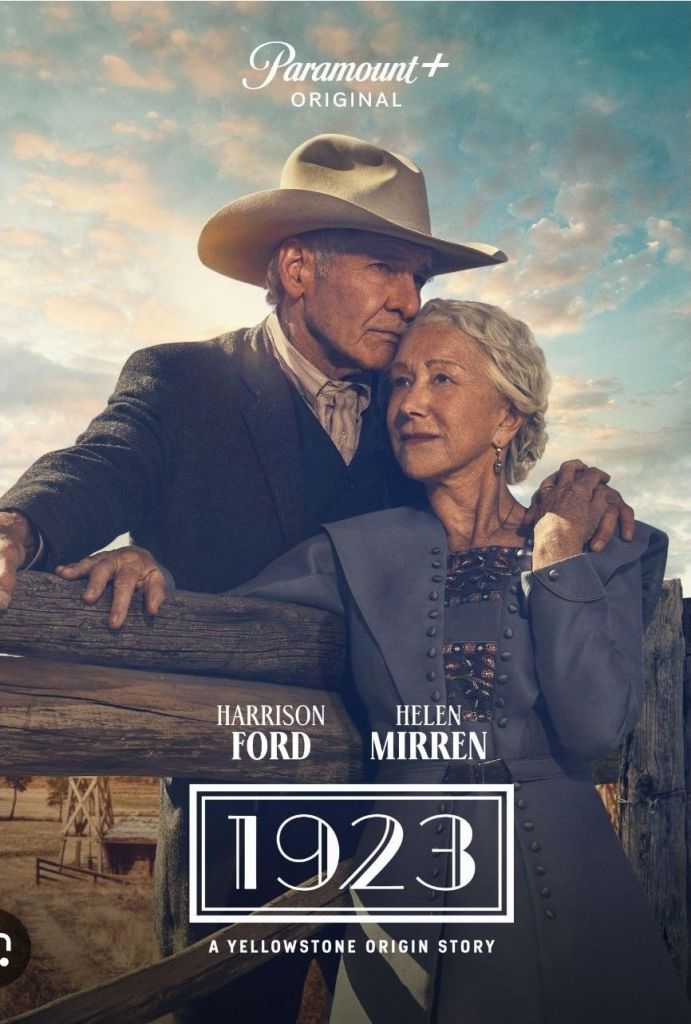
The American frontier is often romanticized as a place of beginnings. But beginnings, like birth itself, are traumatic. The land does not yield; it is wrestled into submission. And in Taylor Sheridan’s 1923, we are not offered the birth of anything new—we are forced to witness the pains of a legacy buckling under the weight of time, violence, and empire. If the West was once promised as a blank slate, 1923 insists that it is a ledger already written in blood.
Sheridan’s series does not ride in with a gallop—it drags in with a dirge. The landscape is not a canvas but a scar. Here, justice is arbitrary, and memory is a liability. It is less a show about settlement than it is about entropy—the slow unraveling of families, nations, and identities. Through the eyes of multiple lineages, each fractured and marked, 1923 offers a lamentation more than a celebration. And yet, in that mourning, it achieves something rare in television: a myth made mortal.
Cast of Characters & Performative Dynamics
Jacob Dutton (Harrison Ford) is a man of land and labor, but Ford does not play him as resolute. He plays him as eroded. The iconic action hero of Indiana Jones and the ethical fugitive of The Fugitive now mumbles with the exhaustion of legacy. His very casting is an elegy to American masculinity—once capable, now calcified.
Cara Dutton (Helen Mirren), a matriarch forged in exile, offers a performance of iron veiled in silk. Mirren’s command of composure—so regal in The Queen—is re-purposed here into the resilience of the frontier wife who must now govern not a court but a crumbling clan.
Spencer Dutton (Brandon Sklenar), the exiled nephew and veteran, is less a cowboy than a ghost. Haunted by war, he moves through Africa and Europe like a man allergic to peace. His storyline, while disconnected in geography, is thematically central—he is what the West exports: violence, displacement, and myth. Yet Spencer’s journey is not a solitary one—it is deeply intertwined with Alexandra.
Alexandra (Julia Schlaepfer), a British aristocrat who abandons societal duty for love and danger, is arguably the most unpredictable character in the series. Schlaepfer plays her with equal parts effervescence and steel. She is not a damsel; she is a spark—igniting not only Spencer’s heart but also his will to return. Their love story—wholly improbable, thrillingly operatic—is the soul’s counterpoint to the land’s brutality.
Their odyssey spans train cars, lion attacks, safari trails, and transatlantic ships. Onboard the doomed ship bound for London, the series reaches a visual and emotional crescendo: chaos at sea becomes a metaphor for love’s fragility. When they are separated at customs after surviving so much together, the wound of interruption feels deeper than bullets. It is narrative momentum through emotional velocity.
Teonna Rainwater (Aminah Nieves), whose performance scorches every frame, offers the counter-narrative. Her story, unfolding within the brutal confines of a Catholic boarding school, is not a subplot—it is the indictment. Sheridan casts her as the moral fulcrum, and Nieves responds with fury, grace, and an almost unbearable vulnerability.
Banner Creighton (Jerome Flynn) plays the Scottish rancher as a colonial analog: all entitlement, no honor. His feud with Jacob Dutton ignites the central conflict over land, law, and legacy. His alliance with Donald Whitfield turns cattle rustling into economic warfare—primitive theft married to modern speculation.
Donald Whitfield (Timothy Dalton) enters late but leaves a deep moral bruise. As a mining magnate oozing aristocratic rot, he doesn’t threaten the Duttons with violence—he threatens them with paperwork and debt. His character embodies the creeping spread of financial colonialism, replacing bullets with balance sheets.
Father Renaud (Sebastian Roché), the head of Teonna’s school, personifies institutionalized cruelty. His presence is as frightening as any outlaw, and far more systemic. He enacts theology as torture.
Narrative Arc: The Full Journey
1923 unfolds as a braided epic. The Dutton family faces existential threats: from cattle thieves, corrupt bureaucrats, and nature itself. Jacob is wounded early on, leaving Cara to command with letters as weapons and silence as shield. Their land is no longer secure; power, once inherited, must now be fought for.
Spencer’s odyssey becomes a globe-spanning crucible. Beginning in Africa, where he hunts predators as a proxy for his own traumas, he meets Alexandra—a force of nature who joins him in abandoning safety for love. Their courtship is impulsive, their marriage immediate, their commitment tested by a series of escalating perils: wildlife, treacherous employers, imperial entanglements, and ultimately a sinking ship that nearly ends their story. It is in these moments that the show trades realism for epic, crafting sequences that blend Hemingway and Homer.
Their separation at customs in London—the bureaucratic violence of love denied—leads to further turmoil. The audience is left in suspense, not just about whether Spencer will return to Montana, but whether love can survive the long shadow of war and geography.
Meanwhile, Teonna’s journey from victim to fugitive is written with searing moral clarity. Escaping the sadistic nuns, she becomes a symbol not of freedom, but of resistance—the cost of survival measured in scars. She does not simply survive her captors; she haunts them. Her storyline, unlike Spencer’s, does not circle back into the Dutton orbit, but that disjunction is intentional. It reminds us that some histories run parallel, never intersecting—until reckoning demands they do.
The subplot involving Irish sheep herders introduces further fracture into the land’s fragile ecosystem. What begins as a border skirmish over grazing rights becomes a moral referendum on class, ethnicity, and the weaponization of legal loopholes. These secondary players are less developed than others, but they function as thematic ballast—reminders that the frontier was never empty, only forcibly emptied.
Sheridan weaves these threads with varying degrees of finesse. The cinematography, lush and painterly, sometimes elevates the tale beyond its script. But the storytelling itself can sprawl, indulging digressions and occasionally losing narrative momentum. And yet, taken as a whole, the series is less about closure than it is about the costs of continuity.
Historical Resonance & Thematic Core
Set against the real backdrop of American upheaval—the rise of industrial agriculture, the forced assimilation of Native children, the tremors of global war—1923 is drenched in historical tension. It does not pretend to be a history lesson, but it traffics in historical aftershocks. Every character is a revenant, haunted not by ghosts but by policies, empires, and economic systems.
Sheridan’s genius, if it can be called that, is in rendering the past tactile without making it didactic. 1923 is not a series of events—it is a series of injuries. Emotional, cultural, institutional. And through this lens, we see that the West was not won. It was wounded. And it never quite healed.
Teonna’s story draws from the brutal legacy of the Indian Boarding Schools, whose mandate was not just assimilation but annihilation of identity. Her escape becomes a kind of historical justice—a re-writing of the silence that haunts so many real-world counterparts.
Spencer’s arc, by contrast, evokes the haunted masculinity of the post-war generation. He is not returning home; he is reassembling the idea of home. His journey reflects not frontier myth, but the aftermath of war, empire, and trauma.
Genre, Form & the Sheridan Universe
Sheridan is building an empire of elegies. 1883 was a psalm of migration, Yellowstone is a meditation on power, and 1923 is a requiem. Where most television Westerns lean into spectacle or nostalgia, 1923 leans into contradiction.
The Western genre has rarely made room for women of agency or Indigenous stories told without condescension. Sheridan attempts both, imperfectly but earnestly. By intercutting the colonial with the domestic, the distant with the intimate, he breaks the structural conventions of genre storytelling.
And yet, Sheridan also courts risk. His canvas is vast, but occasionally unfocused. The promise of character convergence may never satisfy the gravity of their isolated trajectories. Still, what he attempts is uncommon: not just storytelling, but historiography.
Cinematic Merits & Aesthetic Brilliance
The triumph of 1923 is its visual poetry. Cinematographer Ben Richardson paints with light: dust motes become constellations, plains become battlefields, and silence becomes a scream. The use of wide frames to capture isolation, and close-ups to document suffering, renders each episode a meditation on the cost of endurance. The show’s aesthetic does not merely support the narrative—it indicts it.
The score, mournful and minimal, whispers where dialogue yells. It functions like a phantom—present, felt, but rarely seen. Editing choices occasionally falter, particularly in cross-cutting between distant plotlines, but Sheridan’s overall rhythm honors the spirit of elegy rather than entertainment.
Production design is impeccable—from rusted implements to ceremonial beadwork. The props do not illustrate history—they evoke its textures. You can smell the dust, feel the leather, sense the rot beneath the grandeur.
Moral Ledger: Whose America?
Perhaps the deepest question 1923 asks is: Whose story is America’s? The Duttons are offered as both founders and fossils. Their sense of entitlement to land, justice, and permanence is framed not as virtue, but as pathology. Teonna’s storyline complicates any nostalgia the viewer may bring. She refuses to be a footnote.
Even Spencer’s return, framed as salvation, feels like a ghost stepping into a haunted house. No one is saved here. And no one leaves whole. Sheridan offers no heroes—only survivors. And in that moral ambiguity, 1923 finds its rough grace.
Final Verdict
1923 is not a perfect series. Its narrative bifurcations occasionally disrupt its momentum. Some threads fray, others tangle. But its ambition—to hold the mirror of myth up to the cracked face of history—is unmistakable. What it lacks in cohesion, it compensates for in courage.
Sheridan’s work here feels like a cinematic funeral for America’s unfinished business. It does not sing the West into glory—it reads the ledger aloud at the gravesite.
1923 is the West, not as nostalgia, but as consequence. It is television that does not entertain so much as exhume. A drama not of gunfights, but of ghosts.
And that is why, for all its flaws, 1923 matters.
 RMS INSIGHTS ✍🏾