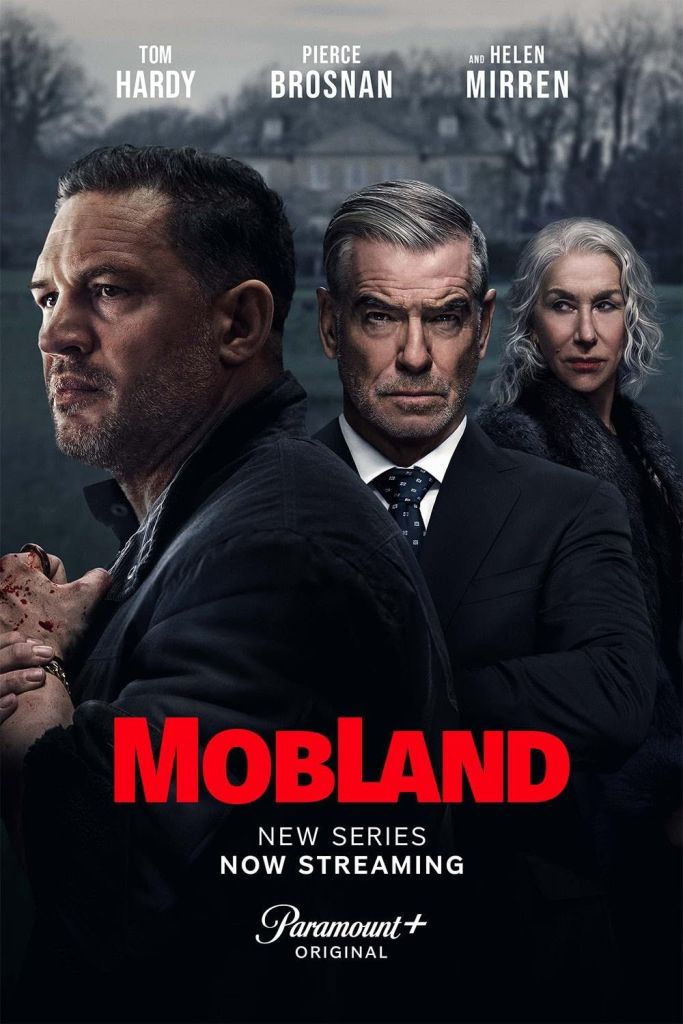
TV SERIES: MobLand
Created by: Ronan Bennett & Jez Butterworth
Directed by: Anthony Byrne, Daniel Syrkin, Lawrence Gough
Starring: Tom Hardy, Pierce Brosnan, Helen Mirren, Paddy Considine, Joanne Froggatt, Lara Pulver
Part I: Opening Invocation – The Crime Family as Greek Chorus
In the world of organized crime, silence is currency, and legacy is a wound that festers beneath tailored suits and soft leather car interiors. MobLand is less a chronicle of power than an anatomy of performance—the performance of loyalty, masculinity, succession, and, most crucially, pain. Here, family is not the cornerstone of stability, but its primary saboteur. And as in all good tragedies, the stage is set not for redemption, but for recursion.
Created by Ronan Bennett and co-written by Jez Butterworth, MobLand attempts to inhabit the decaying skeleton of Britain’s underworld aristocracy. The show offers a familiar feast: dynastic conflict, generational resentment, and the bruised poetry of backroom deals. Yet what elevates it—if it can be said to rise—is not the script, but the faces: worn, watchful, and utterly transfixing.
The plot, such as it is, wanders. The moral terrain is murky, and the motivations are sometimes confused. But the cast performs with such intensity that narrative coherence becomes almost irrelevant. MobLand is, above all, an actor’s dominion—a series built not on its story, but on the slow-burn charisma of those allowed to wear its scars.
This is not a tale of crime, but a requiem for a family that has confused survival with inheritance.
Part II: The Story
MobLand opens with a quiet funeral and ends with one. In between, we are submerged into the crumbling empire of the Harrigan crime family. Conrad Harrigan (Pierce Brosnan) rules not with spectacle but with stillness, his eyes colder than the empire he governs. His wife Maeve (Helen Mirren) exerts influence from the dining table, running her domain like a gothic empress.
Their eldest son is dead—lost to some unspoken war, possibly at the hands of enemies or perhaps his own. The second son, Kevin (Paddy Considine), is alive but unraveling. Desperate for approval, terrified of inadequacy, he moves through the series like a man under psychic siege. His wife Bella (Lara Pulver) sees through it all. She has love left, but not hope.
Enter Harry Da Souza (Tom Hardy), the family’s longtime fixer—half adopted son, half mercenary. He handles the bodies, the books, and the betrayals. Haunted by a violent past, Harry now wants out. But like all good tragedies, MobLand reminds us: no one leaves cleanly. His wife Jan (Joanne Froggatt) urges escape, but Harry’s exits are blocked—by duty, by debt, and by the absence of a life outside the family’s shadow.
The plot meanders through power struggles: a betrayal inside the family, a brewing war with rival factions, and an ill-fated attempt to legitimize the business. But the real war is internal. Kevin spirals. Maeve manipulates. Harry hesitates. Conrad watches. The house groans with secrets.
By episode eight, bodies have dropped, alliances have shifted, and nothing has truly changed. The Harrigans survive—but barely. Harry buries another friend. Kevin disappears into silence. Bella leaves. Maeve sharpens her knives. Conrad stands at the window, watching a city he no longer controls.
It ends, as it began, with mourning. And with legacy refusing to loosen its grip.
Part III: Cast of Characters & Performative Dynamics (Expanded)
Harry Da Souza (Tom Hardy)
Harry isn’t just the fixer. He’s the ghost of the Harrigan family’s past decisions. Tom Hardy plays him like a soldier caught in the wrong war. His presence is gravitational—he draws pain toward him, absorbs it, converts it into slow-burning silence. A tattooed body with a theologian’s gaze, Harry is caught between his wife’s pleas for a new life and Conrad’s constant call for one more job. He’s always about to leave—but never quite leaves. Hardy conveys this internal collapse with almost balletic restraint. Every time Harry picks up a phone or a glass or a gun, it’s with the weight of a man picking up his own obituary.
Conrad Harrigan (Pierce Brosnan)
This is the role of Brosnan’s life. He doesn’t perform power—he withholds it. His Conrad is not a tyrant. He is something far colder: a legacy embodied. A dying monarch presiding over an empire of ash. There’s no yelling, no flourish—just a quiet disapproval that turns every room glacial. His scenes with Kevin carry a tension that borders on theological: the disappointment of a father who cannot name his love, only measure its failures. Brosnan’s stillness is weaponized. He speaks like a man who’s memorized the script to everyone else’s downfall.
Maeve Harrigan (Helen Mirren)
Maeve is no mob wife. She is the house’s true architect—the general behind the throne, the ghostwriter of every scheme. Mirren plays her with chilling elegance: a woman who smiles as she severs. Her presence suggests that behind every act of family loyalty is a ledger she keeps in her head. She knows where the bodies are buried—and whose fault they were. She’s the only one who speaks to Conrad as an equal. If she were born a man, there’d be a statue of her in the Harrigan foyer.
Kevin Harrigan (Paddy Considine)
Kevin is a raw nerve disguised as a second son. He isn’t the heir; he’s the afterthought—except he’s not content to be. His anger stems not from ambition but from confusion: what does it mean to be a man in a family that only rewards obedience or violence? Considine plays him like a candle constantly flickering in the wind. He’s terrifying not because he’s cruel, but because he’s unstable. His breakdown across the series feels inevitable. By the final episodes, he’s no longer trying to prove himself to Conrad. He’s trying to survive his own reflection.
Bella Harrigan (Lara Pulver)
Bella is the cool intellect trapped inside a boiling house. She’s not just Kevin’s wife—she’s a strategist in her own right. Her upbringing is clearly different: private schools, international exposure, the kind of woman who once had options. She married for love, but stayed out of calculation. Pulver plays her with quiet precision—every sigh is measured, every glance loaded. She represents a kind of moral exit sign no one in the family is willing to walk toward. Her silences are louder than Kevin’s tantrums.
Jan Da Souza (Joanne Froggatt)
Jan is not part of the Harrigan family, but she suffers under its gravitational pull. Her tragedy is not that she doesn’t understand Harry—it’s that she does. She knows he’s both victim and accomplice, protector and prisoner. Froggatt delivers a performance of aching restraint. Jan doesn’t have many lines, but when she does speak, it lands like scripture: short, sharp, and devastating. Her scenes with Harry aren’t romantic—they’re eulogies for a future neither of them can quite kill off.
Noel Harrigan (Jack Lowden)
Noel, the cousin and occasional enforcer, is the lurking future of the Harrigan dynasty—a next-generation predator with no illusions of nobility. Jack Lowden’s performance is sleek and venomous. He represents everything Harry fears: efficiency without empathy, tradition without hesitation. He smiles through violence, jokes through executions, and flirts with Bella just to watch Kevin unravel. If Conrad is the decaying lion, Noel is the panther stalking the carcass. He’s the one who will inherit it all—not because he’s the smartest, but because he’s the most emotionally bankrupt.
Detective Cora Venn (Indira Varma)
Cora Venn is the only character outside the Harrigan orbit who seems to understand its gravitational force. A senior detective haunted by her own compromises, she’s not chasing justice—she’s chasing order. Varma plays her like a fallen philosopher: she doesn’t believe in good guys, only less damaging outcomes. Her scenes with Harry crackle with mutual recognition. She sees herself in him—a person who once tried to fix the world and now just tries to keep it from bleeding too loudly. Cora doesn’t get a win, but she gets the last word.
Part IV: Symbolism and Legacy – Bloodlines as Blueprints
At its core, MobLand is not a crime series. It is a meditation on inherited sin. The Harrigan home itself is the show’s central metaphor: a grand estate where corridors echo with past decisions. Its walls hold grudges. Its mirrors reflect old wounds. It’s not a house—it’s a mausoleum with fresh sheets.
Blood is a theme, but not the kind spilled easily. It’s the blood in your name. The kind you can’t wash off. The kind you mistake for duty.
Part V: Compare & Contrast – Peaky Blinders and Top Boy
Peaky Blinders was operatic. Top Boy is immediate. MobLand is neither. It’s glacial, deliberate, like a legal document written in Latin. Where Peaky seduces with danger, MobLand repels with dread. Where Top Boy confronts modernity, MobLand lingers in the corpse of empire.
Think of it this way: Peaky Blinders builds a myth. Top Boy confronts a system. MobLand whispers a eulogy.
Part VII: Expanded Character Arcs and Backstory Hints
The brilliance of MobLand lies not in what it says, but in what it refuses to say. Backstories aren’t given; they’re leaked. They drip from the corners of scenes, flicker in the flinches between dialogue, and settle in the silences like dust that’s never wiped away. Each character walks through the show like a walking scar with an unfinished origin story. The series trusts its audience to notice the weight without always naming it.
Harry Da Souza: The Ghost of Another War
We’re never told where Harry learned to kill cleanly or grieve privately—but the signs are unmistakable. The posture, the precision, the scars on his back and in his voice. There’s a moment in episode three where he flinches at the sound of a gate slamming—not a man startled by threat, but a soldier remembering impact. He likely served—military or mercenary—and what he brought back wasn’t honor. It was residue. His rituals—boiling coffee at 4:00 a.m., fixing his shirt cuffs even when alone—hint at discipline born of trauma. We aren’t told Harry’s past because Harry doesn’t speak about it. And yet, in every hesitation, it speaks.
Conrad Harrigan: The Inheritor of Ash
Conrad speaks of legacy often, but never of labor. He wears power like a tailored suit—custom-fitted, but inherited. What he built wasn’t empire—it was order from memory. His father likely ran the streets in the post-war boom, and Conrad repackaged it as dynasty. He doesn’t create so much as curate—keeping the machinery of violence humming by maintaining the illusion of control. His fear isn’t death. It’s irrelevance. The empire he claims to rule is one he never made. He inherited dust and lacquered it in old-world charm.
Kevin Harrigan: The Artist in a Family of Butchers
In episode five, Kevin sketches a spiral staircase while muttering to himself. It’s never explained. But it haunts. Earlier, Bella finds a tattered portfolio under their bed. Architectural drawings. Abstract watercolors. Kevin isn’t broken because he failed the family—he’s broken because the family never made room for who he really is. His violence is learned; his sensitivity, native. He once had a dream, perhaps of becoming an architect, or maybe just a man with clean hands. Now he draws rooms no one will ever walk through. Kevin’s tragedy is not just that he can’t live up to the family name—it’s that he was never meant to carry it.
Bella Harrigan: The Intelligent Captive
Bella doesn’t speak like the others. Her vowels stretch differently. Her diction is sharp, clipped, almost continental. She was educated abroad—Paris, possibly Florence. Somewhere with light, space, and art. She married Kevin for love, perhaps out of rebellion against her upbringing. But she stayed for survival. She’s fluent in silence, in small facial resignations. Her mind runs faster than every man in the room, and it galls her. Her beauty is not ornamental—it’s weaponized. She reads people faster than they realize they’re being studied. What we see on screen is not the full Bella—it’s her survival version.
Maeve Harrigan: The Architect Behind the Curtain
There are glances from Conrad to Maeve that feel less like love and more like acknowledgment—of debt. Maeve is not the matriarch; she’s the original strategist. In one flashback-laced monologue, she recalls running books out of a flower shop, laundering money before Conrad could even spell “clean.” The power she ceded was not out of weakness but calculation. She allowed Conrad the throne, knowing that in return, she would govern the shadows. Her bitterness in later episodes isn’t because she lost power—it’s because she knows no one will ever credit her for building the castle they’re all dying in.
None of these stories are spelled out. But they’re embedded in the performances, in the pauses, in the props that show up once and never again. MobLand asks the audience to listen between the lines, to see what isn’t illuminated, and to recognize that every character is a biography in partial light. These are people who live not in exposition, but in emotional residue.
They are not telling you who they are. But they’re bleeding it anyway.
Part VIII: Thematic Deep Dive – Guilt, Silence, and the Cost of Legacy
If Peaky Blinders is about ambition, and Top Boy about survival, then MobLand is about atonement deferred until it rots. At its aching core, MobLand presents a world where guilt is not personal—it is infrastructural. It doesn’t arrive in dramatic confessions or tear-streaked repentance. It seeps. It festers. It becomes ambient. The Harrigans do not carry guilt like a burden—they walk through it like atmosphere. It is in the wallpaper. It is in the hallway light that flickers but no one replaces.
Guilt as Inheritance
Each generation inherits more than wealth or trauma. They inherit unacknowledged damage—the sins the last generation refused to bury properly. Harry’s reluctance to act is not cowardice—it is fatigue born of watching men repeat mistakes under new slogans. Kevin’s instability is not simply emotional fragility—it is the psychic weight of wearing a legacy like a lead vest. Even Conrad, so stoic and composed, trembles not with regret, but with the dread that his entire life has been one long delay of consequence.
The show doesn’t moralize. It anatomizes. It shows us what happens when unresolved grief becomes culture, when unspoken wrongs become tradition. MobLand understands that crime doesn’t just create victims—it creates descendants of pain.
Silence as Strategy
In MobLand, language is dangerous. Words are avoided, redirected, buried beneath polite gestures or ritualized sarcasm. What passes for communication in the Harrigan family is actually mutual containment. Characters use silence not as peace, but as protection.
The silence between Conrad and Maeve during dinner scenes is not born of comfort. It is a stalemate. The pause between Kevin’s outbursts is not calm—it is implosion postponed. Even Bella’s long glances carry the weight of things that must not be said, because saying them would detonate the illusion everyone clings to. The family doesn’t just hide secrets from outsiders—they hide truths from themselves.
The Cost of Legacy
Legacy, in MobLand, is a poison disguised as purpose. Every character is either serving it, fleeing from it, or being crushed by it. The Harrigans are a family who no longer believe in their empire—but have no idea who they are without it. They are too haunted to innovate, too guilty to escape, and too proud to confess that the kingdom they’re protecting has already fallen.
The house itself mirrors this. Its grandeur has curdled into gloom. Its staircases creak like tired bones. Its chandeliers don’t shine—they loom. The Harrigan estate is not a home; it is a memorial to delusion. A place where past crimes echo louder than present decisions. The legacy is not wealth—it is repetition. And the cost is not just death—it is the absence of renewal.
The Tragedy of Unnamed Truth
The deepest irony in MobLand is that no one is truly innocent, and yet everyone longs for absolution. But the tragedy is structural: there can be no forgiveness in a system where truth is considered betrayal, and silence is seen as loyalty.
The series suggests that healing would require rupture—that to speak honestly would mean destroying the architecture of survival that everyone depends on. So the Harrigans persist, stoically, suicidally, repeating the very cycles that broke them. This is not dysfunction. This is devotion to the wound.
MobLand is not about crime. It’s about emotional recursion. About how systems of guilt, silence, and legacy repeat themselves until everyone is buried beneath their weight—some literally, others spiritually.
The show is less a story than a dirge for unburied truth. It does not resolve. It reverberates.
No one confesses. No one forgives.
They simply inherit the silence.
Part IX: Director’s Intent & Writing Philosophy – Elegy Over Exposition
Ronan Bennett and Jez Butterworth weren’t aiming to entertain—they were aiming to haunt.
MobLand doesn’t concern itself with ratings-friendly pacing, nor does it pursue the dopamine-high of plot twists. It rejects conventional crime storytelling in favor of a dramaturgy of decay. This is storytelling as slow erosion—moral, structural, and emotional.
Butterworth, known for the mythic ruggedness of Jerusalem, infuses the dialogue with elliptical loops, unresolved phrases, and subtext that buckles under its own weight. Words are never quite statements—they’re invitations to interpret. His characters don’t finish sentences. They trail off. They imply. They weaponize absence.
Bennett, coming off the raw verité tone of Top Boy, brings a sociological edge to the architecture of crime. He treats the Harrigan family as both a criminal enterprise and a dying institution, somewhere between a decaying monarchy and a rotting church. His framing echoes his belief: that crime is not just an act, but an inheritance system—a theology.
Together, they don’t write with clarity—they write with residue. Every scene lingers longer than it should. Every line has a second meaning trailing behind it like a ghost. Their credo is not to entertain but to excavate. They don’t build narratives. They unearth ruins.
Part X: Visual Style Breakdown – Chiaroscuro Crime
Visually, MobLand is composed like a painting abandoned mid-brushstroke. The aesthetic is architectural grief: walls that lean in, hallways that feel like they’re closing off behind you. The camera doesn’t chase movement—it interrogates stillness. In this show, momentum is dangerous. The frame lingers because no one’s truly going anywhere.
The color palette is funeralistic: slate gray, tarnished brass, antique green, oxidized gold. Colors don’t pop—they recede. Even blood looks tired here. Light is rationed like truth. Most faces are seen half-lit, as if only half the self dares show up. This is chiaroscuro not as homage but as worldview—every moment split between what is visible and what is endured.
Interiors dominate. Bedrooms feel like vaults. Living rooms resemble mausoleums. Every space in the Harrigan estate is shot like it remembers something it shouldn’t. Even London feels distant, as though the city has turned its back on the Harrigans and left them to wither inside their own mythology.
Cinematographers Anthony Byrne and Daniel Syrkin use shadow not just to sculpt the frame but to emphasize emotional occlusion. A face in darkness is a soul unconfessed. A character backlit isn’t hiding—they’re vanishing.
There are no wide vistas here, no cityscape establishing shots. There is only enclosure. Claustrophobia becomes aesthetic. Every scene feels like it’s being watched from the corner of a locked room.
The visuals don’t decorate the story.
They mourn it.
Verdict – A Genre Eulogy
MobLand does not reinvent the crime genre. It lays it to rest.
Where other shows glorify the ascent, MobLand focuses on what remains when the climb ends and the body count lingers. There is no grandeur in power here, no glory in the family name. Only rot in the baseboards and dust on the throne.
It is not just a story about criminals. It is a story about what crime leaves behind—in houses, in names, in children, in time.
There are no shootouts. No declarations of war. Just the long, low sound of legacies collapsing under their own weight.
The house bled.
No one cleaned the wound.
They passed it on instead.
R M Sydnor
 RMS INSIGHTS ✍🏾