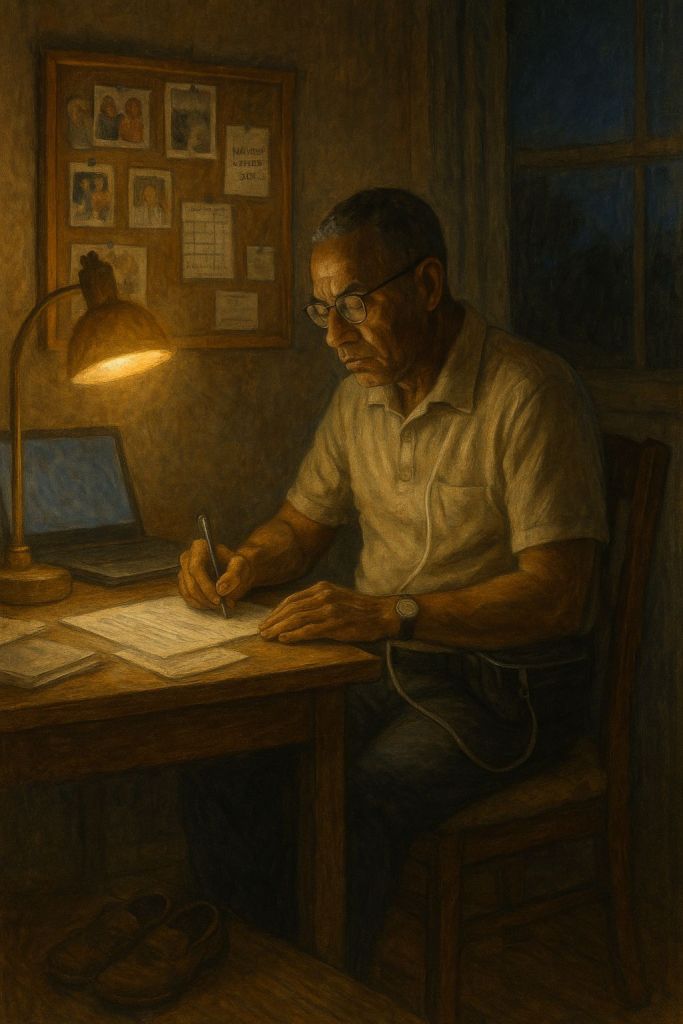
🗓️ 25-07-24-Th | 12:56 PST | ☀️ Sunny | 🌡️89° – 63° | Northridge, CA | 🌑 New moon in ♋➝♌ (arrives this evening) | Week 30 | Day 205/365 | 160 Days Remaining
National Day 🔥 Thermal Engineering Day
RMSDJ
🤔💭✍🏾
What Remains Unshaken
There are conversations that begin in procedure and end in presence. My call with Mike Kia was meant to tidy loose legal threads—documents, omissions, the looming procedural minefield of litigation. But it became something else entirely. Something I am still sitting with.
Mike has been my guide through this legal labyrinth—a legal aid assistant with quiet authority and a gift for navigating the gray zones others fear to enter. Today, he spoke clearly: one point in my response must go. Superfluous. Possibly damaging. He requested every document I had previously sent to Samuel Frasher. Not as an act of suspicion, but as an act of certainty. We must leave no hinge unwatched, no opening unsecured.
He believes the opposing counsel’s strategy is transparent: delay, flood, press, and press again—until the scaffolding collapses under its own weight and the only thing left to bargain with is money. That moment, he believes, will come. But not before the test.
I trust his instinct. He’s precise. Unflinching. But beneath that firmness, something broke through—something I wasn’t expecting.
Mike has been fighting colorectal cancer for five years. His voice, usually composed, cracked just slightly when he told me. There was no melodrama—only fact. Every six months, a checkup. Every day, a hidden device in a fanny pack administers measured poison through his body in the name of keeping him alive. He coughed several times during our conversation. Not the cough of inconvenience, but the cough of consequence.
“I don’t have a choice,” he said.
And there it was. A sentence that carried more than the weight of one man’s struggle. It carried the dignity of endurance.
He continues to work from home—his office fully wired, his son-in-law helping with legal work, a man of thirty and steeped in AI. Mike pays him, as one pays a craftsman. With respect.
He spoke of introducing us one day, perhaps soon. I heard it as both invitation and defiance. Despite the ache in his body, Mike is still building bridges. Still preparing ground for others. Still choosing relevance over retreat.
The law was the reason we spoke. But life was the subject.
🙏🏾 Reflections of Gratitude
Today I am grateful for the quiet resilience of others—their hidden battles, their unsought heroism. Mike reminded me that purpose doesn’t retire in the face of pain. It sharpens.
🏛️ Philosophical Quote
“What lies behind us and what lies before us are tiny matters compared to what lies within us.”
— Ralph Waldo Emerson
🪶 POEM
The Man Who Works Through Fire
He speaks in notes of legal steel,
But underneath, a slower song—
Of battles fought in silence real,
Of carrying the hurt too long.
A fanny pack—a coil, a cord,
A chemical, a prayer in stride—
And yet his focus never blurred,
His duty stands, unturned by tide.
No trumpet cries, no medals gleam,
But there he sits, behind the screen
A soldier in a quieter war,
A mind still bright, a heart still keen.
He coughs, and still the work gets done.
He aches, but does not leave the field.
What we ignore, he does not shun—
He faces all, and does not yield.
So if you ask what strength looks like,
It is not loud. It does not shout.
It holds its breath, and types its brief,
And fights, while never counting out.
🤔 POETRY ANALYSIS
For “The Man Who Works Through Fire”
🪶 Poem Title: The Man Who Works Through Fire
He speaks in notes of legal steel,
But underneath, a slower song—
Of battles fought in silence real,
Of carrying the hurt too long.
A fanny pack—a coil, a cord,
A chemical, a prayer in stride—
And yet his focus never blurred,
His duty stands, unturned by tide.
No trumpet cries, no medals gleam,
But there he sits, behind the screen
A soldier in a quieter war,
A mind still bright, a heart still keen.
He coughs, and still the work gets done.
He aches, but does not leave the field.
What we ignore, he does not shun—
He faces all, and does not yield.
So if you ask what strength looks like,
It is not loud. It does not shout.
It holds its breath, and types its brief,
And fights, while never counting out.
📖 Part I: Line-by-Line Analysis
Stanza 1
1. He speaks in notes of legal steel,
Literal: The man communicates with firmness and precision.
Implied: His language is structured, disciplined—indicative of his profession and inner resolve.
Tone: Steely, composed.
Philosophical: Strength in life is often expressed through quiet structure rather than emotional display.
2. But underneath, a slower song—
Literal: Beneath his stern exterior lies something gentler.
Implied: His inner life is vulnerable, tender, human.
Tone: Revealing, softening.
Philosophical: All outer armor conceals a pulse.
3. Of battles fought in silence real,
Literal: He fights real battles silently.
Implied: His pain is not performative—it’s lived, ongoing.
Tone: Somber, authentic.
Philosophical: The truest struggles often make no sound.
4. Of carrying the hurt too long.
Literal: He has borne pain for an extended time.
Implied: There’s exhaustion, but also endurance.
Tone: Weary, enduring.
Philosophical: Endurance is the art of hurting with grace.
Stanza 2
5. A fanny pack—a coil, a cord,
Literal: Description of his chemotherapy delivery device.
Implied: His life depends on something both fragile and mechanical.
Tone: Technical, intimate.
Philosophical: Survival often hangs on quiet machines and quiet courage.
6. A chemical, a prayer in stride—
Literal: Chemotherapy; walking with hope.
Implied: Faith and poison walk side by side.
Tone: Poignant.
Philosophical: Hope does not replace hardship—it accompanies it.
7. And yet his focus never blurred,
Literal: He stays sharp despite illness.
Implied: Illness hasn’t taken his clarity or sense of duty.
Tone: Admirational.
Philosophical: The mind can remain whole even when the body suffers.
8. His duty stands, unturned by tide.
Literal: His commitment is unwavering.
Implied: Circumstances do not shake his resolve.
Tone: Firm, resolute.
Philosophical: Principles are proven when tides rise.
Stanza 3
9. No trumpet cries, no medals gleam,
Literal: He receives no fanfare.
Implied: He is unsung.
Tone: Quiet, humble.
Philosophical: Heroism often lacks witnesses.
10. But there he sits, behind the screen—
Literal: He works on a computer.
Implied: He continues despite what we cannot see.
Tone: Steady.
Philosophical: Persistence in silence is its own triumph.
11. A soldier in a quieter war,
Literal: He is compared to a soldier.
Implied: His battle is internal, slow, ongoing.
Tone: Metaphoric, reverent.
Philosophical: Not all wars are fought with guns.
12. A mind still bright, a heart still keen.
Literal: He retains intellect and will.
Implied: His inner fire persists.
Tone: Warm, admiring.
Philosophical: The spirit often outlives the strength of the flesh.
Stanza 4
13. He coughs, and still the work gets done.
Literal: He labors through discomfort.
Implied: His pain does not impede his purpose.
Tone: Respectful, unflinching.
Philosophical: Courage is continuing amid discomfort.
14. He aches, but does not leave the field.
Literal: He remains present despite pain.
Implied: He does not retreat.
Tone: Heroic, understated.
Philosophical: The strongest stay when others would leave.
15. What we ignore, he does not shun—
Literal: He faces what others avoid.
Implied: He bears truths we sidestep.
Tone: Thoughtful.
Philosophical: Confronting what is hard is itself a noble act.
16. He faces all, and does not yield.
Literal: He refuses to give in.
Implied: His defiance is quiet but total.
Tone: Strong.
Philosophical: Yielding is a choice; so is resistance.
Stanza 5
17. So if you ask what strength looks like,
Literal: A question of definition.
Implied: A redefinition of masculinity, power, and grit.
Tone: Inquisitive, challenging.
Philosophical: Strength isn’t what we’ve always assumed.
18. It is not loud. It does not shout.
Literal: True strength is quiet.
Implied: The strongest do not advertise.
Tone: Declarative.
Philosophical: Stillness is often mightier than noise.
19. It holds its breath, and types its brief,
Literal: Even in pain, he works.
Implied: Persistence under pressure.
Tone: Measured.
Philosophical: Even mundane acts become profound when done under duress.
20. And fights, while never counting out.
Literal: He never assumes defeat.
Implied: He continues, no matter the odds.
Tone: Triumphant, quiet.
Philosophical: The real battle is staying in the fight.
✒️ Part II: Literary Devices — Defined and Illustrated
1. Metaphor
Definition: A direct comparison between two unlike things.
Example: “He speaks in notes of legal steel”
Effect: Evokes both precision and emotional armor—he is strong but restrained.
2. Symbolism
Definition: Use of objects or imagery to represent ideas.
Example: “A fanny pack—a coil, a cord”
Effect: Symbolizes his struggle and the weight he carries daily.
3. Alliteration
Definition: Repetition of initial consonant sounds.
Example: “Bright… a heart still keen”
Effect: Creates rhythm and cohesion between ideas.
4. Personification
Definition: Giving human traits to non-human things.
Example: “It holds its breath, and types its brief”
Effect: Gives strength a quiet persona—an actor in the scene.
5. Imagery
Definition: Language that appeals to the senses.
Example: “He coughs, and still the work gets done.”
Effect: Allows us to feel his physical pain and mental discipline.
6. Juxtaposition
Definition: Placing two contrasting elements together.
Example: “No trumpet cries… behind the screen”
Effect: Highlights the contrast between public glory and private sacrifice.
7. Enjambment
Definition: The continuation of a sentence across lines.
Example: “And fights, while never counting out.”
Effect: Propels momentum forward, echoing endurance.
8. Irony
Definition: Contrast between expectation and reality.
Example: “No medals gleam… A soldier in a quieter war”
Effect: Reminds us that heroes often live outside our notice.
9. Apostrophe
Definition: Directly addressing an absent or abstract idea.
Example: “So if you ask what strength looks like…”
Effect: Invites the reader to introspect and participate.
10. Isocolon
Definition: Parallel structure in successive clauses.
Example: “It is not loud. It does not shout.”
Effect: Emphasizes the poem’s thesis with rhythmic weight.
🪞 Part III: Final Reflection
The Man Who Works Through Fire delivers a reverent portrait of unsung courage—of the strength that labors, aches, and refuses to yield without a single headline to its name. In a world conditioned to equate noise with power, this poem counters with a different theology: that strength is often quiet, often unseen, and often sitting just across the screen.
Mike’s life becomes emblematic—not just of cancer’s challenge, but of every person working through unseen difficulty.
The question the poem leaves us with is simple, and it echoes like a slow-burning ember:
What if true heroism is not defined by what we conquer—but by what we carry, and still do well?
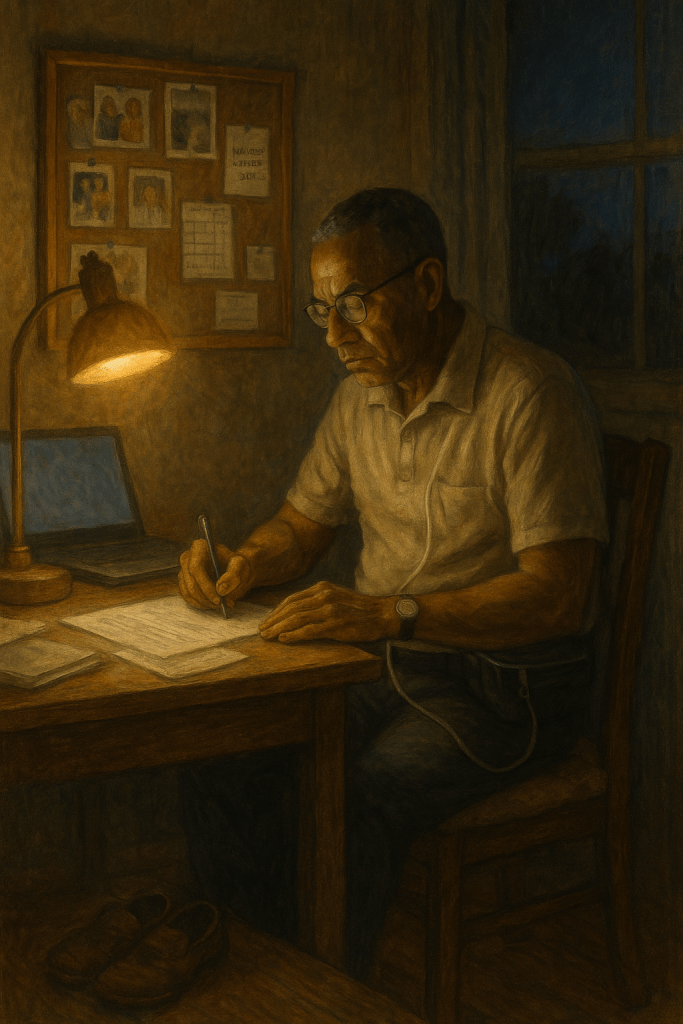
Title: Quiet Valor (2025)
Medium: Digital Mixed Media
Reflecting Randy Sydnor’s application of his unique technique, Mnephonics, this medium blends visual storytelling with symbolic language to evoke memory, learning, and reflection.
Style of Art: Impressionistic Realism with Symbolist Overtones
Dimensions: 1024 x 1024 pixels
Copyright: Randy Sydnor, The Mnephonist
Description:
Not all warriors wear armor. Some wear cardigans, house slippers, and the weight of their own breath.
Quiet Valor invites the viewer into a space where resilience speaks without raising its voice. The scene is humble: a middle-aged man sits at a wooden desk under the glow of a single lamp, the light embracing his labor with quiet reverence. Yet within that modest frame lies a staggering depth of spiritual and physical persistence—an homage to strength not as spectacle, but as sacrifice.
Rendered through digital mixed media, the composition leans on the subtle layering of Mnephonics, a technique pioneered by Randolph Sydnor to awaken associative memory through embedded symbolism. Here, texture and restraint are the vehicle for metaphor. The desk’s worn grain echoes endurance. The faint reflection of the computer screen in his glasses suggests both clarity and containment. Every detail is intentional.
The central figure—a man whose expression weds fatigue with dignity—becomes the silent axis of the piece. His posture is erect, his hands steady, even as his unseen body endures the private weight of illness. A faint line from his fanny pack loops upward—a device that quietly administers chemotherapy. That cord, understated and thin, becomes the symbolic lifeline of valor itself: courage not celebrated but carried.
Supporting elements build on this theme: a corkboard with pinned reminders (one reads “Never count out”), a closed door in soft shadow, and shoes that rest ambiguously elevated—as if part shrine, part staging ground. Whether they rest on a step or float slightly above the plane is never clarified—an ambiguity that honors the man’s dual nature: both grounded and ascendant.
The philosophical heartbeat of the piece beats in rhythm with Stoic thought—particularly Marcus Aurelius’ meditations on quiet duty: “Waste no more time arguing what a good man should be. Be one.” The figure in Quiet Valor is not posturing for admiration. He is simply fulfilling his work, not despite his struggle, but because of it.
Visually, the painting employs chiaroscuro to frame the scene: a warm golden glow radiates from the desk lamp, while the surrounding room dissolves into gentle shadow. This compositional choice draws the viewer inward, toward the heart of the scene—his hands, his task, his courage. Muted browns, ochres, and slate blues infuse the scene with the dignity of earth and endurance.
And as for valor—the titular word is not emblazoned, but embodied. It resides in the man’s presence, in the decision to show up. Not with fanfare, but with faith.
Closing Thought:
If courage had a color, it would be lamplight.
© Randolph M. Sydnor
Prints and digital sale of work is available
Email for more information: rsydnor@mnephonics.com
 RMS INSIGHTS ✍🏾