🗓️ 25-08-09-Sa | 11:00 PST | 😎 Hot❗ | 🌡️96° – 67° | Northridge, CA
🌕 Full moon is in ♒➝♓
| 🌿 Season (Late Summer)
📍 Week 32 | Day 221/365 | 144 Days Remaining
🌇 Sunset: 19:47
National Day 📚 Book Lovers Day
✍🏾 MOOD
Weighted, yet resolved.
🧭 THEME
Maintaining focus and composure under the shadow of financial strain and creative deadlines.
🗝️ KEYWORD
Resilience
📚 SUBJECT OF EXCHANGE
The lingering anxiety of impending book releases, the quiet discipline of physical training, and the unexpected diversions of misplaced chocolates.
✍🏾 RMSDJ
I rose rather late—near to eight—under the pall of a restless night. My sleep score, that modern arbiter of rest, was poor indeed. Yet in truth, the more vital matter is that I remain in sound health, and that focus—chaste and steady—has not deserted me. Still, the anxieties of The Fasting Life and Questions of Value hover like oppisans at the edge of my thoughts, their publication delayed yet, if Providence allows, to emerge in the coming week. I must draft a letter to Steve Harrison and complete the analysis of SAT Underground—tasks that stand in my mind like redoubts against the erosion of purpose.
I have considered, in these next few nights, the use of a mild draught to coax a deeper sleep. For of late I have awakened at that ungodly hour—three o’clock—when the house is silent, and the mind becomes a tourbillion of accounts and anxieties. Chief among them is the $8,000 laid upon my MasterCard for Amazon’s marketing—a wager that, though heavy, is not without hope. I must recall that in October the efflux will reverse, the sum returning, and that payments from Amazon in August and December may yet ease the strain. Should I sell two thousand books at eight dollars apiece, sixteen thousand will flow my way—enough to set the ledger right. Yet when coin departs, worry enters like an ombrophobe into rain—shrinking from the cold, damp touch of uncertainty.
This morning’s stretches were no flummery of motion, but deliberate acts, my attention fixed on the flexion of the abdominals and the guarding of the spine. This chaste discipline, whether seated or standing, shapes not only the body but the mind. I am convinced such a practice merits place upon The Fasting Life blog, for it marries form to intention.
In a moment of domestic inquiry, I sought my Sanders chocolates, convinced they lay in the alcove near the great window by the television. But they were gone. Could an entire year’s worth of restraint and indulgence have effaced them from the cupboard? I doubt it. My search became an exercise in funanbulism—balancing between determination and the creeping suspicion of folly. Half an hour passed before I conceded the point, though the finding of a hidden box of chocolate almonds—rendering my recent Costco purchase superfluous—offered its own Panglossian consolation.
Meditation followed, and though my mind wandered—flitting from Amazon’s sales to the fate of SAT Underground—I did not scold it. The stillness, however fractured, was a redoubt against the day’s oppisans.
Then came the planks: sixty-seven minutes, each breath an oyez from the body, commanding full attention. I imagined the precise abdominal regions in motion, and the minutes slipped past in the flow—where thought and action are bound as one.
Yet vexation returned with the matter of FedEx Office and Vanessa’s work. Pages had been mangled in the scanning, their edges cut, their order marred. For this, I paid $150? I will demand a full rescanning, and if they fail, the oppisans will meet not only my displeasure but MasterCard’s authority. Such negligence must find no redoubt to shelter in.
📖 WORDQUEST
Panglossian /pæŋˈɡlɒsiən/
Definition: Excessively optimistic, especially in the face of difficulty.
Etymology: From Dr. Pangloss, the optimistic tutor in Voltaire’s Candide (1759).
🧠 Memory Hook: A man grinning under storm clouds while holding an umbrella made of lace.
🌍 Literal Sentence: Despite the grim financial forecast, she remained Panglossian, convinced brighter days were imminent.
🔎 She holds optimism even when the evidence is scarce.
🔥 Figurative Sentence: His Panglossian faith was the lantern in our cavern of doubt.
🔎 Optimism personified becomes a guiding light through uncertainty.
Chaste /tʃeɪst/
Definition: Pure, modest, or restrained in style, behavior, or intention.
Etymology: Middle English, from Old French chaste, from Latin castus (pure).
🧠 Memory Hook: A crystal goblet untouched by wine.
🌍 Literal Sentence: The chaste lines of the whitewashed chapel evoked a serene simplicity.
🔎 Purity expressed through aesthetic restraint.
🔥 Figurative Sentence: His chaste devotion to truth was unsullied by personal ambition.
🔎 Purity as a moral rather than physical quality.
Redoubts /rɪˈdaʊts/
Definition: Strongholds or fortifications; figuratively, a place of refuge.
Etymology: From French redoute, from Italian ridotto (“place of retreat”).
🧠 Memory Hook: A solitary tower standing against a crimson sky.
🌍 Literal Sentence: The soldiers fell back to the redoubts as the enemy advanced.
🔎 Physical fortifications meant for defense.
🔥 Figurative Sentence: Her bookshelves were redoubts against the erosion of her imagination.
🔎 Mental and emotional fortresses that protect inner life.
Flummery /ˈflʌməri/
Definition: Nonsense; empty compliment or trivial talk.
Etymology: Originally a Welsh dish of soft porridge, later figuratively meaning “empty talk.”
🧠 Memory Hook: A silver platter holding nothing but air.
🌍 Literal Sentence: The speech was laced with flummery, offering little substance.
🔎 Superficiality disguised as substance.
🔥 Figurative Sentence: He learned to smile politely at the flummery of false praise.
🔎 A shield against shallow flattery.
Tourbillion /ˈtʊrbɪljən/
Definition: A whirlwind or vortex.
Etymology: From French tourbillon, diminutive of tourbe (whirl).
🧠 Memory Hook: A golden leaf spinning endlessly in an invisible gyre.
🌍 Literal Sentence: The desert wind rose into a sudden tourbillion, scattering the sand.
🔎 A visible spiral of movement in nature.
🔥 Figurative Sentence: Her thoughts became a tourbillion of fears and ambitions.
🔎 Inner turmoil given the form of a storm.
Oyez /ˈoʊjeɪ/
Definition: A call for silence or attention, especially in a court of law.
Etymology: From Anglo-Norman French, “hear ye.”
🧠 Memory Hook: A bell ringer halting a marketplace with a single word.
🌍 Literal Sentence: The bailiff shouted “Oyez!” as the judge entered.
🔎 A formal summons for attention.
🔥 Figurative Sentence: The thunder was nature’s oyez, commanding all to listen.
🔎 An authoritative call beyond the courtroom.
Oppisans /ˈɒpɪzənz/
Definition: Those who oppose or resist.
Etymology: From Latin opponere (to oppose).
🧠 Memory Hook: Two silhouettes locked in silent defiance at sunset.
🌍 Literal Sentence: The reform bill faced fierce opposition from entrenched oppisans.
🔎 Identifying adversaries by their stance.
🔥 Figurative Sentence: Our greatest oppisans were the doubts within.
🔎 Internal resistance personified.
Efflux /ˈɛflʌks/
Definition: A flowing out; an outward movement.
Etymology: From Latin effluxus, from effluere (to flow out).
🧠 Memory Hook: A stream of gold pouring from a cracked amphora.
🌍 Literal Sentence: The efflux of water from the reservoir was carefully monitored.
🔎 A literal outward flow.
🔥 Figurative Sentence: The efflux of ideas from her mind was unstoppable.
🔎 Mental energy streaming outward.
Funanbulism /fjʊˈnæmbjʊˌlɪzəm/
Definition: Tightrope walking; skill in balancing.
Etymology: From Latin funambulus (rope-walker).
🧠 Memory Hook: A man crossing a silver thread strung between two moons.
🌍 Literal Sentence: The circus performer’s funambulism held the crowd breathless.
🔎 Physical mastery of balance.
🔥 Figurative Sentence: Negotiating the deal required the funambulism of a diplomat.
🔎 Skillful balance in non-physical arenas.
Ombrophobe /ˈɒmbrəˌfoʊb/
Definition: One with an aversion to rain.
Etymology: From Greek ombros (rain) + phobos (fear).
🧠 Memory Hook: A cat glaring at a single raindrop.
🌍 Literal Sentence: The ombrophobe watched the gathering clouds with dismay.
🔎 Discomfort with rain as an environment.
🔥 Figurative Sentence: He was an ombrophobe of emotion, avoiding even gentle tears.
🔎 Emotional avoidance cast in meteorological terms.
🏛️ APHORISM
Voltaire: “Optimism is the madness of insisting that all is well when we are miserable.”
🔎 COMMENTARY
Voltaire exposes the folly of blind cheerfulness, urging us to distinguish between hope and denial. The mind’s clarity depends on its willingness to name the shadows without extinguishing the light.
❓ QUESTIONS OF VALUE
When does optimism become a mask for fear?
🔎 Sometimes the smile hides the trembling beneath.
🛠️ PRINCIPLE IN PRACTICE
Approach challenges with clear eyes and steady hands — optimism tempered with realism.
🪶 POEM
The Ledger of Night
Coins of worry clink in the dark,
Counting debts the dawn will never pay.
Yet the breath, steady as oars in water,
Carries me beyond the shore of fear,
Into the redoubt of my own keeping.
✍🏾 ELEGANT TURN OF PHRASE
“Redoubts of thought”
The mind built redoubts of thought against the siege of anxiety.
🔎 Mental fortresses protect against intrusive worry.
Her chaste patience was the redoubt in which his temper could not enter.
🔎 Purity of restraint becomes a defense.
In the tourbillion of change, our redoubts were the books that steadied us.
🔎 Knowledge serves as shelter in turbulent times.
🔎 INTERPRETIVE SUMMARY
Strongholds are not always stone; sometimes they are the silent chambers of the mind.
🏛️ STILLPOINT
The Stoics teach that control lies not in the storm’s strength, but in the pilot’s grip on the rudder.
🔎 Calm is not the absence of danger, but the presence of mastery. When the world spills over its banks, hold your course — your peace depends not on the tide, but on your hands.
🧎🏾♂️ REFLECTIONS OF GRATITUDE
For the discipline of morning stretches that knit posture to breath.
For the redoubts of books, music, and stillness.
For the sweet absurdity of searching for chocolates as though they were holy relics.
For the quiet triumph of a meditation not free of thought, but anchored in it.
For the resilience that turns financial anxiety into a sharper resolve.
🪔 AFFIRMATION
I build my redoubts not in stone, but in strength of spirit, and there I am unconquered.
POEM ANALYSIS
🪶 The Ledger of Night
Coins of worry clink in the dark,
Counting debts the dawn will never pay.
Yet the breath, steady as oars in water,
Carries me beyond the shore of fear,
Into the redoubt of my own keeping.
📖 Part I: Line-by-Line Analysis
Line 1: “Coins of worry clink in the dark,”
1. Literal meaning: The speaker imagines worries as coins, making a metallic sound in a dark space.
2. Implied meaning: Anxieties accumulate like currency—tangible, countable, yet ultimately valueless—kept hidden in the darkness of the mind at night.
3. Tone or voice shift: An intimate, almost confessional tone; we hear the inner life made physical.
4. Philosophical gesture: Worry is presented as self-created wealth of suffering—something we mint ourselves.
Line 2: “Counting debts the dawn will never pay.”
1. Literal meaning: These “coins” represent debts that morning will not settle.
2. Implied meaning: Some fears are illusory, built on expectations of events that never occur. The dawn—symbol of renewal—cannot solve what exists only in the imagination.
3. Tone or voice shift: From quiet observation to an undercurrent of futility.
4. Philosophical gesture: A Stoic reminder that imagined debts hold no true claim over us.
Line 3: “Yet the breath, steady as oars in water,”
1. Literal meaning: The speaker’s breath is compared to the rhythmic dipping of oars into water.
2. Implied meaning: Breath is a tool of navigation, each inhalation and exhalation moving the self toward calm.
3. Tone or voice shift: Hope enters here—the “yet” breaks from despair into agency.
4. Philosophical gesture: Mindful breathing becomes an act of self-piloting, a deliberate steering toward peace.
Line 4: “Carries me beyond the shore of fear,”
1. Literal meaning: The breath moves the speaker away from a figurative shore lined with fear.
2. Implied meaning: Fear is not a constant terrain—it can be left behind through deliberate, disciplined action.
3. Tone or voice shift: Expansive and liberating, the imagery moves from confinement to open possibility.
4. Philosophical gesture: Courage is movement—one cannot will fear away, but can row past it.
Line 5: “Into the redoubt of my own keeping.”
1. Literal meaning: The journey ends in a fortified place under the speaker’s control.
2. Implied meaning: True safety is an internal fortress, not dependent on the outer world.
3. Tone or voice shift: Resolute and self-reliant, closing with strength.
4. Philosophical gesture: Peace is not found but built; sovereignty over the self is the truest form of protection.
✒️ Part II: Literary Devices — Defined and Illustrated
1. Metaphor – An implicit comparison between two unlike things.
Example: “Coins of worry” — Worries are likened to coins, implying accumulation and self-created value.
Function: Makes the intangible (anxiety) tangible, allowing the reader to see and “hear” it.
2. Symbolism – Use of concrete objects to represent abstract ideas.
Example: “Shore of fear” — The shoreline symbolizes the boundary between anxiety and freedom.
Function: Gives a physical boundary to an emotional state, making escape imaginable.
3. Imagery – Language that appeals to the senses.
Example: “Clink in the dark” — Appeals to sound and sight.
Function: Creates an immediate, sensory experience of worry.
4. Simile – Comparison using “like” or “as.”
Example: “Steady as oars in water” — Breath compared to rowing.
Function: Conveys rhythm, effort, and direction in calming the mind.
5. Personification – Giving human qualities to non-human elements.
Example: “The dawn will never pay” — Dawn is personified as a debtor.
Function: Highlights the futility of expecting external events to resolve inner fears.
6. Alliteration – Repetition of initial consonant sounds.
Example: “Shore of fear” — Repetition of the “s” sound.
Function: Creates cohesion and softens the transition between imagery.
7. Enjambment – Continuation of a sentence without pause beyond the end of a line.
Example: “Yet the breath, steady as oars in water, / Carries me beyond…”
Function: Mimics the flow of breath, reinforcing the poem’s meditative movement.
8. Caesura – A deliberate pause within a line.
Example: “Coins of worry clink in the dark,” — The comma creates a natural pause.
Function: Gives weight to the image, inviting reflection.
9. Juxtaposition – Placing contrasting elements close together.
Example: “Coins of worry” vs. “redoubt of my own keeping” — Accumulation of anxiety contrasted with fortified peace.
Function: Shows the transformation from vulnerability to strength.
10. Isocolon – Parallel structure in successive clauses or lines.
Example: “Counting debts the dawn will never pay.” — Balanced structure with rhythm in “dawn will never pay.”
Function: Adds a formal, almost ledger-like tone, reinforcing the financial metaphor.
🪞 Part III: Final Reflection
The poem is a meditation on the journey from anxiety to inner sovereignty. It begins in darkness, where worries clink like self-forged coins, debts counted in a futile economy of fear. Yet through breath—a deliberate, rhythmic act—the speaker crosses away from fear’s shore and into a self-built redoubt.
It speaks to a truth known to the Stoics, the mystics, and the disciplined: the mind’s harbor is of its own making. We cannot ask dawn to pay our debts; we must row ourselves to safety. Breath is not merely respiration here—it is agency, the means by which we navigate.
And so the lingering question remains: when next the tourbillion of thought rises, will you stay on the shore and count your debts—or take up the oars and leave them behind?
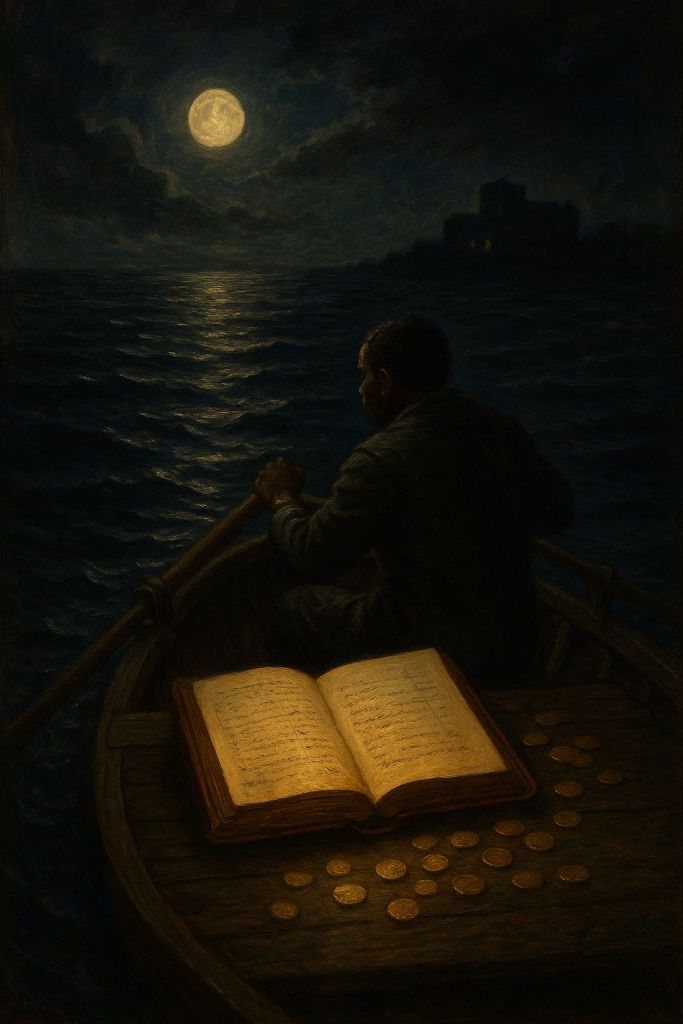
Medium: Digital Art, rendered in the style of classical oil painting
Reflecting Randy Sydnor’s application of his unique technique, Mnephonics, this work fuses visual storytelling with symbolic language, drawing the viewer into a scene where memory and meaning are in constant dialogue. The layering of light, shadow, and object placement turns the surface into a mnemonic map — an image designed to anchor thought and invite return.
Style of Art: Romantic Realism with Symbolist undertones
Dimensions: 1024 x 1024
Copyright: Randy Sydnor, The Mnephonist
Description:
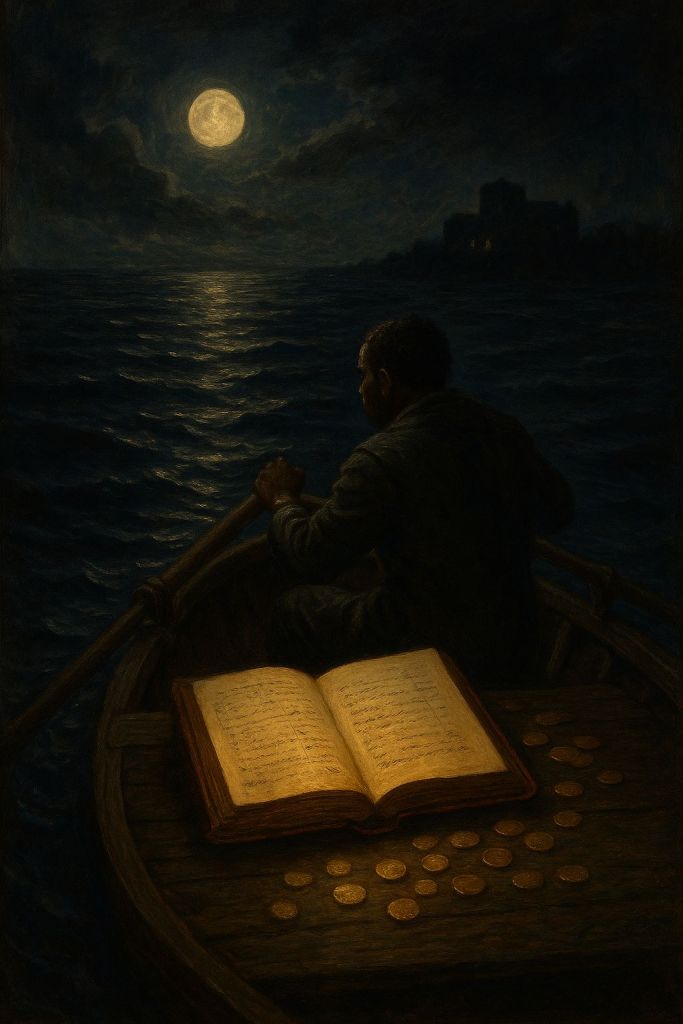
The sea at night is a silent ledger — not of coin, but of conscience. In The Ledger and the Sea, an African American figure rows steadily into moonlit waters, his oars dipping with the deliberate rhythm of breath. Before him, illuminated by an unseen hand of light, lies an open ledger flanked by scattered gold coins, each clinking in the mind’s ear like the “coins of worry” from The Ledger of Night.
Rendered in deep indigo and warm gold, the composition makes use of Mnephonics to imprint the symbolic weight of the scene upon the viewer’s memory. Here, the ledger is no mere book — it is the accounting of fears and labors, of debts both real and imagined. The coins are the oppisans of the mind, glittering with the false weight of anxiety. The water is the efflux of thought, flowing outward to the horizon, while the distant fortress — the redoubt of the self — waits in shadow for the rower’s arrival.
The figure’s posture is chaste in its resolve, his shoulders set against the tourbillion of imagined debts. There is no flummery in his journey; every movement is functional, born of necessity. The oars in water recall the ancient Stoic discipline of focusing on what is within one’s grasp — an oyez from the body to the mind: row forward.
Light and dark interplay in chiaroscuro fashion, guiding the eye from the open ledger to the steady hands, then out across the silvered path on the water toward the fortress. The composition whispers of Romanticism’s fascination with solitude and the sublime, yet it also holds the Symbolist conviction that objects — a book, a coin, a fort — are never just themselves, but carriers of the soul’s geography.
Ultimately, The Ledger and the Sea invites the viewer to contemplate their own account of fears and labors: Are your coins of worry worth the weight you give them, or can you row past the shore of fear into the redoubt of your own keeping?
© Randolph M. Sydnor
Prints and digital sale of work is available
Email for more information: rsydnor@mnephonics.com
 RMS INSIGHTS ✍🏾