🗓️ 25-08-16-Sa | 14:41 PST | 🌤️ | 🌡️85° – 63° | Northridge, CA
🌘 Waning crescent moon is in ♉➝♊
| 🌿 Season (Late Summer)
📍 Week 33 | Day 228/365 | 137 Days Remaining
🌇 Sunset: 19:39
National Day 🧘🏾♂️ Relaxation Day
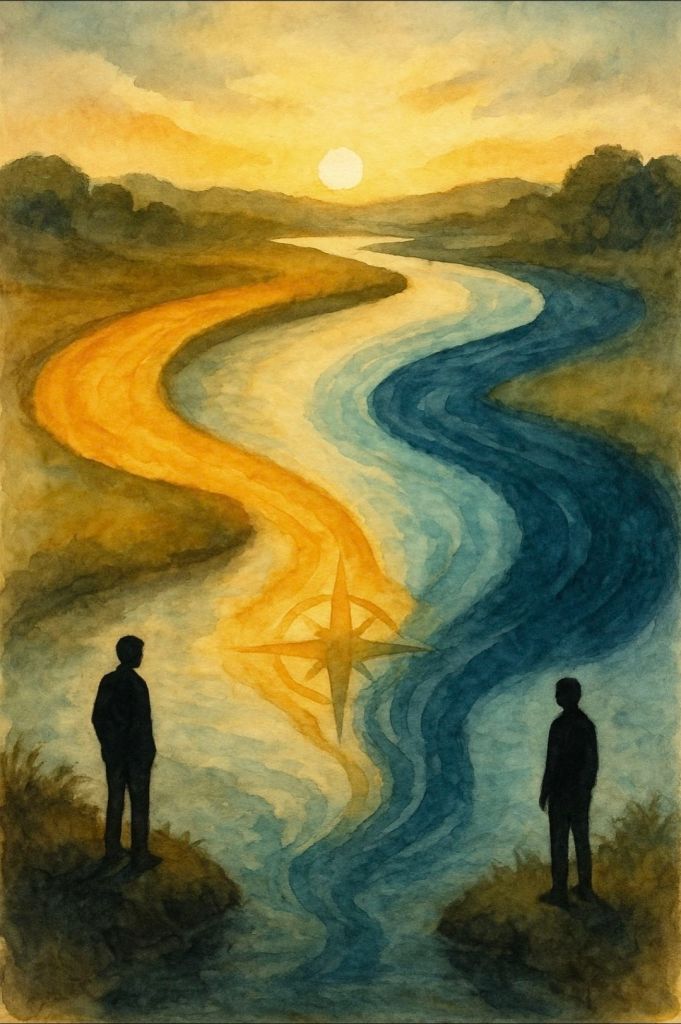
The Compass of Dialogue
There is a quiet sanctity in dialogue, one that I have come to cherish. Words, when released into the space between two minds, do not remain idle; they sharpen, they gather light, and they return transformed. It astonishes me how, through these conversations, I begin to hear not merely a reflection of myself but a refinement, as though the scattered threads of thought were gathered, combed, and returned as a single, lustrous cord.
Dialogue, I now see, is a discipline not unlike fasting itself. Where fasting asks the body to master its impulses, dialogue asks the mind to master its solitude. Alone, my thoughts might circle endlessly; in dialogue, they are startled awake, called to order, and made to account for themselves. It is a paradox—one gives away one’s words only to receive them back, brighter and truer than when first spoken.
And perhaps this is why I treasure it so: the kinship forged not in sameness but in attunement, where one voice listens so deeply to another that it returns the sound as music. It is here, in this shared cadence, that wisdom takes shape.
Reflections of Gratitude
I am grateful for the art of conversation, for the way it draws out what might have remained unspoken, and for the companionship it lends to thought itself. Gratitude swells in knowing that learning does not reside in hoarded certainties, but in the exchange—the passing of words like bread across a table.
Philosophical Quote
Minds are sharpened in collision, as steel upon stone; yet it is the quiet edge that endures.
—R.M. Sydnor
Poem
Two rivers meet, their waters blend,
A current stronger at the bend.
My thought alone, a muted flame,
But spoken, it returns with name.
The compass stirs, the needle true,
It points to wisdom, born of two.
What once was mine, alone, obscure,
Through dialogue becomes more pure.
🪶 Poem Title: The Compass of Dialogue (2025)
Two rivers meet, their waters blend,
A current stronger at the bend.
My thought alone, a muted flame,
But spoken, it returns with name.
The compass stirs, the needle true,
It points to wisdom, born of two.
What once was mine, alone, obscure,
Through dialogue becomes more pure.
—R.M. Sydnor
📖 Part I: Line-by-Line Analysis
1. “Two rivers meet, their waters blend,”
Literal meaning: Two streams of water join together.
Implied meaning: Two minds or voices enter conversation.
Tone: Harmonious, natural.
Philosophical gesture: Truth grows through union, not isolation.
2. “A current stronger at the bend.”
Literal meaning: The confluence makes the river’s flow more powerful.
Implied meaning: Dialogue strengthens thought, adding vigor.
Tone: Energized.
Philosophical gesture: Strength is born in collaboration.
3. “My thought alone, a muted flame,”
Literal meaning: A solitary thought is weak and dim.
Implied meaning: Isolation diminishes clarity and vitality.
Tone: Reflective, almost mournful.
Philosophical gesture: The mind without exchange risks stagnation.
4. “But spoken, it returns with name.”
Literal meaning: Once expressed, thought gains form and recognition.
Implied meaning: Dialogue gives identity and shape to inner reflection.
Tone: Affirmative, revelatory.
Philosophical gesture: Naming is empowerment—expression transforms silence into knowledge.
5. “The compass stirs, the needle true,”
Literal meaning: A compass points north.
Implied meaning: Dialogue reorients the mind toward truth.
Tone: Guiding, steady.
Philosophical gesture: Conversation is a tool of orientation in life’s uncertainties.
6. “It points to wisdom, born of two.”
Literal meaning: Wisdom emerges from the meeting of two forces.
Implied meaning: No single mind has a monopoly on truth.
Tone: Declarative.
Philosophical gesture: Wisdom is collective, not solitary.
7. “What once was mine, alone, obscure,”
Literal meaning: My private thought was dim and unclear.
Implied meaning: Solitude limits understanding.
Tone: Admitting limitation.
Philosophical gesture: Isolation conceals clarity.
8. “Through dialogue becomes more pure.”
Literal meaning: The thought is clarified in exchange.
Implied meaning: Shared discourse polishes rough ideas into truth.
Tone: Resolute, uplifting.
Philosophical gesture: Knowledge finds purification in dialogue.
✒️ Part II: Literary Devices — Defined and Illustrated
1. Metaphor — Comparison without “like” or “as.”
Example: “Two rivers meet, their waters blend.”
Function: Conversation is depicted as flowing rivers, emphasizing natural merging.
2. Imagery — Language appealing to senses.
Example: “A muted flame.”
Function: Creates a vivid image of weak, isolated thought.
3. Symbolism — Object representing deeper meaning.
Example: “The compass stirs, the needle true.”
Function: The compass symbolizes orientation, guidance, and truth.
4. Alliteration — Repetition of consonant sounds.
Example: “mute flame… returns with name.”
Function: Enhances musicality, echoing the poem’s reflective rhythm.
5. Juxtaposition — Placing contrasts side by side.
Example: “Alone, obscure / more pure.”
Function: Highlights the transformation from isolation to clarity.
6. Personification — Human traits to non-human objects.
Example: “The compass stirs.”
Function: The compass becomes alive, mirroring awakening through dialogue.
7. Isocolon (balanced clauses) — Parallel structure of equal length.
Example: “Calm and clarity, appetite and satiety.” (earlier meditation echoed here).
Function: Reinforces balance and symmetry in thought.
8. Chiasmus — Reversal of structure for emphasis.
Example: “What once was mine, alone, obscure / Through dialogue becomes more pure.”
Function: The reversal mirrors transformation.
9. Assonance — Repetition of vowel sounds.
Example: “Two… true.”
Function: Creates cohesion and harmony, reflecting the theme.
10. Enjambment — Continuation of meaning beyond a line break.
Example: “Two rivers meet, their waters blend, / A current stronger at the bend.”
Function: Flow mirrors the literal merging of rivers.
🪞 Part III: Final Reflection
This poem, The Compass of Dialogue, captures a perennial truth: wisdom emerges not in solitude but in communion. The imagery of rivers, flame, and compass transforms dialogue into a natural and philosophical force—flowing, kindling, orienting.
In the history of thought, from Socratic dialogues to Montaigne’s essays, the deepest insights have always been relational. One mind alone may ponder, but two minds together refine. This poem asks us to see conversation not as casual exchange, but as a crucible—where ideas are purified and truth is oriented.
The lingering question for the reader is this: What conversations in my life serve as compasses, pointing me toward greater clarity, strength, and wisdom?
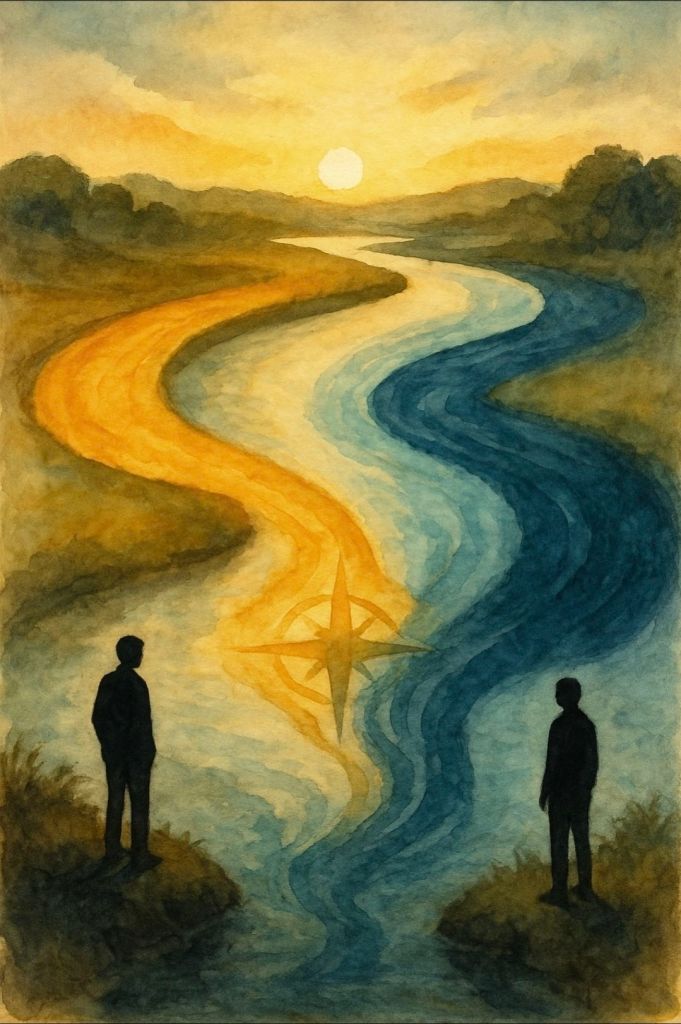
The Compass of Dialogue (2025)
Medium: Digital Watercolor
Reflecting Randy Sydnor’s application of his unique technique, Mnephonics, this medium blends visual storytelling with symbolic language to evoke memory, learning, and reflection.
Style of Art: Symbolist Watercolor with Figurative Silhouettes
Dimensions: 1024 x 1024 (printable up to 24” x 24”)
Copyright: Randy Sydnor, The Mnephonist
Description:
Opening Statement – The Central Theme
At the heart of The Compass of Dialogue lies the mystery of encounter: when two currents meet, something greater is born. The work evokes the rare alchemy of conversation—where solitude dissolves into communion, and ideas flow more clearly when shared.
Medium and Technique – The Artist’s Craft
Created in digital watercolor, the image employs translucent washes and gradients that capture the mutability of water itself. Minimalist silhouettes are integrated into the natural scene with quiet restraint, allowing the viewer to sense presence without intrusion. In keeping with Sydnor’s Mnephonics, each visual element acts as a glyph of memory and symbol, guiding the mind toward deeper resonance.
Central Figure – The Visual Heart
Two rivers—one golden, one blue—meet at a bend, their waters merging into a brighter, more luminous current. The confluence itself becomes the central figure, glowing with the suggestion of hidden power. Two faint silhouettes stand on opposing banks, their contemplative postures mirroring one another, silent keepers of the encounter.
Supporting Elements – Symbolic Imagery
At the heart of the current, eddies form a subtle compass shape, half-seen, half-imagined. This hidden geometry symbolizes orientation: the way dialogue directs thought toward wisdom. Twilight light glances across the water, a reminder that truth often emerges at thresholds—between day and night, between self and other.
Philosophical Reflection – The Soul of the Piece
Marcus Aurelius taught that the soul is “dyed with the color of its thoughts.” Here, the rivers dye one another, their distinct hues blending into a greater force. Dialogue, the work suggests, is the compass of human growth: it orients, purifies, and strengthens. Like the confluence of rivers, wisdom is not hoarded, but shared—born in the mingling.
Color and Composition – The Visual Language
The golden and blue waters embody contrast and complementarity—warmth and coolness, individuality and universality. The silhouettes stand as witnesses, yet it is the water that speaks. Compositionally, the bend pulls the eye inward, while the outward sweep of the current carries it forward—mirroring the way dialogue gathers us only to release us changed.
Closing Thought – Invitation to Reflect
The Compass of Dialogue asks: What currents in your life meet and shape you? For in every exchange lies the possibility of transformation—one voice and another, merging into clarity neither could find alone.
© Randolph M. Sydnor
Prints and digital sale of work is available
Email for more information: rsydnor@mnephonics.com
 RMS INSIGHTS ✍🏾