🗓️ 25-08-16-Sa | 14:00 PST | 🌤️ | 🌡️85° – 63° | Northridge, CA
🌘 Waning crescent moon is in ♉➝♊
| 🌿 Season (Late Summer)
📍 Week 33 | Day 228/365 | 137 Days Remaining
🌇 Sunset: 19:39
National Day 🧘🏾♂️ Relaxation Day
💭 RMS MEDITATIONS
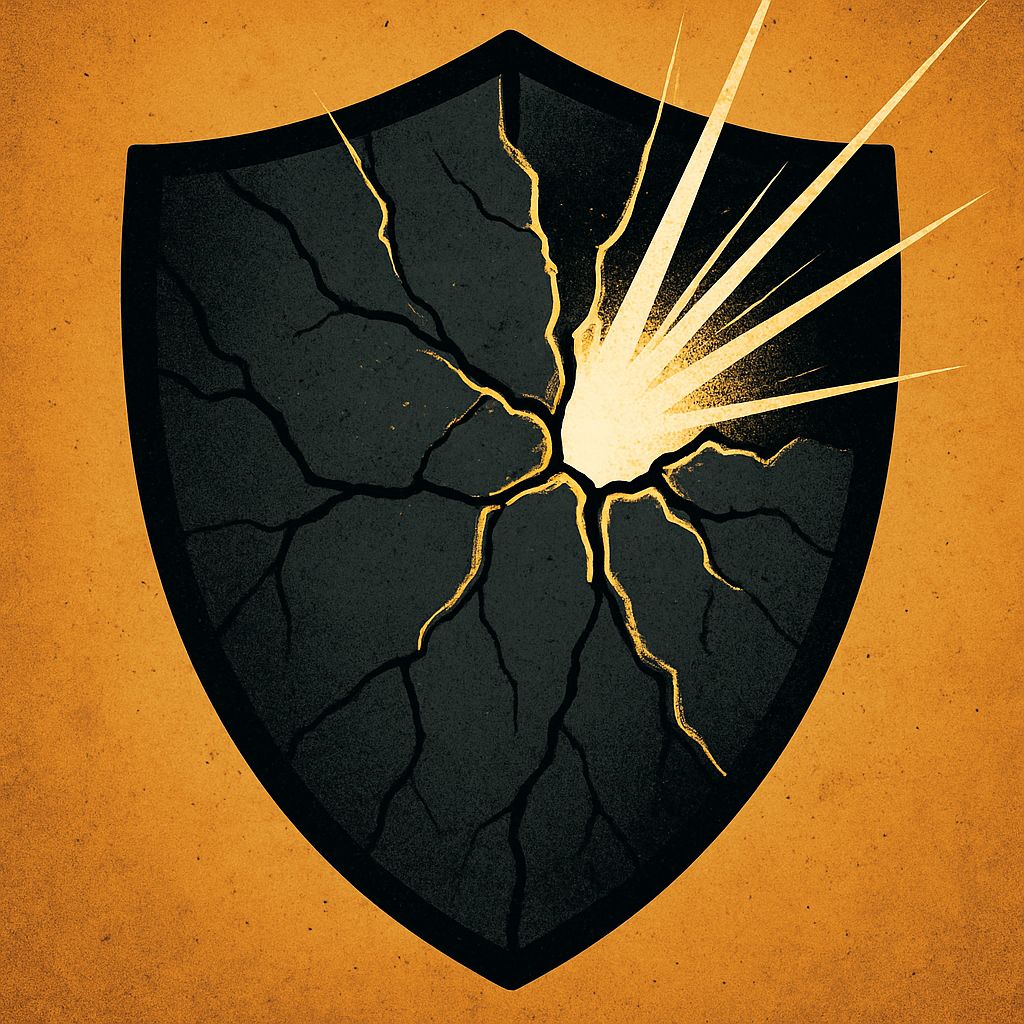
Cracks in the Shield — On Arbitration and Inner Justice
The exchange with Dan lingers in my thoughts. Arbitration, that polished word, has so often been less a bridge to justice than a wall built to shield the powerful. I find myself asking: how many of our human arrangements are like this—polished on the outside, biased within?
Brian Flores stands as the reformer, unwilling to be bought; Jon Gruden, the pragmatist, eager to restore what was lost. Each reveals a different face of struggle—one for principle, the other for return.
And yet beneath it all lies a deeper current. We live in a world where institutions tilt the scales and individuals must decide whether to endure, resist, or retreat. Arbitration becomes a metaphor for life: some of us accept the closed rooms, others demand open courts. The choice, always, is between silence and voice.
What I learn from rumination is not about Flores or Gruden alone, but about myself: where do I accept arrangements too easily, where do I mistake convenience for fairness? Justice in sport may echo justice in the soul. To refuse bias is to insist on truth, even when it comes at a cost.
Reflections of Gratitude
I am grateful for the clarity that comes through texting with a friend of forty years. His words press me to think harder, to strip away illusion.
Gratitude also for the stubborn ones—Flores among them—who remind us that some battles cannot be settled with money, because they are about something larger than the self.
Wisdom’s Lens
“Not everything that is faced can be changed, but nothing can be changed until it is faced.” — James Baldwin
🔎 Baldwin reminds me that the first act of courage is confrontation itself. To face what is unjust, even when change feels beyond reach, is to open the only door through which transformation may pass.
🪶 Poem
Cracks in the Shield
Cracks in the shield,
light seeping through stone,
the quiet voice rising
where silence once reigned.
One man resists,
another restores,
yet both remind me:
truth is the only home
worth fighting for.
— R.M. Sydnor
Cracks in the Shield
Literal frame: A shield is an object meant to protect — solid, unyielding, impervious. A crack signals weakness, exposure, the beginning of failure.
Symbolic weight: The “shield” here stands for entrenched systems of power and silence — institutions, habits, or inner defenses built to conceal truth. The cracks represent vulnerability in these structures, small breaks where honesty, light, or resistance may enter.
Philosophical gesture: The title tells us that even the mightiest barriers of injustice cannot remain whole forever. Cracks are not endings but beginnings — they allow the intrusion of light, the emergence of voice, the possibility of transformation.
🔎 Title explanation
The title suggests that the strongest defenses of falsehood eventually collapse under pressure. Truth enters through cracks, and those fissures are the first signs of justice breaking through.
📖 Part I: Line-by-Line Analysis
Line 1: “Cracks in the shield,”
Literal meaning: A shield has been fractured, no longer whole.
Implied meaning: The protective barriers of power or injustice begin to fail. Cracks are entry points for light, truth, or resistance.
Tone/voice shift: Defiant — the poem begins by naming weakness in what once seemed impenetrable.
Philosophical gesture: Even the strongest structures of oppression eventually erode; justice always finds a way in.
Line 2: “light seeping through stone,”
Literal meaning: Light enters through breaks in stone, soft but persistent.
Implied meaning: Truth and clarity cannot be fully contained; they infiltrate slowly, quietly, inevitably.
Tone/voice shift: Hopeful — light replaces darkness, suggesting renewal.
Philosophical gesture: Truth is subtle but unstoppable, seeping through barriers once thought permanent.
Line 3: “the quiet voice rising”
Literal meaning: A voice once hushed begins to speak.
Implied meaning: Those silenced by injustice are gaining strength, rising with courage.
Tone/voice shift: Intimate and courageous — a whisper that grows into a declaration.
Philosophical gesture: Change begins not in thunder but in whispers; resistance often starts in silence breaking.
Line 4: “where silence once reigned.”
Literal meaning: A place once dominated by silence is now broken.
Implied meaning: Oppression thrived on silence; its rule has been ended by voices daring to rise.
Tone/voice shift: Reflective, almost elegiac.
Philosophical gesture: Silence can govern only until truth finds its tongue.
Line 5: “One man resists,”
Literal meaning: A single figure stands against force.
Implied meaning: Resistance often begins with one courageous individual — Flores in this context, or anyone who chooses principle over comfort.
Tone/voice shift: Admirative, heroic.
Philosophical gesture: Change requires individuals willing to say “no.”
Line 6: “another restores,”
Literal meaning: Another figure repairs or rebuilds what was lost.
Implied meaning: Some fight for reform, others for return — different but equally human aims.
Tone/voice shift: Balanced, inclusive.
Philosophical gesture: Justice wears many faces: one of defiance, one of restoration.
Line 7–9: “yet both remind me: / truth is the only home / worth fighting for.”
Literal meaning: Whether resisting or restoring, both paths point to truth as the ultimate cause.
Implied meaning: Beyond personal battles lies the universal pursuit of truth, which gives every struggle meaning.
Tone/voice shift: Resolute, moral, universal.
Philosophical gesture: Truth transcends roles, motives, and divisions; it is the dwelling place of justice and the worthiest cause for which to struggle.
✒️ Part II: Literary Devices — Defined and Illustrated
1. Metaphor
Definition: An implied comparison between two unlike things.
Example: “Cracks in the shield.”
Function: The shield symbolizes entrenched systems of power; cracks symbolize their vulnerability.
2. Symbolism
Definition: The use of symbols to represent larger ideas.
Example: “light seeping through stone.”
Function: Light symbolizes truth, stone symbolizes oppression.
3. Imagery
Definition: Descriptive language that appeals to the senses.
Example: “the quiet voice rising where silence once reigned.”
Function: Creates a vivid picture of courage growing from silence, engaging the ear and heart.
4. Juxtaposition
Definition: Placing two contrasting ideas side by side.
Example: “One man resists, / another restores.”
Function: Highlights the duality of human response — resistance and restoration — both contributing to justice.
5. Alliteration
Definition: Repetition of consonant sounds at the beginning of nearby words.
Example: “resists… restores.”
Function: Reinforces contrast while binding the two roles rhythmically.
6. Personification
Definition: Giving human qualities to non-human elements.
Example: “silence once reigned.”
Function: Depicts silence as a ruler, dramatizing its oppressive power.
7. Enjambment
Definition: The continuation of a sentence beyond a line break.
Example: “yet both remind me: / truth is the only home / worth fighting for.”
Function: Carries the reader forward, creating momentum toward the moral climax.
8. Isocolon (Bicolon)
Definition: Use of parallel structures of equal length.
Example: “One man resists, / another restores.”
Function: Balances the two opposing yet complementary actions, giving symmetry.
9. Irony (Subtle)
Definition: Expression of meaning by suggesting its opposite or by contrast.
Example: “silence once reigned.”
Function: Irony lies in the fact that silence — the absence of sound — is described as ruling, exposing the absurdity of oppression.
🪞 Part III: Final Reflection
The poem’s heart beats in its tension: cracks in shields, light in stone, silence replaced by voice. It reminds us that justice does not roar fully formed but emerges through fractures, whispers, and courage.
The figures of the reformer and the restorer embody the dual nature of human striving: some tear down, others build up. Both serve truth, and truth alone endures as the only worthy home.
For the reader, the lesson is intimate: where do we accept shields too easily, where do we let silence reign? Baldwin’s reminder that change requires facing what is difficult hovers over this meditation. The poem insists that cracks are not flaws but beginnings, and that our voices, however quiet, may be the first beams of light through the stone.
Perhaps the lingering question is this: What shield in your own life waits to be cracked so that light may enter?
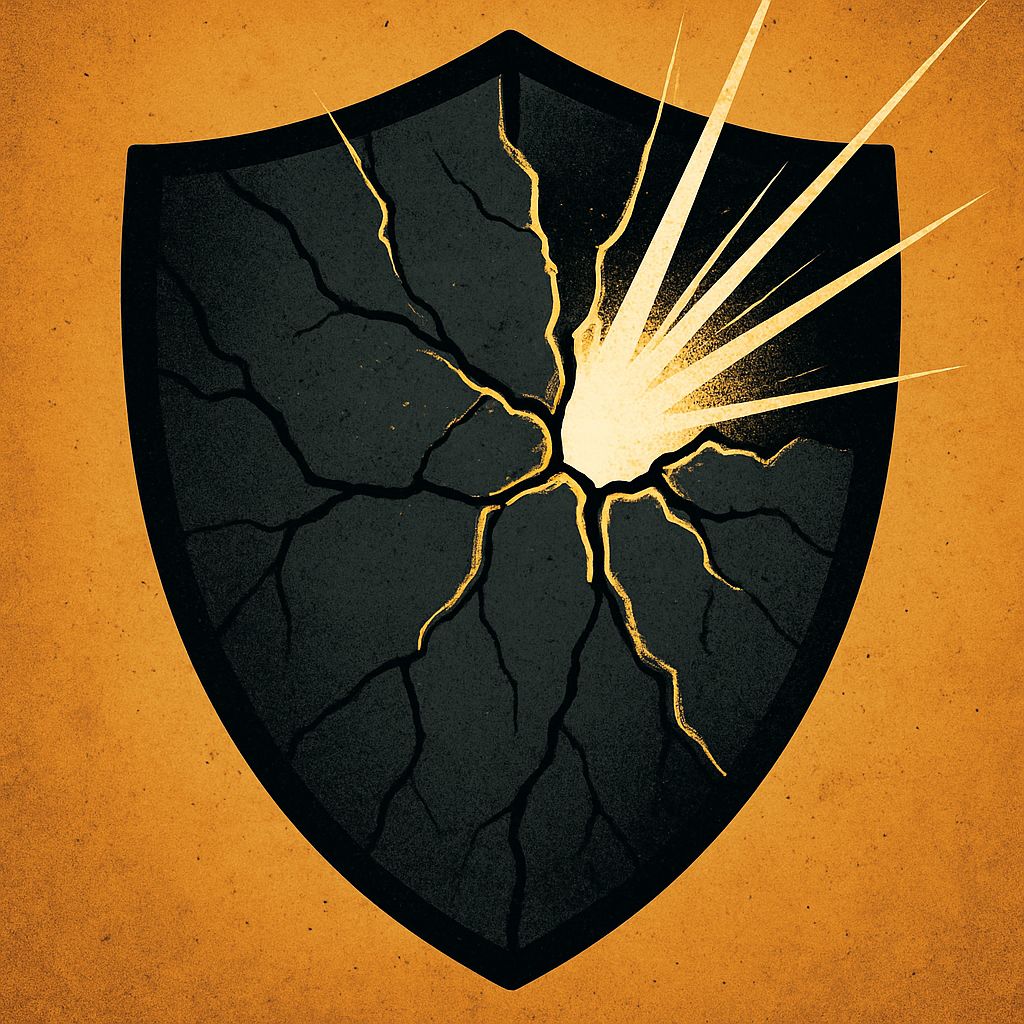
Cracks in the Shield (2025)
Medium: Digital Art
Reflecting Randy Sydnor’s application of his unique technique, Mnephonics, this medium blends visual storytelling with symbolic language to evoke memory, learning, and reflection.
Style of Art: Symbolic Realism with Surrealist Undertones
Dimensions: 1024 x 1024
Copyright: Randy Sydnor, The Mnephonist
Description
Opening Statement — The Central Theme
Every shield, no matter how polished or fortified, eventually bears the testimony of time. Cracks in the Shield reminds us that no structure of silence, no edifice of power, remains impermeable forever. The fissures that emerge are not failures, but invitations—portals where light, truth, and courage enter.
Medium and Technique — The Artist’s Craft
Through digital rendering, the image achieves both sharpness and radiance: fractured metal juxtaposed with streams of luminous gold. This union of breakage and brilliance is amplified by Sydnor’s Mnephonics technique, which turns symbolism into a mnemonic key—an image that teaches as it lingers in memory.
The digital medium sharpens edges, magnifies cracks, and heightens the play of shadow and light, embodying the collision between power’s collapse and truth’s emergence.
Central Figure — The Shield
The shield dominates the composition: ancient, circular, scarred by fractures. It leans forward not as a weapon of defense but as a confession of vulnerability. Light gushes through its wounds, like dawn breaking through a fortress of night. The shield’s surface is etched with faint patterns, suggesting both history and fragility—a palimpsest of battles fought, and of the silence it once enforced.
Supporting Elements — Symbolic Imagery
Around the shield lies stone and shadow, symbols of the walls institutions erect to preserve themselves. Yet the shadows retreat where light escapes, signifying the inevitability of illumination. Each ray is a metaphorical voice, once hushed, now insistent. The imagery suggests the poem’s duality: one figure resisting, another restoring, yet both in service to truth.
Philosophical Reflection — The Soul of the Piece
This work resonates with James Baldwin’s enduring insight: “Nothing can be changed until it is faced.” The shield is the system, the cracks are the act of facing. History reminds us—whether in the fall of empires, the collapse of ideologies, or the persistence of reformers—that cracks are beginnings, not endings. Like Marcus Aurelius observing the cracks in marble or Du Bois tracing fissures in society, Sydnor’s art positions fracture not as ruin, but as revelation.
Color and Composition — The Visual Language
The interplay of dark metallic tones with radiant beams creates chiaroscuro: oppression against revelation, silence against voice. The composition guides the viewer’s eye from fracture to light, insisting that meaning lies in the intersection. The balance of solidity and dissolution gives the piece its meditative weight, a paradox made visual.
Closing Thought — Invitation to Reflect
The shield asks the viewer a personal question: Where in your life are the cracks forming, and will you fear them—or welcome the light they allow to enter?
© Randolph M. Sydnor
Prints and digital sale of work is available
email for more information: rsydnor@mnephonics.com
 RMS INSIGHTS ✍🏾