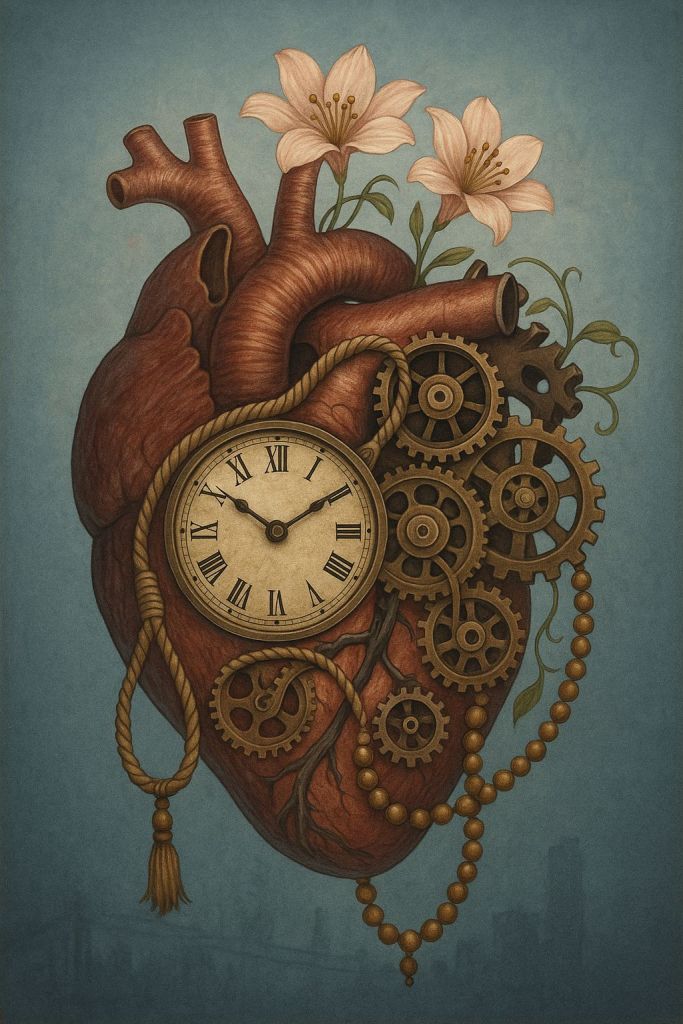
The stairs don’t care who you were. They take the same tax, one rise at a time, a toll in breath and balance. Rashad climbs with the rope looped around his neck like an amen, the plastic handles knocking his chest in a slow, hollow rhythm. The gym’s heat is stingy. Winter presses against the high windows; each pane holds a tender frost that never quite melts.
Samira is waiting near the ring with a tablet that blinks a metronome and a stopwatch. Her scarf is tucked into the collar of her hoodie, the color a quiet plum that makes her look older than nineteen. She taps the screen. The metronome begins its soft clicking, the sound of a patient cricket in the walls.
“Bismillah,” she says.
He lifts the rope and gives it a ceremonial snap. The first turn sings. The second catches a shoe and slaps his ankle. He grimaces and chuckles at the same time. There’s an art to laughing at your own betrayal, to greeting it before it names you.
“Again,” she says.
He nods. Again.
The rope’s arc begins to settle into a figure eight. His breath chases the clicks, never quite on time. It’s not the pain that angers him; pain is honest. It’s the stammering foot, the late hand, the left side that feels like someone else’s stubborn cousin. He corrects posture as if addressing the cousin with respect. Stumble. Reset. Count.
On the far wall the posters fade in layers. Regional belts. Promotions for men long retired or long forgotten. His poster is somewhere under all that, a corner of his name trapped beneath a younger, louder man’s grin. He used to think the ring was a sermon and he was its most convincing preacher. Now he thinks about cadence. He thinks about mercy.
Samira moves when he moves. She does not touch the rope or the rhythm; she touches time. Thirty seconds and she nods. A minute and she lifts her hand. He stops, chest barking. She wipes his forehead, a mothering motion he pretends is purely athletic.
“Heart rate?” she asks.
“Like a man in a hurry.”
“Let it be like a man who knows where he’s going,” she says, and taps a new font. The metronome ticks again.
He loves her for the way she holds him without holding him. She learned the names of each thing that broke and the ways those names might heal. In the hospital, when words slid off his tongue and ran away from his mouth like shy cats, she sat and read the same paragraph aloud until it stayed. The paragraph was about breath. Inhale. Pause. Exhale. The kind of arithmetic even a frightened brain can count.
He thinks about the exhibition in five weeks, the flyer his old coach texted with a string of fire emojis he pretended not to see. Not a fight, just a walk back under the lights. A round of shadowboxing aloud. A minute to nod to the canvas and to the ghost of the man who once strutted there. He told himself he didn’t care if he stumbled. Then he caught himself practicing not to stumble.
“Hands,” Samira says, “quiet.” She taps the screen. “Listen.”
He listens. Rope, air, rope. Click, click. His shoulders soften. His gaze finds a point in the middle distance between the faded posters and the window where the weather changes the glass. He breathes the way she taught him. He misses the old arrogance the way a man misses a bad habit that made him feel interesting. He misses the version of himself who could talk his way through fear. He doesn’t miss the way that man left rooms when people needed him to stay.
Two minutes. She touches the screen as gently as if she were testing an infant’s temperature. He lets the rope fall and doesn’t curse when the handle ricochets off his shin.
“Good,” she says.
“I want great.”
“Then collect good until it becomes great,” she says, and writes something on the tablet in a neat, small hand.
He peels the tape from his right wrist and retapes it, slower this time, coaching his fingers through the small tyranny of fine motor skills. A buddy from the old days comes up the stairs, sees him, tries to bless him with nostalgia. Rashad smiles, the quick smile that says I will not be dragged into that prayer today. The buddy drifts to the heavy bag and begins to wail on it as if it insulted his mother.
Samira catches her father’s eye and crooks a smile: delicate, precise, conspiratorial. He realizes they have private weather now, a climate that lives between them. It isn’t the climate of pity. It is the climate of inventory, of careful gains, of keeping.
—
He used to measure days in bell strikes. He had learned to anchor his temper to rounds, to hide his joy in jabs. The first time he held a regional belt, he slept with it on his chest like a warm animal. He told reporters he was devout because he thought devotion might cut a cleaner silhouette in the photos. The older he got, the truer the words became. That happens sometimes. You lie your way into the truth and then the truth refuses to leave.
He remembers the night before the stroke: a late plate of ribs, the salty pleasure of it, the flame-licked fat like a joke he thought he got away with. He remembers the morning after, the simple act of convincing his left foot that socks open like mouths. In the hospital a young nurse with glitter on her eyelids said he was lucky and he wanted to throw the word across the room. He wasn’t lucky. He was alive, which is different. Luck is the cover a man uses when he’s cheating the numbers. Aliveness is a long arithmetic of breath and food and sleep and surrender.
He remembers a small thing. Not the monitors or the IV. A plastic pitcher with a flimsy lid. The way it squeaked when Samira poured water for him. The patience in the sound. He remembers deciding to live the way a man decides to stop lying to himself. He remembers saying God, and meaning it without show.
—
The routine takes root. The gym becomes a second home to the new hours, the ones that require him to respect the minute hand. He learns to love the hum of fluorescent lights because they keep him from pretending this is a movie. Movies skip weeks with a smash cut and a montage. Fluorescents are stubborn, unromantic witnesses.
Samira’s training log grows like a careful garden. Date. Time. Rope arcs. Footwork drills. Heart rate. Notes. She draws little boxes for days and colors them when he meets them. She prints out the pages every Sunday because paper keeps a promise in a way the cloud does not. She keeps the pages in a slim, black binder, the kind a choir might tuck under an arm. He tries not to watch her hands when she turns the pages. He finds himself watching anyway.
They fight, because they are alive. He salts the eggs and she lowers her brow like a gate. He says he doesn’t need help down the stairs and she says she’s not offering help, she’s offering company. He says he’ll never be pitied and she says she’s not a fool. He curses once when the rope trips his ankle for the seventh time in a minute and her mouth flickers, the smallest flinch. That night he stands in the kitchen and whispers an apology into the sink. In the morning he finds the metronome app already open on the tablet. She has named the file: Father’s breath.
They train through small winters. He learns to tap his chest where a glitch of rhythm sometimes winks, a warning blink his cardiologist calls benign but important. He learns to treat the warning as he used to treat a feint: not panic, but respect. He learns to tie his left shoe with his left hand again, slowly, then quickly, then without looking. He shows no one the small fist-pump he gives himself the first time the loop of the lace locks on the first pass.
His friends drift in and out of the gym like weather. Some pretend nothing happened. Some turn his story into a parable about grit, which makes him tired. Grit is a seasoning. It is not a meal. He prefers the company of the tired men who never stopped coming here, who learned their limits and made furniture out of them. He likes the way they nod at him, the way they refuse to narrate his life for him.
“Shadow,” Samira says, and he steps into the ring the way he once stepped into a late-afternoon room when he was young and handsome and pretended to be bored by his own reflection. The canvas meets the sole of his shoe like a question. He taps his chest once, twice, then forgets himself and begins to move. The small pop of glove on glove. The old muscle memory takes his arm in its mouth and tries to run. He lets it tug and then he calls it back. The metronome’s click is low, steady, the hinge that keeps the door from swinging free.
He tells himself he will not touch a moving bag yet because the bag does not love you back and cannot tell when you are being foolish. He tells himself this and then one day he places a hand on the bag just to feel its friendly weight, the false promise that it will never hit you. He leans his head against the leather. There is a smell in its seams like rain, like history.
“Dad.” Samira’s voice. “We’re not dating the bag.”
“I’m just saying hello.”
“Say hello and walk away.”
“I can walk away from anything,” he says, and then he walks away to prove it, and then he grimaces because proving a thing is often a sign you still doubt it.
—
The day comes when Coach K insists on a light round of controlled sparring. K is a small, square man with the implacable patience of a mechanic and the eyes of a librarian. He sets rules in a bored tone: one minute. Touch, don’t test. Pull your power. No bravado. K glances at Samira. She lifts a shoulder. Her eyes say I trust him more than I fear the risk.
Rashad’s sparring partner is a twenty-four-year-old with long arms and a kind soul who tries too hard to look unserious. They tap gloves. The bell snaps the air into a shape. Rashad steps and his body lags a beat behind, a ghost of time that refuses to close. The young man flicks a jab like someone trying to shoo a moth. Rashad parries late, heat rising under his skin, and the embarrassment tastes like pennies. He wants to be angry at the kid for being kind, and then he catches himself: pride, the old thief, sneaking in with a fake ID.
Half a minute. The rhythm finds his feet the way a stream finds its banks after a storm. He can feel it assembling: breath, knee, shoulder, fist, unison. He moves his head because he remembers what stillness costs. Perhaps the kid sees the old music catch for a second and offers a real punch in respect. It lands. Not hard, but honest. Rashad steps back and the ring tilts five degrees. He swallows. He looks at Samira.
Her hand lifts, palm open, not a stop but a here. She is counting under her breath. He can read the count in the flex of her thumb. That, more than the number, steadies him. He nods. He taps his glove to his chest once and steps in again. The last ten seconds gather like a small choir. The bell rings. The minute ends. He stops.
The kid hugs him without asking permission. K clears his throat in a way that says he approves and also that everyone should pretend he doesn’t. Samira’s palm lands on her father’s sternum and he does not cry, which in this moment feels like a small injustice. The body chooses its ceremonies and sometimes your face is not invited.
Shoelace. He kneels to tie it. The loop holds on the first pass. He grins at the stripe of tape stuck to his forearm and feels suddenly enormous for no good reason at all.
—
The exhibition arrives in February when the light in Detroit is lean and the air punishes vanity. The gym packs for the fundraiser. Men in coats that remember better winters. Women with laughter that masks long workdays. Kids whose eyes sprint. Local radio sets up a shaky banner and a microphone that pops every third word. Coach K looks almost festive; the corners of his mouth keep attempting a smile and failing, as if the muscles forgot the move and need a refresher course.
There is a refreshment table with cookies baked by someone who understands the thirst of a crowd. There are paper cups, the generous kind. Samira is not wearing her hoodie; she is wearing a plain black sweater that makes her look like a conductor who will accept no excuses from the brass section. She has her binder. The binder is calmer than anyone in the room.
When Rashad’s name is read, the room makes a sound that is less like applause and more like a held breath easing. He steps between the ropes the way a man steps onto a porch he built himself. The canvas feels the same as ever: a little cruel, a little forgiving. The lights are warmer than he remembered. He taps the nearest turnbuckle, an old habit with no theology. He shadows. The count in his ears is not the clock; it is the sound of his daughter’s thumb ticking through a line only she can see.
He stumbles once, only enough to remind the floor that he respects it. He moves through the pattern they built: head, hand, hand, small step, breath. It is a choreography of lowered expectations that turns, half a minute in, into something far less embarrassed. He hears a man call his name the way men call to old friends across a street. The minute clicks shut. He bows to the canvas as if it were an elder in a doorway and steps out. There is no speech. He has made enough speeches in his life that said less than this minute says.
Outside, the snow is beginning, the fine kind that writes in cursive on car hoods. Samira threads her arm through his. The cold instructs his lungs. He obeys.
—
He wakes in the night to the sound of the radiator ticking like a cautious metronome. Down the hall, a soft light leaks from the kitchen where Samira keeps her schoolwork and her training things. He gets up and walks slowly past the mirror, pauses, then goes back. He watches his own face in the patient light, the lines revisioned by winter. He mouths words to test clarity. They hold.
On the table is the binder. He opens it as if it might startle. Inside, rows of dates and tiny graphs. The days of failure are not erased; they are circled. The wins are ordinary, which is to say abundant. At the back there is a page where she has written a single heading in small letters and underlined it twice, a scientist’s mercy for a boxer’s vow. He traces the underline with his thumb. He says the heading aloud before the mirror, the name for lives that keep flowering, and feels his breath catch the count: iteroparous.
 RMS INSIGHTS ✍🏾