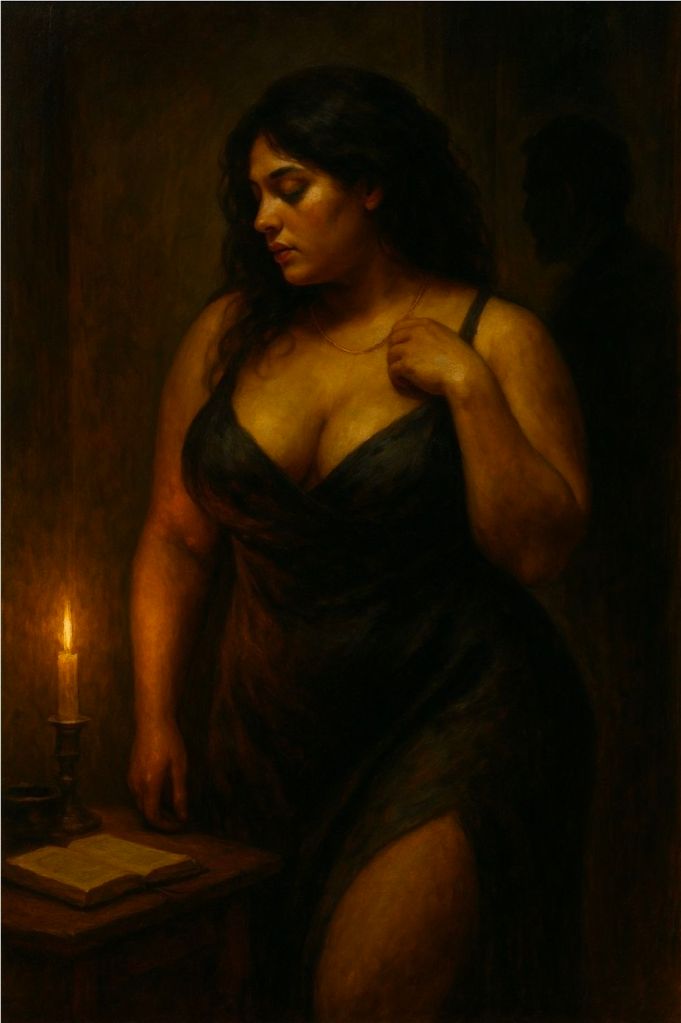
The Apostles of Figueroa
He told people he was looking for her.
That was easier than saying he’d been ruined by her silhouette alone.
Name’s Avery Saroyan. Forty-six. Freelance sleuth, part-time romantic. Full-time coward when it came to anything divine. He hadn’t seen her in six weeks. Not since that Thursday when she’d walked barefoot through his doorway, humming a Baptist hymn that didn’t belong in her hips. Her name—if you trusted what she whispered—was Lorena.
She was, in a word, impossible.
Impossible the way certain jazz notes are—that high wail that breaks your ribs and smiles doing it. She was chest-forward and gospel-shaped, a woman made of crescendos. Her bosom rose like a sculpture under linen, the kind Michelangelo would’ve sinned to carve. Her backside wasn’t round—it was ripe, a fruit gravity dared not bruise.
But the real story was the walk—that holy cadence of hip and hush, hips that moved not in invitation, but in absolute control of space. Wherever she went, time forgot to tick.
Avery said he’d been hired to find her. What he meant was: he was trying to re-enter the room she left behind.
He started at Café Figaro, a tired corner haunt off 5th—red leather booths, clinking spoons, fogged windows that never cleared. They’d once argued there about Sartre, she sipping horchata spiked with mezcal.
Now, the same waitress still worked the counter.
“You look for her,” she said, sliding him a bitter coffee, “but she’s not lost. You are. She told me once—‘Avery doesn’t love women. He loves ache dressed in a woman’s dress.’”
He laughed, too tightly. “Did she say where she went?”
The waitress shook her head. “Only said she had to unbutton the parts of herself she kept covered too long.”
At a botanica on 7th, he met a woman with pale gold teeth who read cards and burned amber.
“She bought three red candles,” the woman said. “And left this behind.”
Avery opened the envelope she offered. Inside, a page torn from Song of Songs. Scrawled in Lorena’s hand:
“Let him kiss me with the kisses of his mouth—for your love is better than wine.”
Underneath: Stop looking for me in scripture. I’m in your skin.
The last place he checked was the rooftop of a Koreatown building where they once danced barefoot to Sam Cooke.
He stood there now, the city below him loud with strangers. The air smelled of asphalt and hibiscus. And for a moment, he swore he felt her.
Lorena was never sweet. She was sensuality sharpened to a point. Her skin bore the glow of cinnamon and sunlit honey. Her laugh ended in a throat tremor. When she drank, she let a single drop of wine fall from her lower lip to her collarbone, just to watch him shudder.
Once, she whispered against his ear:
“You think wanting me is the same as knowing me. But want’s not knowing—it’s worship with the lights off.”
Then she rolled over, pulled the sheets tight, and slept like someone who feared no ghosts.
At a storefront church off Figueroa and 11th, he encountered an old man sweeping cigarette butts off the steps.
“She came here once,” the man said. “Sat in the back. Stayed through the sermon and most of the silence.”
“Did she say anything?”
“No,” the man said. “But I’ve been alive long enough to know this: Some women aren’t running. They’re letting men walk in circles ‘til they realize they were chasing themselves.”
Back home, he lay on the floor. No lights. Just the weight of everything she wasn’t and everything he had mistaken for her.
He played the memories like a record:
Her perfume: cardamom, rose, and forgiveness withheld.
Her touch: not gentle, not rough—just earned.
Her silence: always placed with intention, like incense in a cathedral.
And her walk.
Always, the walk.
The hips—poetry without punctuation.
He found a photo of her tucked in an old book—her eyes half-lidded, her lips parted, her hand on her own chest. Not for him. For herself.
She had never belonged to him.
He hadn’t been trying to find her.
He had been trying to locate the last place where he could still pretend he wasn’t possessed.
And now, the surrender. Quiet. Complete.
What he was after, all along, was permission.
To ache. To hunger. To stop cloaking desire in doctrine. To admit that his entire life had been a negotiation with one trembling word: Concupiscence.
Concupiscence is not simply lust—it is desire stripped of shame, devotion ungoverned. It is the holy ache to possess and be possessed, and the terror of admitting that we were designed to long. We do not chase the beloved. We chase the part of ourselves that trembles in her presence.
Randy Sydnor
 RMS INSIGHTS ✍🏾