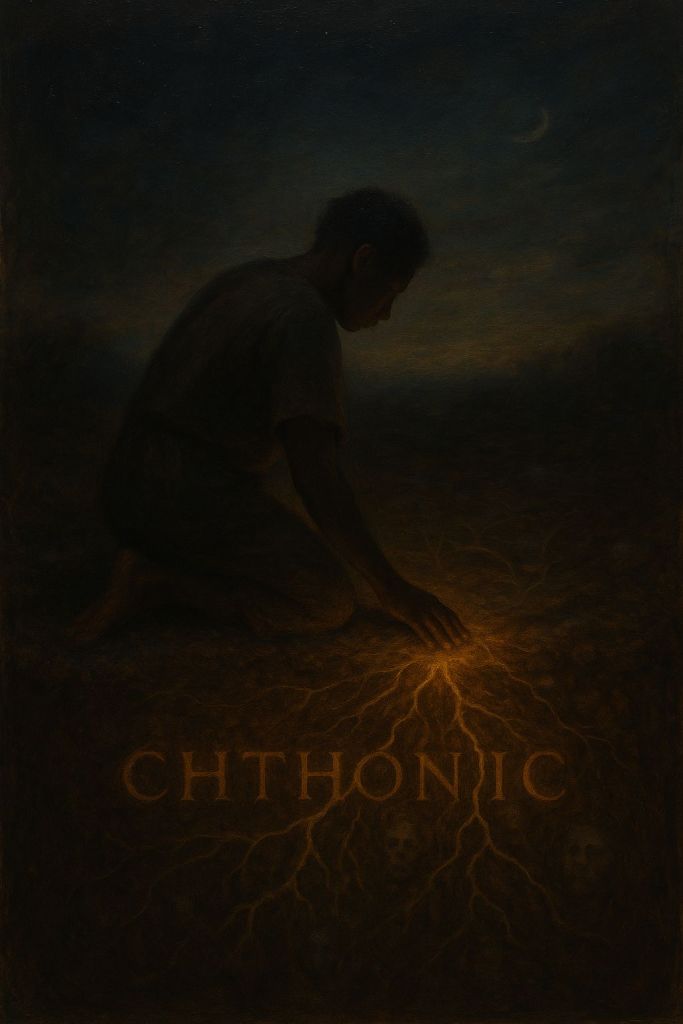
chthonic
adjective
IPA Pronunciation
/ˈθɑː.nɪk/ or /ˈkθɒ.nɪk/
American Pronunciation Key
THAH-nik or KTHAH-nik
Spelling Prompt (Mnephonics Spelling Integration)
Break it down like this — CHTHO–NIC.
Think of CAT, THORN, and NICK — three unlikely allies whispering from the dark. (Note: the CH and the THO distinctiveness.)
🔎 Picture this: when the cat claws at the thorn under the floorboards and leaves a nick in the stone, you’ve entered the CHTHONIC realm — the hidden, the buried, the sacred below.
Definition
Chthonic refers to that which dwells beneath the earth — gods, forces, or instincts belonging to the underworld or rooted in the primal soil.
It also describes powers unseen yet foundational: the elemental, the ancestral, the deep pulse beneath appearance.
Etymology
From Greek khthonios (χθόνιος), “of the earth,” from khthōn (χθών), meaning “ground” or “earth.”
In ancient Greece, chthonic deities were not demonic but vital — embodiments of fertility, decay, and renewal. They ruled what sprouted and what returned to dust. Over time, chthonic came to describe all that is mysterious, subterranean, or psychologically hidden — the shadow-side of divinity and the self alike.
eStory
In the oldest myths, a farmer tilled his field and offered the first grain to the gods above. One night, the ground answered back — a voice rising from the soil, older than Olympus. It told him that what grows upward owes its life to what lies below.
He knelt, trembling, and pressed his ear to the earth, hearing both heartbeat and hunger. From that moment, he prayed not only to the sky but to the soil itself.
🔎 The story captures the chthonic spirit: reverence for what lies beneath, the unseen root that nourishes every visible bloom.
Literal Use
The priestess whispered an invocation to the chthonic gods before lighting the torch.
🔎 Ancient rituals often began with invocations to deities of the underworld.
Archaeologists uncovered a temple devoted to chthonic spirits near the ruins of Eleusis.
🔎 The Eleusinian Mysteries honored Demeter and Persephone — both chthonic figures.
Volcanic gases escaped from a fissure once thought to be a chthonic breath from Hades.
🔎 Early science often attributed natural phenomena to underworld powers.
In sculpture, the serpent often symbolizes chthonic power — renewal through decay.
🔎 Serpents, being earth-dwellers, became emblems of underworld life.
Modern pagan rites still honor chthonic energies as sacred, not sinister.
🔎 Neo-paganism reclaims earthbound divinity as a spiritual balance.
Figurative Definition
Chthonic describes the deep, instinctual layers of mind and memory — the unseen psychic soil from which consciousness grows.
Figurative Use
Carl Jung spoke of the chthonic feminine as the primal, fertile unconscious.
🔎 Jung’s archetypes often drew upon Greek myth.
When Nina Simone performed, her voice carried chthonic power — beauty born of struggle.
🔎 Her music felt like a lament rising from ancestral depths.
The novelist mined his chthonic fears to shape characters who felt terrifyingly real.
🔎 Writers often turn inward to their psychological underworld.
Rituals of grief have chthonic resonance — grounding sorrow in ceremony.
🔎 Burial rites echo ancient gestures to the earth.
Every revolution begins as a chthonic stirring in the collective soul.
🔎 Change erupts from what society has long buried.
Jazz itself is chthonic: improvised, unpredictable, rooted in human pulse.
🔎 The genre channels emotion from beneath surface control.
A sculptor said his marble spoke in chthonic tones, the language of time and pressure.
🔎 Stone remembers the planet’s oldest movements.
Certain poems feel chthonic — born not written, as if unearthed.
🔎 Deep poetry sounds as if it rose through centuries of silence.
The cathedral’s crypts retain a chthonic sanctity — stillness beneath grandeur.
🔎 The sacred often begins below.
Even technology has its chthonic element: invisible code shaping visible worlds.
🔎 The digital underground mirrors the mythic one.
Contemporary Application
Toni Morrison’s Beloved is a chthonic masterpiece — a ghost story about history’s buried traumas.
🔎 Morrison reveals the haunted depths of American memory through myth and realism.
The debate over AI consciousness has taken a chthonic turn, exploring the dark intelligence beneath algorithms.
🔎 Philosophers now ponder whether technology can host its own underworld of awareness.
🐘 Mnephonics Hook
Picture a cave mouth at dusk — the air thick with moss and whispers. The scent of iron soil clings to your hands. Beneath your feet, a pulse throbs — steady, ancient, alive. You sense that the ground is not still but breathing, and in that breath you hear your ancestors hum. That breath is CHTHONIC — the earth remembering itself through you.
🎤 Word + Rap
From the depth to the dawn, I rise chthonic,
Soul in the soil, spirit symphonic.
Buried truth talks, roots whisper sonic —Power in the dark, baby, that’s chthonic.
🏛️ Wisdom’s Lens
Heraclitus: “The unseen design is mightier than the seen.”
🔎 The philosopher’s insight mirrors the chthonic truth — that what governs life is often invisible, yet inescapably real.
🌅 Closing Meditation
To honor the chthonic is to remember that every ascent begins with descent — and every light depends on its shadow.
🔎 True strength comes from knowing the soil beneath your soul.
 RMS INSIGHTS ✍🏾