Borrowing Courage from the Sun
The mornings had grown quieter over the years, though not emptier. Silence, Adeline Carter had come to believe, was a kind of company. It had weight, texture, even rhythm — the way air paused between one heartbeat and the next. She sat at the edge of her bed in that quiet hour before sunrise, her long hair, streaked now with silver, falling forward over her shoulders like the threads of a pale curtain.
On her nightstand lay the small rectangle of devotion that connected her to another world — her phone, facedown beside her reading glasses and a mug faintly perfumed with tea. She reached for it and tapped the screen. The voice that filled the room was light, young, and still searching for melody.
“Hey, Grandmama,” Naomi said, a touch of shy laughter at the edge of her breath. “Here’s my poem for today.”
There was a rustle, the sound of a page being adjusted, and then the words came in a steady, deliberate rhythm, as if the child were learning to match the beat of her own heart.
“The dark before morning
feels like the world holding breath.
I open my eyes
and borrow a little courage
from the sun.”
A brief pause followed, then Naomi’s whisper — tender, conspiratorial.
“Okay. I love you. Bye.”
The message ended, but the warmth lingered. Adeline set the phone down gently, both palms folded around her tea. The room still smelled faintly of sandalwood and laundry soap, of paper and pencil shavings — the familiar fragrance of a teacher’s life distilled into domestic form. Outside her window, dawn had begun to test its colors: the faint blue of hesitation, the pale pink of intention, the slow gold of promise.
She sat still for a while, listening to the distant sound of a bus engine and the whisper of wind moving through the trees. There was peace in the knowing that every morning began with words — hers, someone else’s, it didn’t matter. Poetry was how she measured the pulse of the world.
When she rose, her knees reminded her of the years. They clicked faintly, like polite applause. She smiled at the sound, as if the body itself were affirming her persistence. In the bathroom mirror, her reflection appeared both familiar and strange: the lines beside her eyes, earned from decades of laughter and squinting at chalkboards; the long blonde hair that caught light even on dim mornings; the soft folds of skin at her neck, evidence of a life fully inhabited. She had once been told she was pretty, but she had never believed it. Pretty was for display; she had chosen purpose. What she carried now was something quieter — the kind of beauty that patience bestows.
By habit, she dressed neatly: a cream-colored blouse, dark slacks, a silk ribbon to tie her hair, the small pearl earrings Claire had given her one Christmas when money was thin but love was plentiful. The ensemble wasn’t fashion; it was composure made visible.
Her breakfast was humble — oatmeal with blueberries, a drizzle of honey, and one more mug of tea. She ate standing by the window, gazing at the photo magneted to her refrigerator door. Three generations stared back at her: herself in soft focus, hand resting lightly on her daughter’s shoulder; Claire, poised, forty-three, an architect with a gaze both tender and exacting; and little Naomi, ten, in front, laughing mid-motion, her braids lifting as though in defiance of gravity. The sight filled Adeline with a kind of gratitude that didn’t need words — a gratitude that simply breathed.
After rinsing her bowl, she set it upside down on the drying rack, a ritual of small closure. Then she reached for her worn leather bag, the one softened by years of papers, pencils, and afterthoughts, and slipped Naomi’s voice into her memory like a bookmark she could return to later.
Outside, the morning air met her with that cool, forgiving touch that belongs only to early hours. The neighborhood stirred — a dog barked, a newspaper hit a driveway, someone’s radio murmured gospel faintly through a window. Jefferson Elementary stood three blocks away, modest, sturdy, unpretentious, its brick walls warmed by decades of children’s laughter.
She preferred to walk. The world revealed itself more honestly at walking speed. On the corner, she passed a boy waiting for the bus, backpack slung like a question mark across his shoulder. He looked up, and she nodded. His wave was shy but certain — a small reminder that recognition, too, was a form of love.
The crossing guard lifted a hand in his usual salute. “Morning, Mrs. C.”
“Morning, Joel,” she replied. “Another day to learn how to listen.”
He chuckled, unsure whether she meant it as philosophy or humor, and she smiled, letting him keep the mystery.
By the time she reached the school gates, the sun had climbed past hesitation and begun its steady ascent into certainty. She stood a moment before entering, watching the building breathe children through its doors — laughter, chatter, motion. The scent of pencil lead and cafeteria toast drifted into the air, oddly comforting.
Inside, the hallways pulsed with life — the sound of sneakers on tile, lockers opening with metallic sighs, announcements crackling from unseen speakers. She walked through it all like a conductor moving through an orchestra already in motion, her pace unhurried, her expression calm. Teachers nodded. Students called her name.
“Hi, Mrs. Carter!”
“Morning, Mrs. C!”
Each greeting was a small spark of belonging.
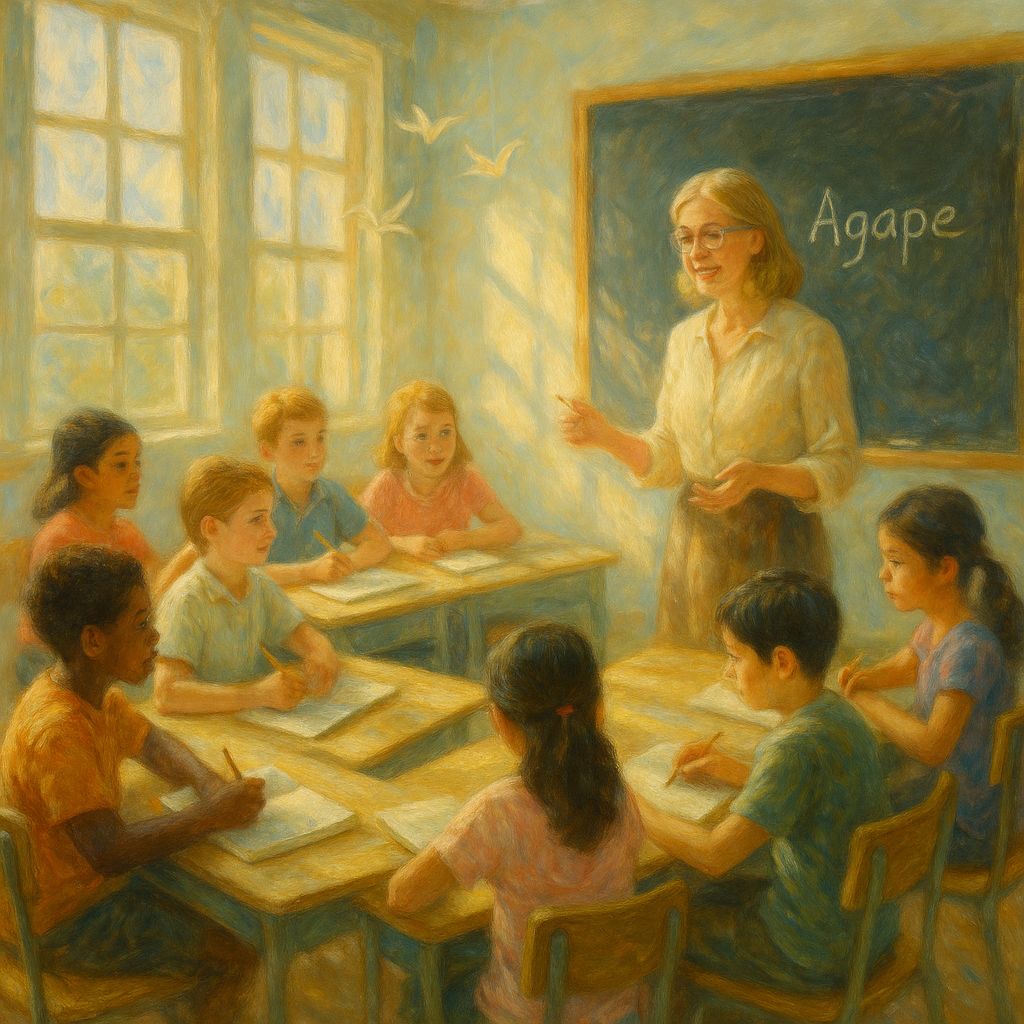
Room 104 waited at the far end of the corridor — her kingdom of paper, light, and small awakenings. The door opened with its familiar creak. She paused at the threshold, taking in the sight she loved: the cranes hanging from the ceiling, folded from poems past; the wall of haikus written in children’s uneven handwriting; the sunlight slicing through the blinds in slender ribbons that fell across the desks. Every object in that room had known her patience.
She set her bag on the desk and turned on the small speaker that lived beside the globe. A slow jazz piano wandered into the air, its notes deliberate, its silences generous. She walked to the board, selected a stick of fresh white chalk, and wrote a single word across the dark green surface in her elegant, looping script.
AGAPE.
She stepped back, letting the chalk settle into its own stillness. The word looked both ancient and new, like something the light itself had chosen to illuminate.
When the bell rang, the room filled quickly — chairs scraping, laughter spilling, the small gravity of twenty-four young lives in motion. She greeted each child by name, one of her quiet vows since her first year of teaching. Names, she believed, were sacred poems.
When the last seat was filled and the restless energy had begun to settle, she stood before them with that gentle authority that came from years of repetition made holy.
“Good morning, poets.”
“Good morning, Mrs. C,” they chorused.
“Today,” she said, turning toward the board, “we will learn a word that does not end when you stop saying it.”
They leaned forward, curiosity flickering like light across their faces.
Diego squinted. “A… gape? Like when your mouth’s open?”
Laughter broke out. Adeline joined in. “Yes, Diego, that’s one meaning. But words, like people, often carry more than one story.” She underlined the word slowly. “This one comes from Greek — agape. Say it with me.”
“Ah-GAH-pay,” they echoed, the sound unpolished but earnest.
“Good. It means love — not the easy kind, not the one that expects reward. It means love that keeps giving even when no one is watching. Love that shows up. Love that endures.”
The laughter faded into thoughtfulness. Maya tapped her pencil against her desk. Leila whispered the word to herself, tasting it. Kenji nodded slightly, eyes fixed on the board as though memorizing not just the spelling but the idea.
Adeline smiled. “I want each of you to think of a moment when someone showed you that kind of love. It doesn’t have to be grand. Often, the truest love hides in ordinary things.”
She moved among the desks as they began to write, the whisper of pencils rising like the hush of rain. Her gaze drifted across the words forming in front of her — fragments of tenderness disguised as simplicity.
A grandmother’s humming while stirring a pot.
A father fixing a broken robot at midnight.
A mother’s hand lighting a candle during a storm.
A friend listening without interrupting.
Adeline felt something shift quietly in her chest — that familiar ache of recognition, the one that came when her students unknowingly mirrored her own life back at her.
She stood at the front again and read the word once more in silence. Agape.
Love that gives and keeps giving.
And for the first time that morning, she wondered if she had taught it or simply lived it.
The Cost of Becoming
That night, long after the children’s laughter had dissolved into the hum of crickets, Adeline sat at her kitchen table surrounded by papers. The room was small, softly lit by a lamp with a frayed shade, the kind of imperfect glow that invited thought rather than distraction. She read their poems one by one, her lips moving silently with each line as though prayer and reading had become the same gesture.
Each child’s world opened on the page like a door left ajar. Maya’s words carried rhythm and sorrow, Diego’s heart beat in grease and pride, Leila’s imagery shimmered with faith, and Kenji’s precision sang of invisible courage. Even Sophie, the quietest, had found music in restraint. Adeline read them slowly, absorbing their small certainties and smaller doubts.
When she reached the last poem, she smiled at the smudge of an eraser mark in the corner. It was not a mistake, only proof that someone had dared to revise. She pressed her fingertips lightly to the paper — her way of saying thank you.
Then, almost by habit, she opened the drawer to her right and found it there: the letter. The cream envelope, its edges worn from being opened too often, still carried the faint smell of office ink. She unfolded it again and let her eyes drift over the words, the language of bureaucracy trying its best to sound kind.
Realignment. Budget adjustments. Retirement option. Gratitude for years of dedicated service.
She traced the letters with her thumb. Gratitude — such a beautiful word, wasted in such a cold sentence. She folded the paper again, placed it beside her tea, and stared at it as though it might apologize.
It didn’t.
Instead, she saw herself in its reflection — the young woman she once was, sitting in a different room, thirty-five years earlier.
The scene returned whole, alive, as if memory had simply been waiting for permission.
She was twenty-eight then, newly divorced, raising Claire alone in a two-bedroom apartment above a laundromat. The air smelled perpetually of detergent and determination. She worked mornings as a substitute teacher and took evening classes at the junior college, chasing the degree that always felt just beyond reach.
There were nights she would sit in the back row of her education seminar, still wearing her classroom cardigan, her hands stained faintly with chalk, her mind balancing lesson plans against grocery lists. The professors talked of pedagogy and philosophy, of Bloom and Vygotsky, while her stomach growled and her heart held steady.
After class, she’d walk home under flickering streetlights, passing the same corner store where the owner saved her day-old bread without asking. Her shoes made a soft rhythm against the cracked sidewalk — the sound of someone rewriting her future one weary step at a time.
Claire, then eight, often stayed with her grandmother on those nights, but sometimes, when money was too thin for babysitters, she’d curl up on the couch beside a stack of graded papers and fall asleep before Adeline returned. One night, Adeline found a note on her pillow in a child’s crooked hand:
When you’re tired, I’ll be your teacher.
She kept that scrap of paper folded in her wallet for decades. Even now, it rested between her driver’s license and an old bus ticket, a relic of endurance.
The kettle whistled softly, pulling her back into the present. She poured another cup of tea and let the steam rise against her face. She thought of Claire now — forty-three, capable, busy, carrying her own quiet fatigue. They spoke often but sometimes too carefully, both women guarding tenderness with the same discipline that had saved them.
She wished she could tell her daughter what she finally understood: that perseverance wasn’t the absence of weariness but the decision to keep moving through it.
A faint vibration broke her thoughts. Her phone lit up. Claire’s name.
“Hi, Mom.”
“Evening, sweetheart.”
“You sound tired.”
“A little. It was a good day, though. We started a new word.”
Claire laughed softly. “Only you would measure days in words.”
“Someone has to keep the dictionary alive.”
“I saw the district email,” Claire said, and the warmth in her tone thinned to concern. “They can’t just do that. You’ve given them your life.”
Adeline smiled at the edge in her daughter’s voice. It was the same tone Claire had used at sixteen, defending her mother to a teacher who’d doubted her grades.
“I’ve given them my love,” she said. “Life was always a loan.”
“That’s not fair.”
“It’s not supposed to be. Fairness is a luxury of the young.”
There was silence on the other end, the kind that holds both worry and admiration.
“Come live with us,” Claire said. “We’ll make space. Naomi would love it.”
“I’m thinking about it,” Adeline answered. “But not yet. I still have work to finish.”
“It’s almost the end of the year.”
“Yes. And it deserves to end beautifully.”
Claire sighed, that long, affectionate exhale that only daughters give. “You never stop turning things into lessons.”
Adeline chuckled. “It’s the only magic I know.”
After they hung up, she sat a while longer, listening to the quiet creak of her home settling into night. The letter remained on the table, but its power had dimmed. She wrote something small on its back, her handwriting steady and deliberate.
Love does not retire.
She folded it and placed it back in the drawer.
The next morning arrived with soft rain. The air smelled of wet soil and renewal. She walked to school beneath her umbrella, feeling the cool drops against her face like punctuation.
In Room 104, the children gathered earlier than usual, some still shaking raindrops from their sleeves. She greeted them each with a nod or a word, her eyes carrying more tenderness than usual.
“Today,” she said, “we are going to listen to silence.”
They laughed at first, unsure if she was teasing.
“I mean it,” she continued, smiling. “Poetry is made of what we don’t say as much as what we do.”
She wrote LISTEN on the board beneath AGAPE.
“Think of someone who showed you love not with words, but with actions. Maybe someone who stood quietly beside you when you needed it most.”
The pencils began again, hesitant at first, then sure.
As they wrote, she saw herself in them — every struggle she’d ever faced distilled into smaller, braver versions. Each child was a mirror of her past and a promise for her future.
When the bell rang, they left behind scraps of paper filled with the unspoken made visible.
After class, she lingered, reading fragments aloud under her breath.
He stayed at the hospital even when I fell asleep.
She held my hand and didn’t let go when I lied.
He fixed the window after the storm, and I didn’t ask.
Her throat tightened. These were not children writing assignments; they were souls learning to translate love.
Weeks passed. Spring deepened. The air warmed, and the cranes hanging from the ceiling turned gently in invisible currents. The word Agape faded slightly on the board, its chalk outline soft but persistent.
The students began using it naturally, as if it had entered their vocabulary of living. Maya used it to describe her aunt’s patience. Diego used it when his father picked him up early from school. Sophie whispered it when she lent Leila her notebook without being asked.
Adeline watched it take root. She could feel it spreading — not just through their words, but through their gestures, their pauses, their sudden, surprising kindness. It was like watching seeds sprout after a long drought.
One afternoon, while the class was dismissed to recess, she stood by the window watching them run through puddles. The laughter, the reckless abandon, the innocence — it struck her that perhaps teaching had always been a form of prayer, and that her classroom, with its cluttered desks and mismatched chairs, was a chapel disguised as a room.
She leaned against the windowsill, listening to their laughter echo down the hallway, and thought again of the letter. Realignment. Gratitude. Retirement. Such sterile words for something so alive.
She whispered into the empty room, “I am not done yet.”
And the rain outside, tapping gently against the glass, seemed to agree.
The Lesson Continues
The final weeks of school arrived with that peculiar mixture of anticipation and sorrow known only to teachers. The children, restless from sunlight and possibility, carried summer in their voices. Adeline, meanwhile, carried time — a quiet awareness of endings pressing softly at her ribs.
She noticed herself watching them differently now: Diego’s unguarded laughter, Sophie’s new confidence, Maya’s instinct to encourage the shy ones. They no longer felt like students; they were echoes she had helped tune to their own pitch. Every gesture, every kindness between them, seemed to whisper the word on the fading board — Agape.
One morning, she entered the room to find the blinds half-drawn and the lights off. She hesitated at the doorway. From somewhere inside, a small voice said, “Wait, Mrs. C!”
The lights flickered on.
The room had been transformed. Colorful paper cranes hung in new constellations from the ceiling. A banner stretched across the chalkboard in bold, uneven letters: THANK YOU FOR TEACHING US AGAPE.
She covered her mouth, startled. The children stood in a semicircle, faces glowing with mischief and pride.
Maya stepped forward, holding a folded sheet. “We wrote something. Together.”
The chatter fell into hush as Maya began to read.
“When words fall down
and love forgets its name,
you taught us to find it again —
in silence, in small things,
in holding the world
as gently as we hold a crayon.”
Her voice trembled. Diego took over.
“You said every poem has breath,
and that means every person does too.
So when we see someone falling apart,
we will hand them a poem
and say, Breathe here.”
Then Sophie, almost whispering:
“You said love doesn’t retire.
So when you go home,
take ours with you.
It’s the homework
we’ll never forget.”
When they finished, the room seemed to exhale. The silence afterward was rich, alive, luminous. Adeline blinked, but the tears insisted. She pressed her hand to her chest, feeling the rhythm of her own heart as if rediscovering it.
“Children,” she managed, voice breaking into softness, “this… this is what teaching feels like when it comes back home.”
Leila stepped forward and placed something small in her palm — a single white chalk stick tied with red thread.
“For next time,” she said.
Adeline smiled through her tears. “There’s always a next time.”
They surrounded her in a loose embrace, the way children do — spontaneous, imperfect, wholehearted. For a moment, she thought of every classroom she had ever taught in: the walls that held her laughter, the boards that carried her handwriting, the hundreds of faces that had come and gone. All of them were here, somehow, folded into this one small, impossible moment.
Then the door opened, and two familiar figures stepped inside.
“Grandmama!”
Naomi’s voice pierced the air like sunlight through clouds. She rushed across the room, hair flying, arms outstretched. Adeline caught her and lifted her with effort and joy, spinning once before setting her down. Behind them, Claire stood in the doorway, watching, her eyes already glistening.
“I didn’t think you’d make it,” Adeline said.
“We wanted to surprise you,” Claire replied. “Naomi insisted we be here on your last day.”
Naomi tugged at her grandmother’s sleeve. “Can I show them my poem?”
The class nodded eagerly. Adeline gestured to the front. “Go ahead, sweetheart.”
Naomi unfolded a small paper and began, voice steady, eyes bright.
“When the sun leaves the window,
it’s not gone — it’s resting.
When the voice stops,
the words still hum
inside someone else.”
When she finished, no one moved. Even the restless ones — Diego, Kenji — sat still, reverent.
Adeline knelt and kissed her granddaughter’s forehead. “You’ve learned the oldest truth, my darling.”
Naomi grinned. “That poems don’t end, they just wait?”
“Exactly.”
Claire came closer, her voice low but firm. “Mom, you’ve done enough for a lifetime.”
Adeline looked around the room — the cranes swaying gently, the children whispering, the chalk dust catching light like fine snow. “No, my love,” she said. “Enough isn’t a word love understands.”
The dismissal bell rang, sharp and sudden, slicing the moment into memory. Backpacks zipped, chairs scraped, farewells tumbled out. One by one they hugged her — awkwardly, earnestly — and left, leaving behind a silence full of wings.
When the last child had gone, Adeline remained standing at the board. The word AGAPE had nearly vanished beneath smudges of learning and time. She picked up the chalk Leila had given her, untied the red thread, and traced the letters again — slowly, carefully, each stroke a benediction.
Claire watched her. In that moment she saw her mother differently — not as someone ending, but as someone complete. The strength she’d once mistaken for sacrifice was, she realized, a form of faith.
Naomi climbed onto a chair beside her grandmother and whispered, “Can I write too?”
“Of course.”
Naomi added a small heart beside the word, the chalk squeaking softly. Then, after a pause, she drew a line under it — steady, deliberate — as if to say: this lesson is still being written.
The three of them stood together before the board — three generations linked by dust, light, and something that did not require speech.
Adeline finally turned off the lights. The room dimmed, but the word on the board glowed faintly, as if refusing to vanish.
Outside, the late afternoon shimmered with warmth. The rain had passed; the world smelled of clean pavement and lilac. They walked home slowly — Naomi skipping ahead, Claire beside her mother, Adeline carrying her bag one last time.
Halfway down the block, Naomi looked back at the school. “Do you miss it already?”
Adeline smiled. “No, sweetheart. It’s still with me. The classroom was just a place; the love was the lesson.”
They reached the corner where the crosswalk hummed under the traffic light. Claire took her mother’s arm. “You taught them everything.”
“Not everything,” Adeline said. “Just how to notice.”
They crossed together, moving through golden light, three shadows overlapping and separating, like verses in the same poem.
At home, as twilight brushed the windows, Adeline sat by her desk and opened her drawer. The retirement letter waited where she had left it. She unfolded it once more, then placed the children’s farewell poem on top of it — one act of love covering another.
She reached for her pen and wrote a single line at the bottom of the page.
What we give is what remains.
Then she placed both pages under the weight of a small stone her students had painted years ago — its surface faded but still legible: Hope.
The evening settled around her, neither loud nor lonely. She brewed tea, lit a candle, and sat beside the window watching the last light yield to dusk. In the distance, the faint laughter of children floated through the open air. She could not tell if it was memory or present, but perhaps that no longer mattered.
Somewhere in another house, Naomi would be writing. Somewhere, a child would whisper a new word. Somewhere, love — the kind that does not retire — would begin again.
 RMS INSIGHTS ✍🏾