The Provocation
Rainer Maria Rilke:
“Be patient toward all that is unsolved in your heart and try to love the questions themselves, like locked rooms and like books that are written in a very foreign tongue. Do not now seek the answers, which cannot be given you because you would not be able to live them.”
Rilke’s appeal is not an invitation to passivity but to moral discipline. He understood that to live a question requires faith in time — a trust that the mind will grow into the space its uncertainty opens. This patience is not inertia; it is apprenticeship. Each unanswered question trains endurance, teaching us to dwell inside ambiguity without panic.
In our age, where opinions arrive faster than understanding, Rilke’s voice sounds almost monastic. To love the questions is to resist the tyranny of immediacy — to choose reflection over reaction. The one who asks patiently begins to inhabit a slower world, one in which meaning unfolds, not explodes.
🔎 Questions are not interruptions to life; they are the steady rhythm by which life reveals itself.
The Turning Point
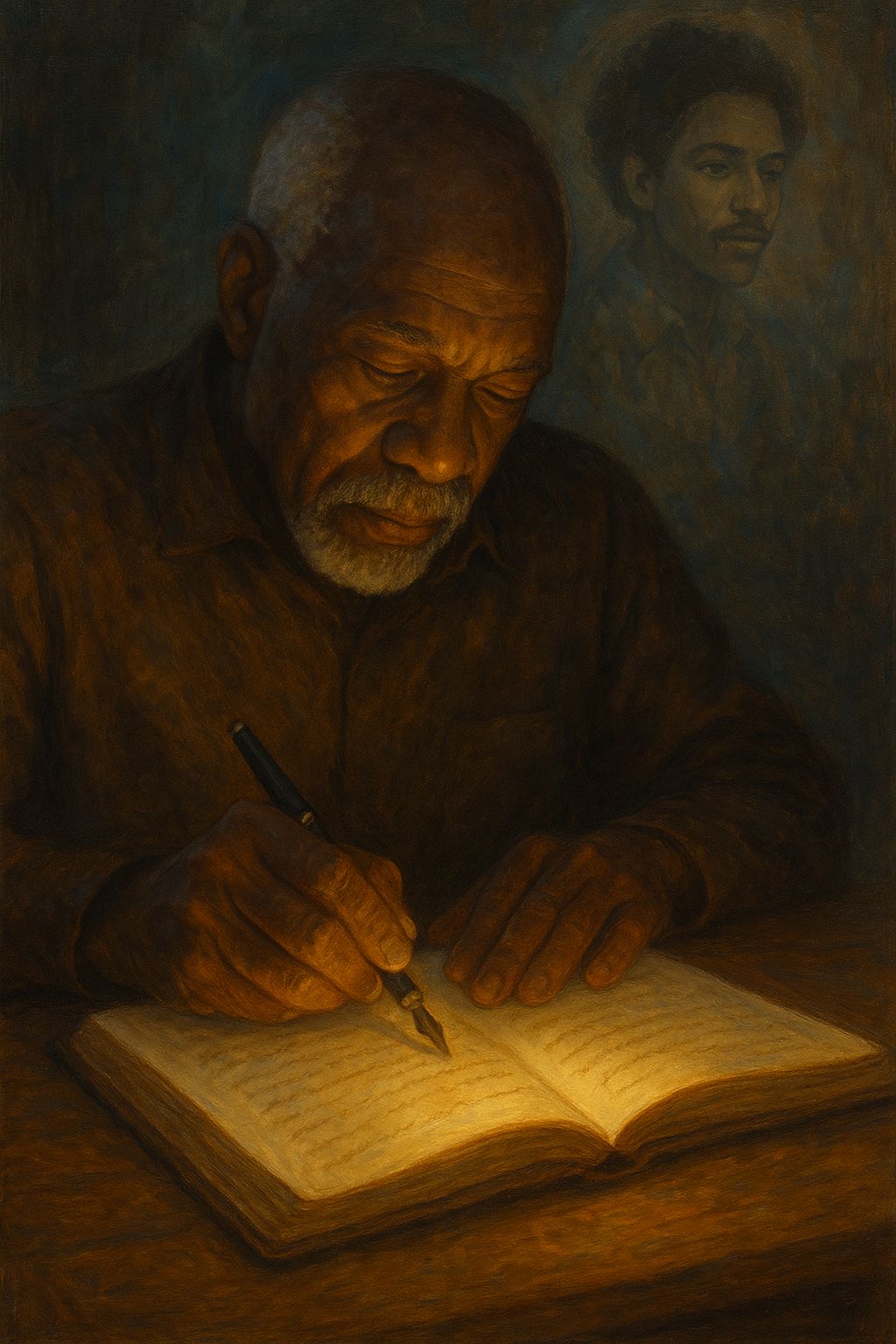
There is a distinct stillness in writing a question by hand. The physical act arrests the restless current of thought. The page, whether paper or screen, becomes a small clearing where the mind slows enough to listen to itself. A question written down becomes visible doubt, and in its visibility lies the beginning of clarity. The diary, then, is not a record of answers but a chamber of echoes, where thought can return to itself and deepen with each revisit.
Can the simple act of writing a question anchor the wandering mind?
🔎 When a question becomes visible, confusion begins to take form — and form is the first gesture of comprehension.
The diary has often been reduced to confession — a vessel for secrets or sentiment. Yet in its highest form, it serves as a laboratory of discernment.
Socrates had no journal, but his life was one long dialogue with ignorance; Montaigne’s essays were self-interrogations disguised as conversation; Leonardo da Vinci filled his notebooks with inquiries that bound art to anatomy, invention to wonder. To record one’s questions is to continue that lineage — the ancient craft of shaping uncertainty into direction.
Why do we treat uncertainty as weakness when it is the beginning of intelligence?
🔎 The refusal to appear unsure is not strength; it is vanity disguised as wisdom.
In an age of ceaseless connectivity, the diary of questions might seem archaic, but technology can become its new parchment. The voice memo, the encrypted note, the fleeting digital whisper — each can carry the spirit of inquiry if used with intention. The question is not whether we write by pen or pixel, but whether we still know how to listen once we have written.
Can the digital mirror reflect the depth once found in the handwritten line?
🔎 A tool becomes sacred only when it serves stillness, not speed.
Every diary of questions requires courage, because questions expose the fragility of our certainty. They humble us. The culture of immediacy rewards conclusion, not contemplation. Yet what is quick rarely transforms. The questions that matter ripen slowly; they need silence, gestation, and return. Each unanswered line is a living seed, awaiting the climate of maturity.
Does wisdom belong to those who find answers, or to those who can wait for them?
🔎 Time is not the enemy of truth — it is its midwife.
Over years, a diary of questions becomes a map of interior growth. Each question marks a turning point in consciousness. The entries once born of confusion reveal patterns of awakening. Questions asked at twenty echo differently at sixty; what once ached for solution becomes gratitude for mystery. To write them down is to confess that thought, like the moon, waxed through inquiry and waned into understanding.
Can we learn to love what remains unsolved within us?
🔎 To live in mystery is not to lose clarity but to expand its horizon.
🤔 Questions of Value
Why does a written question seem wiser than a spoken one?
🔎 Writing slows the hand, and with it the mind; inquiry gathers depth through stillness.
What is lost when curiosity competes with convenience?
🔎 Comfort answers quickly, but wisdom waits to be invited.
Do our devices mirror thought, or merely scatter it?
🔎 Reflection demands enclosure; a mind always connected forgets how to return home.
Can silence become a language of inquiry?
🔎 The truest questions often arrive in the spaces between words.
Does humility, not intelligence, define the thinker?
🔎 To admit uncertainty is the beginning of knowing.
What does it mean to archive wonder in a digital age?
🔎 Each stored question becomes a relic of consciousness — evidence that the soul still searches.
Are we courageous enough to remain students of our own confusion?
🔎 Only the humble dare to keep learning after they have been praised for knowing.
When we answer too quickly, what happens to meaning?
🔎 The speed of resolution often steals the depth of realization.
💭 The Rhetorical Mirror
Example: “Everything you need to know is already online.”
Fallacy: Appeal to Convenience (Reductionism).
This illusion equates access with understanding. It suggests that depth can be downloaded and that curiosity is obsolete. The screen becomes a counterfeit sage — efficient, infinite, and indifferent.
Such thinking hollows the intellect. Knowledge without reflection breeds arrogance; it replaces inquiry with imitation. Algorithms now determine what we should wonder about. We scroll instead of study, skim instead of seek. The digital flood does not drown us with ignorance, but with premature certainty.
Can information replace reflection?
🔎 Data informs; wisdom transforms — and transformation requires time.
What happens to thought when every question expects a link?
🔎 To outsource curiosity is to mortgage the soul of discernment.
Do we mistake access for insight?
🔎 The library and the labyrinth look alike only to the hurried.
Can the human mind rediscover its depth amid abundance?
🔎 Silence remains the only space where information becomes knowledge.
🔎 To recover the diary of questions is to recover the dignity of wondering alone.
🪶 The Distillation
I open the diary—
a quiet mirror of unfinished thoughts.
The ink has thinned with time,
but the questions remain vivid, unafraid.
Each one holds a fragment of light,
a syllable of something infinite.
They do not clamor for answers;
they hum with patient radiance.
I trace the dates—
the handwriting changes,
the hand itself ages,
but the curiosity endures.
Like the moon,
each question waxes and wanes,
borrowing its glow from the sun of reflection,
rising again in another phase of mind.
Some nights I read them aloud
and realize I have become
the echo of what I once sought.
R.M. Sydnor
🏛️ Wisdom’s Lens
Simone Weil: “Attention is the rarest and purest form of generosity.”
🔎 In an age addicted to distraction, to give attention is to restore the sacred. The diary of questions teaches that generosity begins with the mind’s willingness to dwell, to hold, to remain. Each written line becomes a vigil of awareness — an act of quiet giving to what deserves to be understood.
🌅 Closing Meditation
“To keep a question alive is to keep the soul awake.”
🔎 The courage to remain curious is the heartbeat of metanoia — the turning of the mind toward wonder, again and again.
📚 ENRICHMENT
📚 The Essays — Michel de Montaigne (1580–1595)
Montaigne’s Essays are the birthplace of the reflective mind on paper — an intellectual autobiography of curiosity. Writing without pretense of mastery, he turned self-questioning into a literary form, teaching that thought unfolds through uncertainty.
🔎 Montaigne proved that a question sincerely lived can illuminate an entire philosophy.
📚 Pensées — Blaise Pascal
(posthumously published 1670)
Pascal’s Pensées (“Thoughts”) are fragments of inquiry—unfinished yet enduring meditations on faith, reason, and the tension between doubt and belief. He wrote not to conclude but to wrestle, to record the pulse of his own uncertainty.
🔎 The fragment, for Pascal, was not failure but fidelity to the mystery he refused to simplify.
📚 Letters to a Young Poet — Rainer Maria Rilke (1903–1908)
A collection of ten letters written to an aspiring writer, Rilke’s reflections offer a lifelong companion to those who question inwardly. His central wisdom—to love the questions themselves—anchors this very edition of Metanoia.
🔎 Rilke reminds us that the most personal questions often become the most universal answers.
📚 Meditations — Marcus Aurelius (2nd century CE)
Composed privately by a Roman emperor, Meditations reveals a ruler’s struggle to govern both empire and mind. Through daily writing, Marcus practiced the Stoic art of self-inquiry, transforming duty into discipline.
🔎 Stoicism teaches that to rule the self through reflection is the highest form of power.
🪶 Notebooks — Leonardo da Vinci (15th–16th century)
Leonardo’s notebooks are the living anatomy of curiosity. Blending sketches, formulas, and questions, they reveal a mind that saw no boundary between art and science. Each page embodies inquiry as a physical act of wonder.
🔎 Leonardo’s genius lay not in what he knew, but in how he refused to stop asking.
🎧 On Being with Krista Tippett — “The Soul in Inquiry” (Podcast Episode)
Tippett’s conversations trace the meeting point between spirituality and intellect. “The Soul in Inquiry” gathers thinkers who treat questioning as devotion — a way of honoring complexity in an impatient world.
🔎 To listen deeply is to practice inquiry through empathy.
🎦 The Examined Life — Directed by Astra Taylor (2008)
A documentary that follows philosophers—Cornel West, Avital Ronell, Peter Singer, and others—as they bring their ideas into public space. Filmed amidst ordinary life, it turns sidewalks into classrooms and questions into shared air.
🔎 Philosophy steps off the page when we walk with our thoughts instead of hiding behind them.
🎞️ The Great Beauty — Directed by Paolo Sorrentino (2013)
This visually rhapsodic film follows an aging writer rediscovering depth after years of surface living. It meditates on art, longing, and the quiet ache of rediscovery.
🔎 Beauty, when encountered honestly, always leads back to questioning what endures.
📰 The Art of Stillness — Pico Iyer (2014)
A modern essayist’s meditation on slowing down in a world that cannot stop. Iyer’s work redefines travel as an inward journey — a pilgrimage toward presence and pause.
🔎 Stillness becomes the soil in which the next true question can root.
♾️ On Metanoia
Metanoia means “a turning of the mind.”
To maintain a diary of questions is to rehearse that turning daily — from noise toward nuance, from impatience toward patience, from knowing toward listening. Each question recorded renews the courage to stay awake within mystery.
 RMS INSIGHTS ✍🏾