A Dialogue Between Metabolism and Mindfulness
Long before a meal gathers its gravity, before the house fills with aromas and voices, a quieter hour unfolds—an hour most people overlook. It arrives in the early stillness after waking, when hunger murmurs rather than commands and the body hovers between fasting’s sharp clarity and the swelling emotion of a holiday gathering.
I stepped into such a morning once, the kind of dawn undecided between silver and blue. The air carried enough chill to lift posture and clear vision. Houses slept. Yet something in the atmosphere vibrated gently, as if the day practiced breathing. Fasting’s unmistakable clarity met me instantly: ribs widening, abdomen flattening, spine extending with quiet authority.
My legs moved first—unhurried, steady, aligned with intention. The sun had not yet claimed the sky, and in that suspended hour, I recognized a truth fasting repeats often: prepare the body before preparing the feast. The walk became rehearsal for presence. Each step softened anticipation. Each breath unclenched whatever I had carried unconsciously.
By the time the wind shifted and daylight pressed forward, understanding settled fully. Movement calmed hunger. It steadied emotion. It created space—the space a holiday table always demands. We walk before a feast for a reason: the table receives us differently when we arrive already composed.
Physiology — The Hormonal Reset
Fifteen minutes of walking ignites a powerful internal cascade. Leg musculature draws glucose from circulation with effortless efficiency. Insulin sensitivity sharpens. Cortisol drops in measured steps. The autonomic nervous system shifts from guarded vigilance toward collected readiness.
Fasted movement amplifies these responses. Low glycogen and calm digestion increase mitochondrial responsiveness, elevate fat oxidation, and stabilize blood chemistry. Biological clarity becomes emotional clarity. Hunger sharpens without agitation. The body gains room for intention rather than compulsion.
A pre-feast walk never serves calorie burning. It governs internal chemistry before a day of stimulation begins.
Biomechanics — Realigning the Body
Each step reorganizes structural geometry. The foot meets the earth, sending a line of force upward through ankle, tibia, knee, and femur. The pelvis receives impact, channels it across the hip joints, and lifts the spine. Muscles coordinate. Posture rises.
Walking liberates rib mobility. The diaphragm descends. Obliques stabilize rather than brace. Awareness spreads through the spine. Even facial tension softens; jaw and brow release as breath finds rhythm.
When the body organizes itself, the mind accepts new leadership. Movement becomes structural composure.
Neuroscience — Interrupting Reactivity
The vagus nerve responds immediately to low-intensity motion. Heart-rate variability climbs. Neural circuits responsible for threat scanning settle. Impulse loses momentum. Agency returns.
This matters deeply on days shaped by memory and expectation. Most people reach a holiday table already primed—by traffic, unresolved history, or the silent pressure of others’ moods. Walking interrupts the priming. It widens the emotional aperture. Perspective returns without force.
A pre-feast walk acts as neurological rebalancing.
Psychology — The Synchrony of Shared Steps
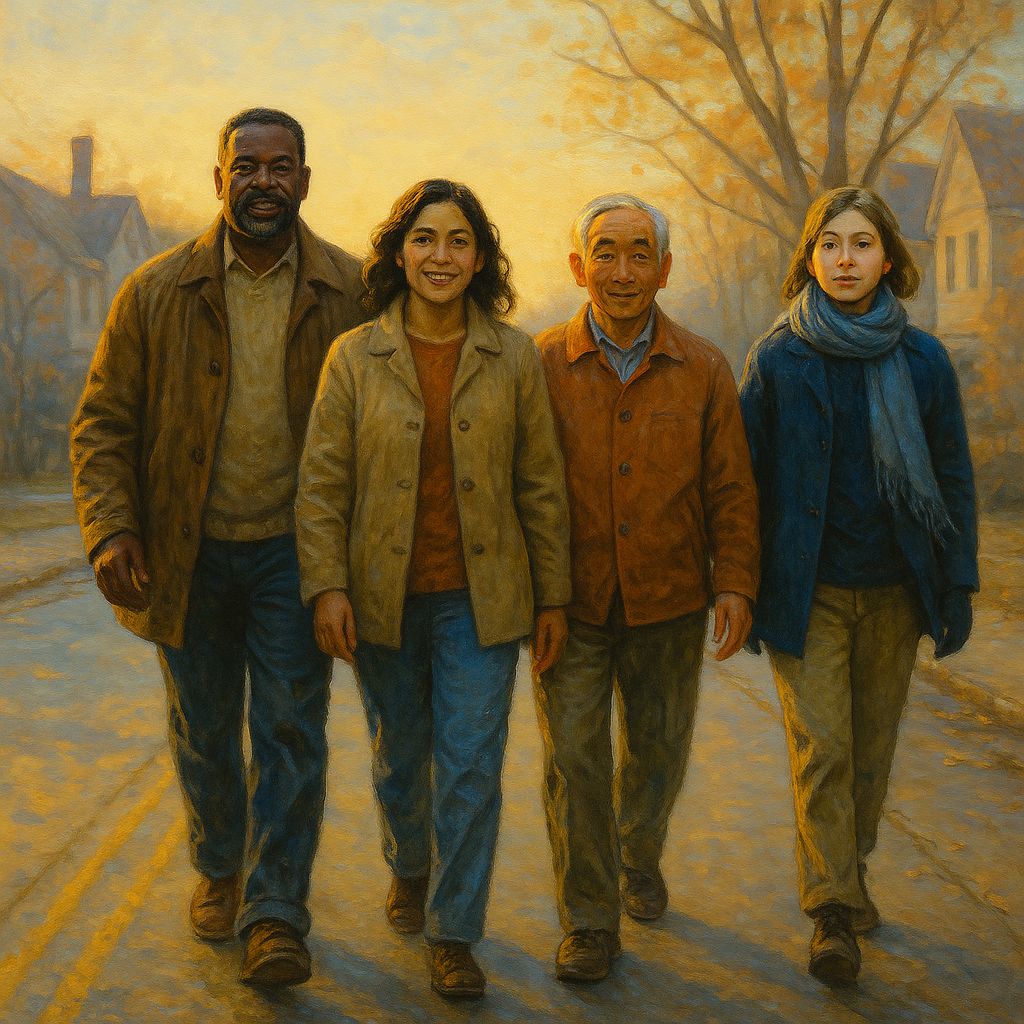
People walking side-by-side settle into shared cadence without conscious effort. Breath aligns. Stride harmonizes. Rapport forms through motion alone.
Two people walking rarely collide in conversation.
Two people sitting often struggle not to.
Walking shifts eye-line, reduces defensiveness, and dissolves rehearsed emotional patterns. No table stands between participants. Both face the world together rather than facing each other in postures shaped for conflict.
A walk choreographs cooperation before words appear.
The Ritual Before the Table
Returning from a walk changes the entire arc of a gathering. The body carries steadiness into the room; steadiness alters every gesture—the way gratitude sounds, the way tension evaporates, the way hunger feels. Breaking a fast becomes an act of intention rather than collision.
Movement carves a threshold. Crossing it transforms the table from a site of competition into a site of nourishment. A ritual requires no grandeur—only consistency.
Walking before eating builds emotional and biological architecture for presence.
THE COMMUNION OF STEPS — The Human Meaning of the Walk
Families gather fewer times than anyone admits. Seasons turn, lives scatter, health shifts, and the number of shared meals dwindles quietly. A walk before a feast becomes more than physiology; it becomes communion.
Walking draws people into gentle alignment—emotionally, physically, relationally. Conversations soften because bodies soften. Old tensions lose their authority. Breath settles into shared rhythm, and for a few minutes, everyone moves with the same pulse. Even long-distance relatives, awkward acquaintances, or quiet souls find an easier path toward one another.
On a walk, nobody performs.
Nobody competes.
Nobody hides behind a screen or a chair.
People reveal their humanity through pace, breath, and presence.
Moments like these become precious because life grants them sparingly. Families remember the walk long after they forget the menu. A shared step becomes a vow, unspoken but unmistakable:
I am here with you.
You are here with me.
And we are alive together.
In a fractured world, a walk restores the ancient truth we often forget—connection begins with movement toward one another.
🌅 Gratitude
I have learned through fasting: clarity begins before consumption. A body prepared through movement greets a meal with gentler breath and cleaner intention. Walking smooths impatience, widens awareness, and returns me to myself with steadier grounding.
I have come to see fasting as arrangement—an ordering of breath, posture, and choice so the next act of nourishment carries dignity. Walking before a feast has become gratitude in action: for the body that carries me, for the food created with care, and for the people gathered, whether harmony greets us or challenge tests us.
🏛️ Wisdom’s Lens — Philosophical
Seneca: “We grow angry not from injury but from expectations carried into the moment. Minds unprepared for change ignite quickly; minds trained for calm interpret differently.”
🔎 A pre-feast walk releases expectation’s grip, giving emotion space to settle so grace replaces reflex.
🏛️ Wisdom’s Lens — Anatomical
Patrick McKeown: “Functional breathing begins with quiet nasal flow, diaphragmatic descent, and mobile ribs; calm grows when the body trusts the breath leading it.”
🔎 Walking with nasal breathing stabilizes the diaphragm and strengthens vagal tone, giving the body an internal anchor before external noise demands attention.
🪶 Steps Before the Table
A feast waits indoors,
yet breath leads the body first.
Steps unwind the knots
hiding beneath the ribs.
Morning opens,
the spine lengthens,
and hunger settles
into a calmer voice.
The table prepares its welcome,
but the walk prepares the soul.
— R.M. Sydnor

 RMS INSIGHTS ✍🏾