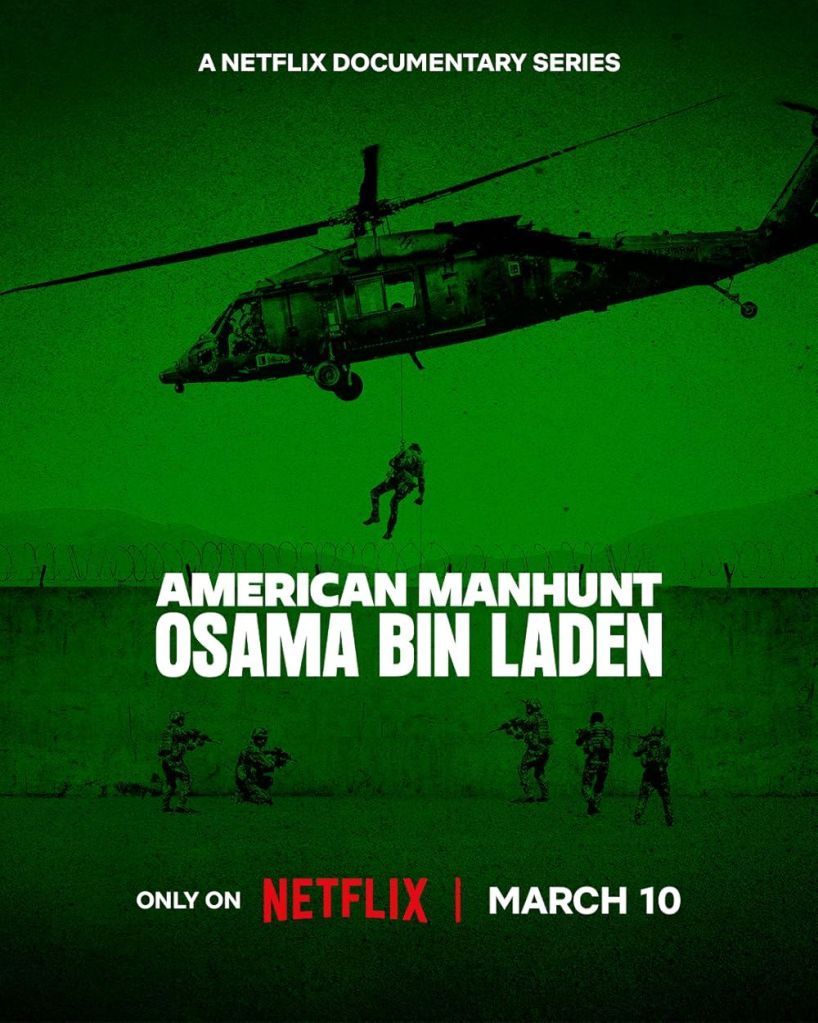
The Shadow in the Compound: A Reckoning with American Vengeance


No empire ends quietly, and no enemy dies alone. Osama bin Laden—specter of September 11, avatar of asymmetric warfare, and the most hunted man in modern history—was not merely a fugitive. He was a dark reflection, the lens through which America saw its anguish, its outrage, and its almost theological need for vindication. Netflix’s American Manhunt: The Search for Osama bin Laden does not embellish this pursuit, but it reanimates it with arresting lucidity—resisting bombast while embracing complexity.

Directed by Mor Loushy and Daniel Sivan, the documentary threads together a sprawling narrative with surgical clarity. The story is retold not through narration or omniscient commentary, but through the fractured and sometimes contradictory testimonies of those who were there—CIA operatives, military commanders, national security advisors, and the President who sanctioned the raid with a gambler’s nerve and a philosopher’s burden. There is no choreography here, no flourishes of self-congratulation. Only the tightening thread of obsession, of moral compromise, and of sacrifice.

President Barack Obama, famously cerebral, anchors the film’s moral undertow. His decision to authorize Operation Neptune Spear is not portrayed as muscular or dramatic; it is quiet, deliberate, solitudinous. We see him in the Situation Room—not so much directing as absorbing—flanked by then-CIA Director Leon Panetta, Secretary of State Hillary Clinton, Defense Secretary Robert Gates, Admiral Mike Mullen, National Security Advisor Tom Donilon, Counterterrorism Advisor John Brennan, and Vice President Joe Biden. Each speaks a different dialect of caution. None possess certainty. The President proceeds anyway.

And this is where the film begins to rise: in the friction between confidence and conjecture. The CIA analysts, especially Maya (a pseudonym), part of the so-called “Sisterhood”—Cindy Storer, Nada Bakos, and others—are presented not as heroes but as haunted professionals. Their pursuit of Abu Ahmed al-Kuwaiti, the courier, is an exercise in attrition and intellect, intuition and exhaustion. They are as much cartographers of doubt as they are agents of discovery.

Abbottabad is introduced not with flair but with dread: a drab compound with high walls, opaque habits, and architectural whispers of secrecy. That this suburban fortress existed undisturbed for so long is less a testament to Pakistani duplicity (though that shadow lingers) than to the stubborn ambiguity of intelligence. The compound itself becomes a character—mute, suspicious, and strangely inert. The drama is in its stillness.

When the operation begins—stealth helicopters slicing the darkness—the tempo of the film changes, but not with cinematic bravado. Instead, we are given uncertainty. One of the helicopters crashes. The team adapts. In the control rooms of Langley and the West Wing, nerves strain under silence. These are not men and women reveling in retribution. They are holding their breath. The SEALs—anonymous, meticulous—move through the compound not with swagger, but precision. Bin Laden is shot. His body is photographed. DNA confirms what instinct already knew.

And yet, as the documentary reminds us, closure is elusive.

The strength of American Manhunt lies not in its archival footage or its tight pacing—though both are superb—but in its refusal to pretend that this act of surgical vengeance was tidy. The intelligence community had failed catastrophically on 9/11. For nearly a decade, they labored under the crushing weight of that failure. And this success, though spectacular, was not catharsis—it was a question mark.

What did America gain? What did it lose?

We hear from the families of those who searched for bin Laden for years, including analysts whose marriages dissolved under the pressure of obsession. We glimpse the moral fog surrounding targeted killings, the drone campaigns that metastasized after bin Laden’s death, the way violence institutionalizes itself in a bureaucracy. No one in the film pretends this was a storybook ending. Instead, it was the closing of one chapter in an epic that refuses to finish.

The cinematic tone, then, is elegiac rather than triumphant. Mor Loushy and Daniel Sivan avoid the trap of mythmaking. They lean instead into the ragged truths: that intelligence is imperfect, that leadership is lonely, that war never ends the way it begins. American Manhunt honors the skill of the SEALs, the doggedness of the analysts, and the gravity of Obama’s decision—but it never flinches from the ethical gray. It dares to ask whether vengeance ever truly satisfies a wounded empire.

And perhaps that is the film’s deepest contribution. It re-centers bin Laden not as a cartoon villain or diabolical mastermind, but as a man whose death raised as many moral specters as it laid to rest. It asks whether the hunt changed America more than the attack did. Whether, in vanquishing the enemy, we also distorted ourselves.

In the final moments, we see President Obama address the nation with calm restraint. There is no gloating, only gravity. He speaks to justice—not revenge. But the images that follow—the celebrations in the streets, the chants of USA—tell a different story. We were not ready to reflect. We were hungry to win.

Verdict: American Manhunt is not just a documentary about an operation. It is a meditation on obsession, on memory, on the thin line between justice and revenge. It is a reckoning cloaked in restraint, a chronicle of triumph shadowed by doubt. And in that doubt lies its brilliance.

R.M. Sydnor 

The Incomparable William F Buckley Jr.

PBS’s American Masters doesn’t trade in sainthood. Its finest portraits render their subjects in chiaroscuro—equal parts dignity and defect. The Incomparable Mr. Buckley upholds that tradition in profiling William F. Buckley Jr.—founder of National Review, master of televised debate, literary showman, and the man who gave postwar American conservatism its polished voice and prickly conscience.

He was born in 1925 in New York City, the sixth of ten children in a sprawling, hyper-articulate Catholic family. His father, William Sr., was an oil magnate and ideological absolutist with Southern landholdings and a Calvinist’s faith in capitalism. His mother, Aloise Steiner Buckley, a Southern belle with gentler bearing, provided music, charm, and restraint. Together, they presided over a household where French, Latin, logic, and loyalty to God and property were daily fare. It was not a home so much as a crucible.

The family’s wealth insulated the Buckley children, but it also armed them. William Jr. emerged with the accent of a 19th-century baronet, the posture of a fencing master, and the moral certitude of a bishop. He entered Yale as if into inheritance. And when Yale failed to meet his expectations, he turned on it—with glittering vehemence.

God and Man at Yale, published in 1951, was a bombshell disguised as a senior thesis. Its argument: that the university had betrayed its Christian and individualist roots, surrendering to collectivism and atheism. The prose was provocatively archaic, yet the thrust was unmistakably modern. This was not merely a critique of education—it was a blueprint for counter-revolution. The American conservative movement, until then diffuse and culturally marginal, had found its polemicist.

By 1955, Buckley had founded National Review. It was not just a magazine—it was an ideological citadel. In its pages, Buckley defined a new conservatism: urbane, anti-communist, economically libertarian, and socially hierarchical. His prose was a blend of rococo elegance and dry contempt. He did not argue for approval; he argued to reign. Readers didn’t just agree—they aspired.

He published more than fifty books: political commentaries, spy thrillers, religious meditations, memoirs. The Unmaking of a Mayor was equal parts political comedy and civic dissection. Nearer, My God offered a rare glimpse into his spiritual reflections. Even his novels—clever, if a bit baroque—carried the same crisp posture as his public self. He made ideology feel like a private club with a sommelier.

And yet, the costs of that ascent remain part of the record. Buckley was, by any honest reading, a segregationist. His 1957 essay Why the South Must Prevail asserted the right of white Southerners to govern over Black citizens—not as a matter of prejudice, but, he claimed, of civilizational necessity. That Buckley later retracted this position matters. That he held it at all matters more. The documentary makes no excuses.

One of his starkest reckonings came in 1965 at the Cambridge Union, in debate with James Baldwin. Baldwin’s speech—incandescent, unsparing—laid bare America’s betrayal of its Black citizens. Buckley followed with wit, erudition, and rhetorical flair—but also with a visible tightness, as if aware that history had tilted toward Baldwin before a word had been spoken. The moment was not a defeat, but it was a humbling—a rare crack in Buckley’s polished armor, and the documentary captures it without editorializing. It trusts the camera, the silence, the afterglow of Baldwin’s thunder.

The film wisely returns often to Firing Line, Buckley’s long-running television program, which aired 1,504 episodes over 33 years. Here, Buckley became both emissary and gatekeeper of conservative thought. He hosted everyone from Noam Chomsky to Ronald Reagan, playing both swordfighter and salon host. The set was minimalist. The conversations were maximalist. Viewers didn’t just tune in—they were initiated.

And there was the persona: the arched brow, the patrician drawl, the looping syntax that seemed to tango with itself. Buckley’s charisma was not merely linguistic. It was theatrical. The man performed intelligence—something his detractors dismissed as pretense but which his admirers saw as the very soul of elite engagement. That twinkle in his eye, that knowing pause—it wasn’t smugness. It was seduction.

No portrait of Buckley is complete without his role in grooming the political ascent of Ronald Reagan. The conservative movement, once the province of marginal pamphleteers and country-club grumblers, found in Buckley an architect—and in Reagan, a frontman. Buckley gave conservatism the vocabulary of gravitas; Reagan gave it the smile. The 1960s and ’70s saw Buckley tirelessly promoting Reagan as the movement’s ideal statesman: optimistic, disciplined, ideologically sound.

Buckley consulted with Reagan directly, advised on messaging, and defended him in print long before the political winds changed. It was Buckley who helped airbrush the John Birch Society and its paranoiac fringe out of the picture, insisting conservatism must not slip into lunacy. His expulsion of the Birchers was an act of philosophical self-respect. Reagan’s election in 1980 was, in no small part, the flowering of seeds planted in the editorial gardens of National Review.

But Buckley’s movement, like all movements, mutated. Today’s conservative landscape—rife with populism, grievance, and performative antagonism—bears only passing resemblance to the patrician discourse of Firing Line. Buckley believed ideas should be sharpened like swords, not hurled like bricks. He disdained conspiracy theories, theatrical outrage, and demagoguery. The very populism he once sought to discipline now rages, unkempt and unlettered, across the platforms of American life.

It is not merely that he would have opposed Trumpism. It’s that he would not have known quite where to begin. Where Buckley once sparred with Chomsky in syntax-rich combat, today’s heirs trade memes and innuendo. Figures like Tucker Carlson, Marjorie Taylor Greene, and their ilk owe more to televised resentment than rhetorical discipline. Buckley’s diction would be mocked; his detachment misunderstood as weakness.

The documentary touches on this transformation gently—perhaps too gently. But it raises the question: if Buckley founded the temple, did he fail to guard its altar? Or did he simply not foresee the day the velvet ropes would be trampled by the mob?

The film doesn’t avoid the personal. It gives due place to Patricia Buckley, his wife of more than five decades. She was not merely a society figure. She was a partner in the truest sense—a co-conspirator in charm and civility. Her death in 2007 shattered him. The documentary doesn’t overstate it, but you see it—in the thinning voice, the retreat from public jousts. Buckley without Patricia was a violinist without strings. He would later confess in a rare interview with Charlie Rose that he no longer wished to live. The twinkle, by then, had flickered into memory.

In his final years, Buckley grew more reflective. He questioned the Iraq War. He distanced himself from the Bush administration. And his writing—especially in Miles Gone By—betrayed an awareness that the world he helped shape was moving on without him. He died in 2008 of emphysema, a slow, diminishing ailment for a man once defined by verbal flight. The voice that had launched a movement finally quieted. And yet, the echoes endure.

What The Incomparable Mr. Buckley accomplishes—gently, but thoroughly—is the restoration of contradiction. Buckley the libertarian who praised Franco. Buckley the Catholic who denounced anti-Semitism but flirted with eugenics. Buckley the champion of free speech who occasionally reached for the censor’s glove. Buckley the gentleman who once threatened to punch Gore Vidal in the face. He was a colossus built of paradoxes.

The film omits his son, Christopher Buckley—himself a novelist and satirist—whose political journey diverged from his father’s but never lost affection. One suspects the exclusion was more editorial constraint than avoidance. Still, a nod might have added dimension to the portrait.

He was not easy to love, but impossible to ignore. He wielded ideas like foils, slicing through sentiment with style. He was wrong—sometimes deeply—but never dull. And in an age that increasingly rewards volume over voice, William F. Buckley Jr. remains a paradox worth revisiting: the radical traditionalist, the gracious elitist, the missionary of manners.

Verdict


A masterwork of biography that neither flatters nor flinches. The documentary invites us not to genuflect before Buckley, but to wrestle with him. His legacy, like his syntax, was elaborate, contradictory, and enduring. The modern right may no longer speak in his accent—but it still stirs in the cathedral he built.

R. M. Sydnor

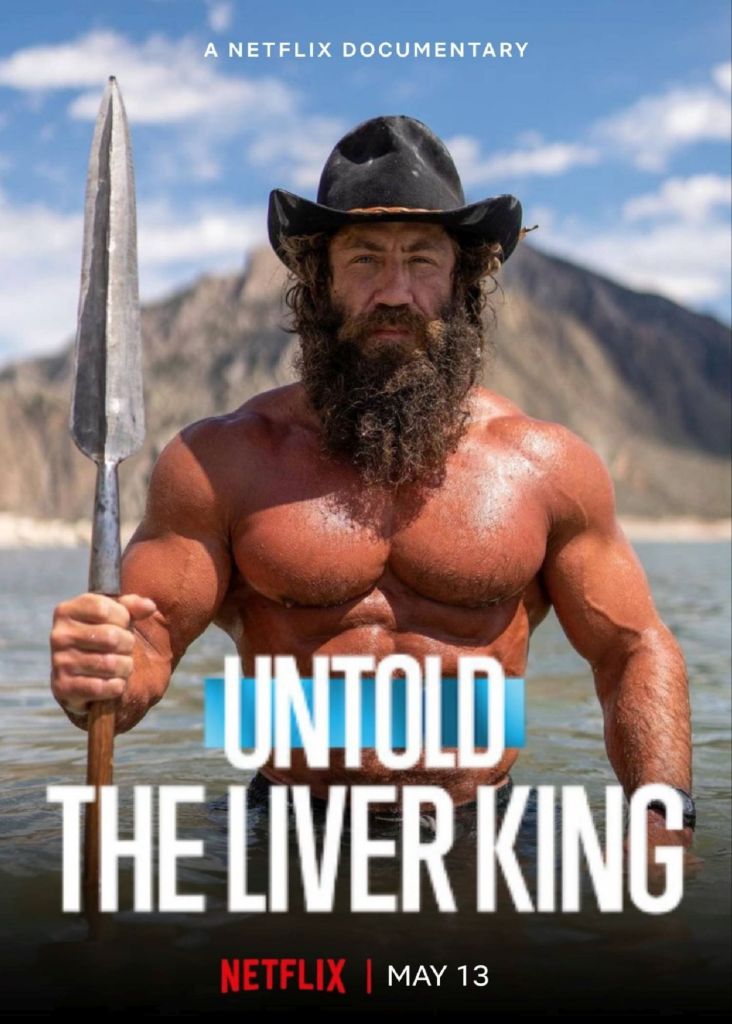
The Liver King: A Raw Deal in the Age of InfluenceUntold: The Liver King – Netflix Documentary Review


The Rise of a Carnivorous King

Brian Johnson didn’t enter the wellness arena—he charged in, half-naked and wholly committed. Known as the Liver King, he became a primal prophet of sorts, preaching a return to what he called “ancestral living.” His diet? Barbaric. His discipline? Unflinching. His presence? Viral.

He devoured bull testicles with the same ferocity he flung kettlebells, and through it all, he maintained one core message: modernity is poison. The antidote? A return to the wild. Yet, like many self-proclaimed messiahs, he was not what he appeared.


Ancestral Tenets: Selling Simplicity in a Complex World

Johnson didn’t just market meat—he marketed meaning. His philosophy, neatly packaged into Nine Ancestral Tenets, became the bedrock of his brand. These weren’t abstract values but a regimented ideology:

1. Sleep – Total blackout, no alarm clocks, and a rejection of artificial light.

2. Eat – Raw organs, bone marrow, raw milk. No vegetables. No compromise.

3. Move – Grueling functional workouts mimicking hunter-gatherer life.

4. Shield – Reject seed oils, endocrine disruptors, and EMFs.

5. Connect – Bare feet on soil. Grounding as gospel.

6. Cold – Ice baths and cryotherapy as modern rites of passage.

7. Sun – Maximize Vitamin D through shirtless, timed exposure.

8. Fight – Life is struggle; seek discomfort intentionally.

9. Bond – The nuclear family as the ultimate tribe.

Each tenet was a totem—elevated by algorithm, sold as salvation. They gave structure to chaos and ritual to recovery. But like many dogmas, they suffered from the same flaw: they excluded nuance.


The Steroid Scandal: Emails, Omnitrope, and the Fall of a King

While publicly denouncing performance-enhancing drugs, privately, Johnson was injecting them with zeal. Leaked emails revealed a pharmaceutical tab north of $11,000 a month—featuring testosterone cypionate, Deca-Durabolin, and notably, Omnitrope, a high-end synthetic HGH.

He had consulted with a hormone clinician. He knew the science. He was meticulous. These were not the desperate acts of a lost man but the calculated decisions of someone engineering a body that fit a story.

The emails were damning. “I need to build the best possible version of myself,” he wrote. But that version, it turns out, was more syringe than spleen.

His video confession, contrite in tone but corporate in structure, walked the line between accountability and damage control. But the deception ran deeper than needles. It cut to the core of what followers believed: that with enough liver and lunges, they too could transform.


The Lawsuit: When Branding Becomes Betrayal

Johnson’s revelation triggered not just backlash, but litigation. A $25 million class-action lawsuit alleged consumer fraud, false advertising, and negligent misrepresentation. Plaintiffs claimed they had spent significant sums on Liver King-branded supplements and regimens, under the belief that Johnson’s physique was the fruit of ancestral discipline—not chemical intervention.

The legal argument centered not just on truth-in-advertising laws but on emotional harm and intentional deception. The plaintiffs were not just seeking compensation; they were demanding accountability for a betrayal of trust. The courtroom became an altar where Johnson’s myth was weighed—and found wanting.


The Documentary: Visual Theater, But Missing Teeth

Netflix’s Untold: The Liver King is atmospheric and slick, but occasionally too reverent. It follows Johnson with a camera’s eye that’s more sympathetic than skeptical. It gives us gravel and kettlebells, moody Texas skies, and shirtless interviews lit like a GQ confession booth. The aesthetics are evocative. But where is the grit?

The visual language leans into Johnson’s charisma—close-ups of liver, sweat, and familial bonding. But what’s missing is a formal counterpoint. There’s little editorial interrogation, few critical voices, and no cross-examination of the public cost of his myth.

What the documentary excels at is capturing the theater of identity: the way Johnson physically transforms not just his body, but the world around him. From cold plunges to liver feasts, each act is shot like sacred ritual. But sacred to whom?


The Turn: Fruit, Vegetables, and the Softening of a Savage

In the final act, Johnson begins to soften—not just physically, but ideologically. He confesses to having malnourished himself in his meat-only crusade. He now eats fruit. Occasionally vegetables. He even admits he was wrong—something the Liver King would have once called weakness.

The transformation is striking. Gone is the growl. In its place, a kind of awkward humility. The man who once snarled at comfort now seeks balance. The rebrand is underway. Whether it’s penance or pivot, we don’t yet know.


Cultural Context: A Post-Truth Prophet

Johnson is a symptom of something deeper. We live in an age of engineered authenticity—where the appearance of grit is more bankable than the substance of virtue. Johnson offered a narrative that was simple, aggressive, and masculine—a recipe for virality in a culture craving clarity.

His story was never really about health. It was about belonging. In a world of soy lattes and cubicles, he promised a tribe, a fight, a furnace to forge yourself anew. But like all cults of personality, it asked for faith over fact.

He is not the first influencer to manufacture myth. But his myth was so total, so fleshy, so primeval—it dared us to look away. And many couldn’t.


Metaphor and Meaning: A Stoic Lens on Self-Delusion

Marcus Aurelius wrote, “The nearer a man comes to a calm mind, the closer he is to strength.” Johnson reversed this. He confused noise for power, ritual for resilience, and spectacle for virtue.

His kingdom was built not on rock but on sinew and spectacle. And like all empires of muscle, it collapsed—not under external attack, but internal rot.

Nietzsche warned: “He who fights with monsters must take care lest he thereby become a monster.” The Liver King fought weakness with such aggression that he became the very thing he feared: a mask, a performance, a synthetic vision of strength.


Verdict: The Muscle, the Myth, the Mirror

Untold: The Liver King is not just a documentary. It is a cultural x-ray. It peers into our modern marrow and finds a hunger—not for liver, but for meaning. Johnson’s fall is not just his own. It’s ours. We crave shortcuts, we sanctify confidence, and we confuse visibility for truth.

This film, though beautifully composed, misses a chance to challenge harder. But in its silences, it allows room for reflection—and that may be its quiet strength.

Rating: 9.4/10

A rich, revealing portrait of the man, the myth, and the marketplace that made him. With a few more sharp edges, it could’ve cut even deeper. Still, it flexes where it counts.

25-5-12-M 132 ⏳ 233 🗓️ W20 RMSDJ  📖 ✍🏽🌡️75° – 53° 🌥️🌕 ♏

25-5-12-M
132 ⏳ 233 🗓️ W20
RMSDJ  📖 ✍🏽
🌡️75° – 53° 🌥️
🌕 ♏


🌅 MORNING

The morning air arrived with a hush, not of emptiness, but of anticipation—like a stage awaiting its first footfall. Even the wind seemed hesitant, as if nature itself respected the sanctity of a quiet Monday. My limbs carried the soft residue of sleep, but my mind was already moving, already combing through its intentions with the precision of a surgeon sharpening his scalpel.

💡 Clarity is not stumbled upon; it is carved from the inertia of habit.


There are no neutral dawns. Each morning declares allegiance—toward rigor or ease, toward becoming or drifting. Today, I chose rigor.

❓ What force compels us toward discipline when ease beckons more sweetly?


I took nothing more than a small bottle of grapefruit elixir and a vial of green tea with lemon—tokens, not necessities. Hunger never announced itself. My body, now familiar with fasting’s cadence, understood that not all appetites are meant to be satisfied. Some are meant to be studied. Others, transcended.

💡 Hunger is not always a cry for nourishment—sometimes, it is the body’s quiet invitation to reflection.


The pool called with its own logic—a blue stillness requiring movement to reveal its depth. I sealed the Samsung Galaxy watch, activated the running icon (though a walking icon may have been more honest), and let the water pull me into rhythm. The aerobics became something else—ritual, almost prayerful, a choreography of muscle and mindfulness.

❓ Can a routine become sacred simply by how we enter it?


Returning, I turned to the real labor: the editorial sanctification of WordQuest. We removed the word gloss, that clunky echo of schoolroom marginalia, and replaced it with the right-tilted magnifier. 🔎 No label. No redundancy. Just symbol. Just sight. Each entry now opens with elegance and closes with clarity.

💡 Refinement begins not with correction, but with consecration.


🔎 LIMNED implies light made deliberate.
🔎 DELINEATE here suggests the drawing of a boundary not to divide, but to define.

💡 Definition is not the end of a word’s journey—but the start of its intimacy with the reader.

The work did not feel editorial. It felt ecclesiastical. Prompts were no longer procedural—they were musical. Literal usage. Figurative illustration. Elegant turns of phrase. Each required its own tempo, its own breath.

💡 A sentence polished is a soul aligned.


And then came the metamorphosis: the once utilitarian All in the Family now reborn as MEET THE FAMILY. No longer a sterile list, it became a circle—each word-relative introduced with the warmth of kinship, followed by a paragraph that offered not just meaning, but memory. The section didn’t instruct. It welcomed.

❓ What if lexicons were written not to inform, but to invite?

💡 What you magnify becomes your gospel.

❓ When does silence stop being empty and start becoming essential?

💡 The difference between a rule and a standard is this: a rule demands obedience; a standard invites reverence.


Inquiries & Illuminations

💡 Clarity is not stumbled upon; it is carved from the inertia of habit.

💡 Hunger is not always a cry for nourishment—sometimes, it is the body’s quiet invitation to reflection.

💡 Refinement begins not with correction, but with consecration.

💡 Definition is not the end of a word’s journey—but the start of its intimacy with the reader.

💡 A sentence polished is a soul aligned.

💡 What you magnify becomes your gospel.

💡 The difference between a rule and a standard is this: a rule demands obedience; a standard invites reverence.

❓ What force compels us toward discipline when ease beckons more sweetly?

❓ Can a routine become sacred simply by how we enter it?

❓ What if lexicons were written not to inform, but to invite?

❓ When does silence stop being empty and start becoming essential?

🙏🏾 Gratitude

The sky was kind this morning.

My body held its peace.

The water received me without complaint.

WordQuest sharpened under my hand.

Simplicity returned with elegance in its arms.

The watch, like my spirit, sealed itself against the noise.

Language leaned toward light.


💡 The soul is not made by ease. It is carved—slowly, precisely—by what we choose to do with the quiet.

25-5-10-Sa 130 ⏳ 235 🗓️ W19 RMSDJ  📖 ✍🏽🌡️102° – 65° 🥵


25-5-10-Sa
130 ⏳ 235 🗓️ W19
RMSDJ  📖 ✍🏽
🌡️102° – 65° 🥵
🌔 ♎ ♏

☀️ AFTERNOON

The day arrived already ablaze. 102° and climbing—heat that didn’t just descend, but insisted. The clouds, slack and unmoved, hovered without offering anything but presence. Indoors, I chose precision over perspiration. WordQuest stood before me, not in disrepair, but in need of deeper architecture.

The session with Maestro began like a silent duet. We weren’t just editing words—we were shaping resonance. The order of sections in WordQuest had started to feel functional but uninspired. I sensed it first. Then I articulated it. Maestro followed my lead.

We began with the eStory for LIMNED. The story—She Who Traces the Sacred—was already strong, but it lacked framing clarity. We restructured its presentation, created the pairing prompt, and gave it a lyrical entry point:

💡 To limn is not merely to draw—it is to dignify.

❓ What sacred stories am I carrying that have yet to be traced, named, or honored?

From there, the work moved like breath. We revised the SOUND section, stripping away the clutter. I renamed it—just 🗣️ SOUND—nothing extra. Clean. Precise. For verisimilitude, we shaped a sonic hook that felt inevitable:

💡 It doesn’t ring true. It rings real enough to believe.

The spelling structure needed re-sequencing. I instructed Maestro to shift it behind IPA and SOUND—a decision rooted in how the mind naturally absorbs sound before shape.

We finalized the new structure:

IPA

Hyphenated guide

Syllabic segmentation

Visual mnemonic

Aphoristic insight


This gave clarity room to breathe.

Then came the full recalibration of the section order. From recognition to resonance, I laid out the new arc:

IPA → SOUND → SPELLING → DEFINITIONS → USAGE → PHILOSOPHY → MEMORY

💡 Structure is not rigidity—it is reverence for rhythm.

We capped the session by creating the WordQuest Master Template, a clean skeleton built to hold nuance, rhythm, and elegance. Not just a form—but a form that holds feeling.

❓ In what ways am I rearranging my own thoughts to let truth arrive with more grace?

Later in the afternoon, I broke a 19-hour and 30-minute fast. Not because I was weak—but because I was listening. Ground turkey, mashed potatoes with cauliflower—polite but forgettable. Tuna with blue cheese—a bold surprise. Then came the yam: salted, honeyed, and crowned with pumpkin and chia seeds. Faithful, familiar. I saved another yam for the Vitamix—skin and all.

💡 Hunger, when honest, is a form of listening.

❓ What nourishment do I withhold not from wisdom, but from ritual?

Music carried the rest of the hour. Jazz guitar, feathered and light. I visited César Cervantes and Brian Okino—Saturday’s soft crew. I told Cesar that Aliza had email me and I’ll respond tomorrow. Anna Sanchez had the day off. Deservedly so.

💡 Rest isn’t escape—it is alignment.

💡 “Nature does not hurry, yet everything is accomplished.” — Lao Tzu

The day’s work continued. I thought I was done—four words edited, prompts refined, structure in place. But then the text whispered again. Something still needed tuning. Another inconsistency, another dissonant note. But I didn’t resist.

💡 Repetition is not failure—it is refinement disguised as patience.

❓ What might become effortless if I welcomed the labor that precedes it?

A new idea visited near sundown—a vocabulary rap book. Clear definitions. Rhythmic delivery. Bold illustrations. Wordplay with educational teeth. It could teach without preaching. And the eStories? They deserve autonomy—each one a small book, a single word unwrapped in metaphor, character, and consequence.

💡 When language and image walk together, memory lingers longer.

💡 “All truly great thoughts are conceived while walking.” — Friedrich Nietzsche

❓ What great thought has been pacing just behind me, waiting to be invited forward?


Inquiries & Illuminations

💡 The impediment to action advances action. — Marcus Aurelius

💡 First say to yourself what you would be; then do what you have to do. — Epictetus

💡 Waste no more time arguing what a good man should be. Be one. — Marcus Aurelius

💡 He who has a why to live can bear almost any how. — Friedrich Nietzsche

💡 Stillness is not inaction—it is invitation.

❓ When do I confuse movement with meaning?

❓ What am I holding apart that longs to be united?

❓ What silence have I mistaken for emptiness?

❓ Is my why durable—or merely decorative?

❓ What might sharpen if I allowed fewer words and deeper truths?


🙏🏾 Gratitude

I’m grateful for the clarity that comes not in thunder but in adjustment.

For structure that sings, for Maestro’s adaptability, for the humble yam, and the surprise of blue cheese on tuna.

I’m grateful for Chekhov’s quiet scalpel, for Eliza’s small reaching out, for Saturdays without demands.

And I’m grateful that rhythm—true rhythm—always returns, if I make space for it.

Confessions in Transit: Daddio and the Cartography of Connection

Daddio (2023)

Confessions in Transit: Daddio and the Cartography of Connection


📌 Opening Commentary

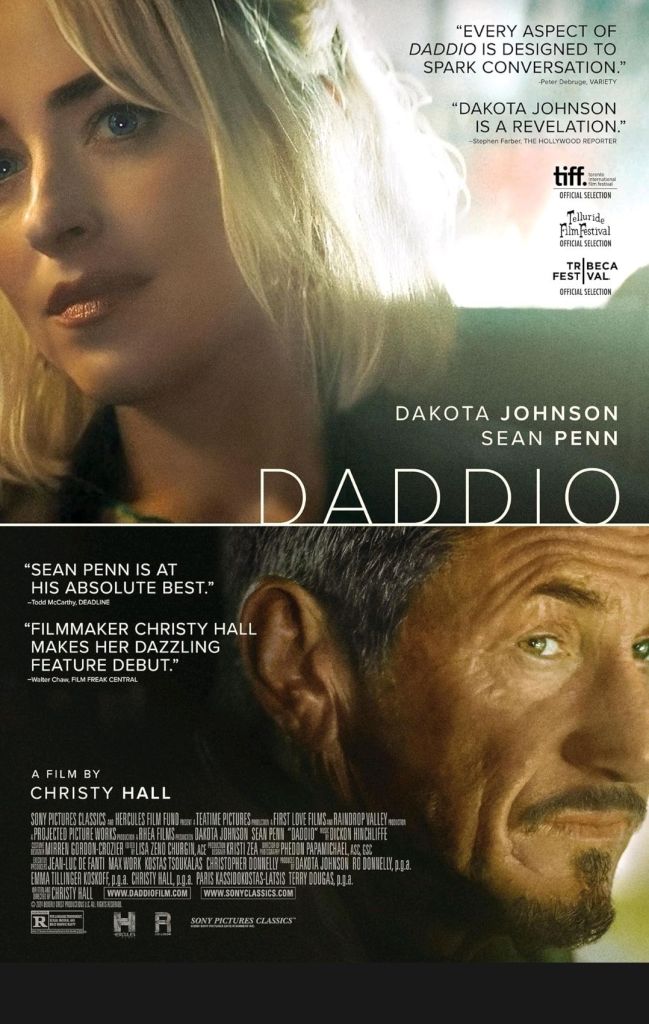
In an era where cinematic spectacle often overshadows subtlety, Christy Hall’s Daddio emerges as a cinematic haiku—brief, bounded, but resonant. Hall, adapting her own play and stepping confidently into the director’s seat, strips storytelling to its bones. No chase scenes, no cutaways—just two people in a cab, and a conversation that peels back layers faster than any thriller could. It’s a bold debut, one that invokes Before Sunrise, My Dinner with Andre, and even Hitchcock’s taste for confined spaces. Yet Daddio does something altogether its own: it uses dialogue as a scalpel, not a sponge.


Overview

After landing at JFK, a woman—known only as “Girlie” (Dakota Johnson)—slides into the back seat of a yellow cab driven by Clark (Sean Penn). The city pulses outside; inside, something quieter begins to stir.

What begins with small talk about traffic and smartphones soon spirals into the intimate. She’s involved with a married man; he’s a veteran of love and divorce. Beneath the surface chatter, emotional fissures begin to show. Questions turn philosophical, flirtation turns introspective.

Clark challenges Girlie’s assumptions. Girlie needles Clark’s self-mythology. Their exchange becomes less a dialogue and more a kind of psychological jazz—improvised, searching, occasionally discordant, but brimming with truth.

In a moment of vulnerability, Girlie breaks—confessing that what masquerades as power in her affair is, in truth, loneliness. Clark responds not with pity but perspective, offering a challenge: maybe what she fears most isn’t abandonment but authenticity.

As the cab glides to a stop, they part. No grand gestures. No promises. Just two strangers altered by the collision. We never learn their full stories, but we understand them—deeply, briefly, fully.


Symbolism & Subtext

The taxi becomes both vessel and crucible—a symbol of transition. Trapped in metal and motion, the characters are both nowhere and on the verge of somewhere. The window between them and the world reinforces the theme: proximity does not always mean connection, and distance does not preclude intimacy.

Clark’s cigarettes, the glow of dashboard lights, even the endless hum of the city—all serve as ambient reminders that sometimes, in the most mundane places, the sacred can happen. Their talk of love, ethics, and desire functions less as confession than excavation—digging down to the bedrock of who they are beneath the masks.


Memorable Moments & Key Details

Girlie’s quiet deletion of a message she almost sends speaks volumes about her longing and restraint.

The entire film unfolds in the claustrophobic cocoon of the cab, yet the cinematography creates visual space—intimate, but never static.

Clark’s line—“We all lie. The trick is knowing why.”—echoes long after the meter stops running.


Strengths & Weaknesses

Directorial Vision

Hall’s restraint is her genius. She allows silences to breathe and lets discomfort fester—trusting her audience to lean in, not lean back.

Cinematography

Jordan Parrott’s lens never lets the cab feel like a trap. Instead, it becomes a stage for human drama, lit in chiaroscuro, framing thought as much as face.

Screenwriting

Hall’s script reads like a long-form poem, its rhythm rooted in emotional truths rather than plot mechanics.

Pacing & Structure

Some may find the single-setting format limiting. But if you’re tuned to its frequency, the film offers profound rewards.


🎭 Performances

Sean Penn, a two-time Oscar winner, reminds us why he remains one of cinema’s most formidable actors. As Clark, he sheds the bravado of past roles for something more weathered, more humane. Every shrug, every half-smile, every tightening of the eyes reveals a man who’s seen too much—and forgotten too little. This is not a “role” so much as a slow inhabitation. Penn doesn’t act next to the dialogue—he mines it, finding new seams of meaning in every pause.

Dakota Johnson, often underestimated, emerges here as a revelation. Her “Girlie” begins composed but not cold—her defenses carefully curated. Yet as the ride stretches on, we see them falter. Her voice catches at just the right moment; her gaze hardens when necessary, softens when safe. This is a performance of restraint, made electric by what she chooses not to say.

Together, Penn and Johnson achieve what few film duos manage: two fully inhabited characters who evolve in real time—without a single change of scene.


🎭 Production Design & Costumes

The set design—minimal as it is—reflects the authenticity of the city. Worn vinyl, flickering neon, streaked windows—everything feels lived in. Girlie’s wardrobe shifts subtly from armor to skin as the evening unfolds, while Clark’s workmanlike layers hint at a man who carries emotional weight like a weathered coat.


🖋️ Writing Style & Literary Devices

Metaphor: The cab ride becomes an emotional pilgrimage.

Paradox: Intimacy between strangers feels more genuine than decades of partnership.

Allusion: Hall’s writing borrows the soul of modern theater—Mamet, Shepard, LaBute—but tempers their cruelty with grace.

Irony: The cab, designed for transit, becomes a moment of stillness in both their lives.


🔄 Comparative Analysis

Daddio belongs to a rarefied lineage of confined-location films—Locke, Buried, Phone Booth—but it trades tension for introspection. It also echoes Before Sunrise’s conversational dance but infuses it with more psychological heft and moral ambiguity. Whether it will be canonized remains to be seen, but it certainly refuses to be ignored.


🏆 Verdict

A two-character character study that transcends its premise, Daddio reminds us that a well-timed conversation can do what car chases never will—change someone.

Final Score: 3.7 / 4.0 — A-


Legacy Factor

Though modest in scope, Daddio may prove timeless—an intimate whisper of a film in a world that too often shouts.

AUDIO REVIEW

https://www.dropbox.com/scl/fi/1lgob2nulf4r4p52ymtjk/Daddio-Review.mp3?rlkey=9cimea188hw50sg65i9bb04tt&st=ppd06rhg&dl=0

25-5-3-Sa 123 ⏳ 242  W18 RMSDJ  📖 ✍🏽🌡️ 66° – 55° ☁️ ☂️ 🌒 ♋ ♌


25-5-3-Sa
123 ⏳ 242 🗓️ W18
RMSDJ  📖 ✍🏽
🌡️ 66° – 55° ☁️ ☂️
🌒 ♋ ♌


AFTERNOON

The afternoon unfurled in a kind of dim composure — the skies wrapped in wool, the air hushed as if rehearsing rain. I made my descent to the lobby to retrieve my tripod, newly arrived. There I encountered Brian Aquino, dressed casually in a modest pair of Jordan sneakers.

When I asked after Caesar, Brian motioned to the staff restrooms. One, he noted, sits near my quarters beside the patio’s glass doors; the other, farther down, is tucked beside the manager’s domain.

Moments later, Caesar appeared — cloaked in black, his steps light, his sneakers soft on the tile. He spoke of Brevo: a platform to marshal contacts and choreograph digital correspondence. Alongside it, he uses 7-Day Leads, a service built to nurture cold contacts into warm prospects. Together, they form a mechanical duet — strategy and scatter, catch and call.

💡 Lao Tzu: “To attain knowledge, add things every day. To attain wisdom, remove things every day.”

🙏🏾 What Caesar builds in tools, I must balance with emptiness — the clearing of inner clutter.

We shifted to a discussion of 11 Labs. Caesar spoke with quiet authority about its voice cloning potential. By feeding it a script, one could generate a voiceover — a seamless mimicry ideal for content creation. I was intrigued. A voice borrowed from oneself — what curious alchemy.

What defines the voice — the vibration, or the volition behind it?

Lunch was modest but textured: roasted chicken breast, a few rotisserie slivers, rice tangled with pumpkin seeds and cashews, supplemented coffee, a single Biscoff, and a piece of dark chocolate. These things nourish more than body — they instruct the senses.

💡 George Eliot: “It is never too late to be what you might have been.”

🙏🏾 My tools may be digital, but the transformation is personal.

Later, a musical detour: a playlist called Cosmic Guitar. It hovered between meditative and strange, like surf music staring at the stars. The melodies moved like comets wrapped in nylon strings.

The weather, meanwhile, remained contemplative — the sort of gray that suggests both pause and permission.

Caesar, ever the technologist of temperament, guided me deeper into 11 Labs. The price: $11 monthly, with a $22 initiation. I chose the Pro version, earning 50,000 credits. These credits are units of speech — the currency of vocal duplication.


💡 Simone de Beauvoir: “Change your life today. Don’t gamble on the future, act now, without delay.”

🙏🏾 The delay is not in the tools — it is in our permission to use them boldly.

I began recording my voice. Naively, I believed a short sample would suffice. But 11 Labs asked more of me — a full 10 minutes. Thankfully, I had already narrated over 15 for my audiobook. My first attempt was clumsy; the process, like poetry, revealed its form only through patience.

❓ Is the authentic self something we record, or something we refine through repetition?

Caesar reminded me to wait until the 123 prompt finished fully before proceeding. Once aligned, I recorded several diary entries. The software now labors in silence, rendering my voice in electric echo. It shall take 5 to 6 hours. That, to me, speaks of care.


💡 Coach: “A voice may speak truth, but only silence proves it.”

🙏🏾 The quiet between recordings teaches more than the playback ever will.

Marlene, the building’s maintenance steward, stopped by to collect an Amazon parcel. She mentioned her birthday falls tomorrow — under the sign of Taurus, where steadiness meets devotion.

Later, I indulged in a late repast — a hamburger pressed between ciabatta, crowned with spreadable sharp cheese, spinach, honey barbecue sauce, dry Italian salami. Potato chips and cashews followed. I sipped lemonade with quiet thanks.

11 Labs performed admirably. It stumbled only once — mispronouncing my cognomen, Sydnor. I will, of course, correct this. But the rhythm? The tempo? The hesitations between thought and speech? It honored me there.

Can a digital version of oneself still carry the soul’s inflection?

Rain came softly as a benediction. The sky, after so much restraint, finally wept — but gently. And I, grateful for the pause, rested without guilt.


Gratitude


I give thanks not for the brilliance of machines, but for their humility — how they ask for more before they can give.

I give thanks for Caesar’s quiet orchestration, for his way of moving through code as if it were prayer.

I give thanks for my own curiosity — unwearied, undeterred — outrunning the skepticism that once ruled my breath.

I give thanks for the warmth of ciabatta against a cool hand, for the way a guitar sings of stars without speaking their name.

And I give thanks — solemn thanks — for the strange grace of hearing one’s own voice outside the body and not turning away.


💡 Søren Kierkegaard: “Life can only be understood backwards, but it must be lived forwards.”

🙏🏾 Today, I do both — reflect and move.

25-5-3-Sa 123 ⏳ 242 🗓️ W18 RMSDJ  📖 ✍🏾🌡️66° – 55°  ☁️ 🌒 ♋ ♌


25-5-3-Sa
123 ⏳ 242 🗓️ W18
RMSDJ  📖 ✍🏾
🌡️66° – 55°  ☁️
🌒  ♋ ♌


MORNING

My sleep did not arrive as a banquet but as crumbs — a trail of drifting interludes never leading to rest. Around half past seven, I fell into a dream. A man and a woman of Asian descent approached my door with curious purpose. The woman, arms folded around a dog of no distinction, moved to remove the door itself. She threatened release — not of fury, but of form. The dog barked its claim with theatrical confidence, though its frame suggested no true menace.

Before conflict could blossom, the scene bent. Management arrived, abrupt as lightning in a pastoral novel, announcing that the room was no longer hers. It belonged to me.

What then was the dog, if not a toothless emblem — a mascot of false threat? And the woman? She stood not as adversary, but as trespass incarnate: a disturbance not of property but of peace. The dream ended not with fear, but with reclamation — a quiet reminder that this body, this room, this page — remain mine.

💡 Epictetus: No man is free who is not master of himself.
🙏🏾 In that spirit, this morning I reclaim not only space but speech.

There is a discipline to clarity — an interior exactness that refuses the laziness of fragments. I confess: I have not always honored that discipline. Too often, I’ve mistaken dictation for delivery. But a thought, like a seed, requires a vessel. Even breath deserves grammar.

From this day forward, I resolve to treat every spoken phrase as a potential cathedral. My diary is not a compost heap for passing whims — it is an altar of record. And to speak slowly is to think richly. Each pause gives birth to precision. Every sentence, sculpted with intention, carries its own resonance.

💡 Simone Weil: Attention is the rarest and purest form of generosity.
🙏🏾 I must be generous with my own thoughts, not rush past their meaning.

❓ Have I become impatient with the weight of reflection?

❓ Do I interrupt my own interiority with noise disguised as urgency?

💡 Søren Kierkegaard: Life can only be understood backwards, but it must be lived forwards.
🙏🏾 The past offers its meanings only when we hold still long enough to hear them whisper.

Before I move deeper into today’s meditations, I must admit this:
I have not been consistent in uploading these entries to the blog. A ritual abandoned is a flame extinguished. And yet, I have lit candles this week — seven entries glowing in silent formation behind me. They deserve air.

❓ What is sacred if not shared?

I must also remain vigilant with the very machinery through which I channel these insights. My Android — ever rebellious — allows its programs to clamor like children in a cathedral. Their presence, if unchecked, siphons energy and muddles focus. Apps war over memory. Clarity is the casualty. What clutters the machine, clutters the mind.

Today, I celebrate a number: 5.8.
That is my A1C — a testament not only to biology but to will. Behind it lies fasting, restraint, and a renewed sacrament of care. Why does fasting so dramatically reduce glucose? Because it empties the bloodstream of excuses. It forces the body to speak its native tongue: metabolize, restore, repeat.

💡 Seneca: A hungry stomach listens to reason.
🙏🏾 Fasting is not absence but dialogue. It sharpens the body’s ear toward ancient instruction — and whispers to the spirit in its most lucid voice.

💡 Coach: The soul cannot rise if weighed down by excuses. Discipline is not denial — it is the architecture of flight.
🙏🏾 I write not to report the day but to lift it. Each sentence is scaffolding.

There is, too, joy in creation. This morning, I proposed a new word to Maestro: E-STORY — the thread between digital record and inner narrative. A term both modern and eternal. The moment delighted me, not for its cleverness, but for its fidelity to my current pilgrimage.

💡 Anne Brontë: A light wind swept over the corn, and all nature laughed in the sunshine.
🙏🏾 May I learn again to laugh in the sunlight of discipline. May I give my words air, not for the world’s applause, but for my own release.


Gratitude

This morning I find myself thankful not for triumph, but for the return of order. There is grace in routine — when the body obeys the mind, when the mind listens to conscience, and when conscience bows to something stiller than itself.

I give thanks for the fasting that steadied my blood and tempered my hunger. I give thanks for the dream, odd and unwelcome as it was, for it reminded me that possession of one’s space is a quiet form of liberty. I give thanks that I have words — not just to speak, but to shape. I give thanks for the work — that it waits for me, and not the other way around.

The world spins madly, and yet this morning I was able to sit, write, and mean it.

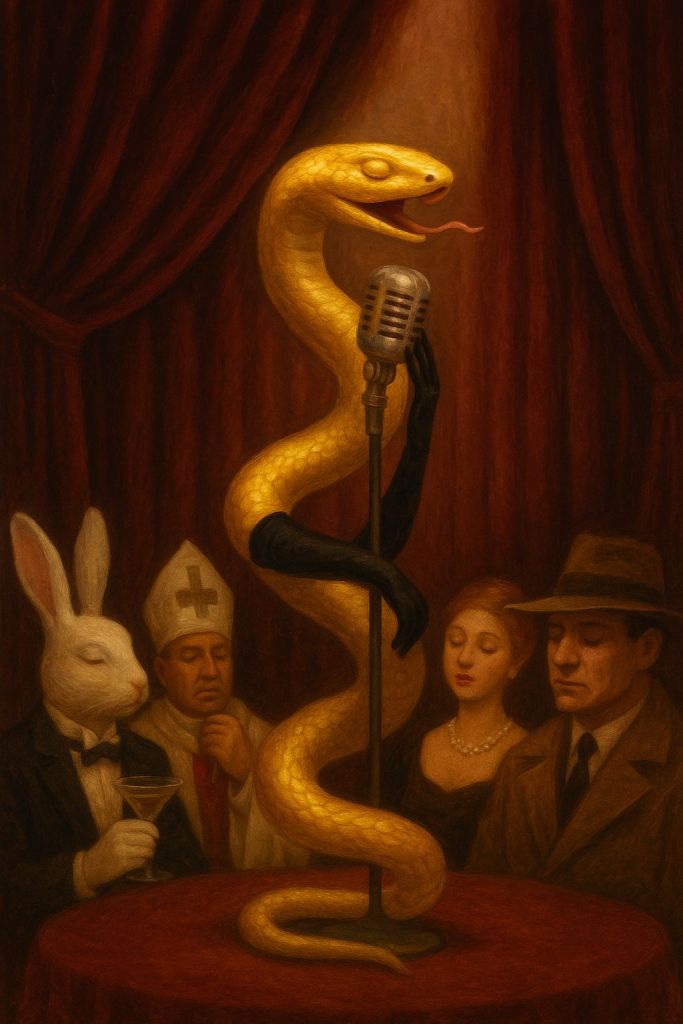
Title: The Velvet Serpent Cabaret

Medium: Digital Art
Reflecting Randy Sydnor’s application of his unique technique, Mnephonics, this medium blends visual storytelling with symbolic language to evoke memory, learning, and reflection.

Style of Art: Surrealism

Dimensions: 1024 x 1536 px

Copyright: Randy Sydnor, The Mnephonist

Description:

In every whisper, there is a wager. The Velvet Serpent Cabaret invites the viewer into a space where language itself performs—slipping between truth and illusion with each syllable. Here, seduction is not just a gesture; it is strategy.

Rendered in digital elegance, the piece evokes the opulence of oil while capitalizing on the precision and luminosity of the digital medium. With Mnephonics at its core, each visual element becomes a symbolic glyph—designed to slip into memory like a song you didn’t know you knew. The serpent’s gloved coils, the vintage mic, and the velvet drapery become mnemonic triggers—linking sound to sensation, impression to intention.

At center stage coils the golden serpent, dignified and dangerous. Draped in black opera gloves, it performs not merely for applause but for sway. Its pose is confident, almost human in its bearing, suggesting both performance and plot. Its eyes do not search the crowd—they scan it, as if already tallying the cost of every gaze.

The audience—an anthropomorphic confessional of archetypes—leans in: a martini-holding rabbit in a tux, a bishop locked in silent prayer, a pearl-draped debutante, and a world-weary detective. Each reflects a fragment of society’s masks. But their trance betrays the twist: they’re not watching a concert. They’re accessories to a heist of attention, innocence, and certainty.

Philosophically, the piece reverberates with the paradoxical poise of Marcus Aurelius: “The nearer a man comes to a calm mind, the closer he is to strength.” The serpent’s serenity is its cunning. The performance becomes an allegory of persuasion—how we lean toward beauty and away from caution. The visual narrative aligns with Dadaist subversion and echoes the theatricality of fin-de-siècle cabaret art.

Visually, the burgundy velvet curtains press in like theatre wings of the unconscious, while a single golden spotlight falls not just on the serpent—but on the viewer’s complicity. The warm, chiaroscuro lighting draws out texture and temptation, while subtle shadows suggest what’s unsaid. Each compositional choice steers the eye toward revelation and then immediately toward misdirection.

In the end, The Velvet Serpent Cabaret asks: when we surrender to beauty, are we choosing clarity—or illusion?


© Randolph M. Sydnor
Prints and digital sale of work is available
Email for more information: rsydnor@mnephonics.com

Ink, Iron, and Imagination: The Metamorphic Artistry of Love, Death + Robots

Love, Death + Robots (2019–2025)


Ink, Iron, and Imagination: The Metamorphic Artistry of Love, Death + Robots


No anthology in recent memory has fused science fiction, surrealism, horror, and satire with such visual virtuosity as Love, Death + Robots. Created by Tim Miller and executive produced by David Fincher, this series redefines animated storytelling not as a genre but as a kaleidoscope of possibilities.

Across its three volumes, Love, Death + Robots oscillates between the apocalyptic and the absurd, the poetic and the profane, the sublime and the grotesque — with each short film a self-contained universe of style, story, and speculative inquiry.

If animation has long been dismissed as the territory of children or the kitsch-prone, this series is the rebuttal — an operatic chorus of artistic ambition. Every episode (ranging from photo-realistic CGI to stark black-and-white ink strokes) offers not just a story, but a different soul.

This is not one show, but many masks worn by the same archetype: humanity, questioning itself in myriad futures. And in its best moments, Love, Death + Robots doesn’t just entertain — it haunts, provokes, and elevates.


Narrative Overview

As an anthology, Love, Death + Robots resists a traditional plot summary. Instead, it is a constellation of narratives — each complete, self-contained, and yet thematically tethered by a fascination with humanity’s relationship to creation, control, chaos, and consequence.

Among the most celebrated entries:

“Sonnie’s Edge” sets the tone with cybernetic gladiators and questions of autonomy. A woman weaponizes her trauma, channeling it through a bioengineered beast. The twist: the creature is her.

“Zima Blue” transforms from a sci-fi profile piece into a metaphysical meditation on art and origin. A cosmic muralist reveals he was once a pool-cleaning robot, seeking to return to simplicity — a modern-day Icarus unlearning his wings.

“Three Robots” offers satirical respite, as post-apocalyptic androids tour human ruins like a safari. Their deadpan curiosity mocks and mourns our extinct habits.

“The Drowned Giant” (narrated like a Borges short story) documents a beached colossus, its awe diminished as the public desecrates it. The giant becomes trash, then myth — a parable of wonder lost.

“Bad Travelling” (directed by Fincher) is a sea-bound gothic nightmare, in which a captain negotiates with a monstrous crustacean. The power struggle plays like Melville meets Machiavelli.

“Jibaro” (Oscar-worthy in style and sound) reinvents the siren myth as a gold-encrusted ballet of lust, greed, and colonial symbolism. With no dialogue, its choreography and sound design strike like a spell.


Each narrative offers a moral or a mirror. Some ask what separates man from machine; others question if that boundary ever existed. Some revel in violence; others recoil from it. Most of these vignettes unfold in ten to eighteen minutes — bursts of concentrated vision that waste no frame. The joy of Love, Death + Robots is not predictability, but provocation.


Symbolism & Subtext

Symbolism in this series is not adornment — it’s architecture. Nearly every episode functions as a parable.

In Zima Blue, color is memory, and abstraction is enlightenment. The final panel — a simple blue tile — is both tombstone and liberation.

Jibaro weaponizes sensory overload. The siren’s gold plating symbolizes colonization — beauty as bait, then conquest. The knight’s deafness, once his shield, becomes his doom when he hears the song too late.

The Drowned Giant reflects society’s diminishing reverence for mystery. The giant becomes not a marvel, but a carcass — a symbol of how spectacle erodes sanctity.

In The Witness, reality loops upon itself — voyeurism becomes a curse, the gaze a prison. The stylized animation enhances the dreamlike horror.


Across volumes, robots symbolize us more than they parody us. Our machines remember us as ironic gods — powerful yet petty, brilliant yet doomed.


Memorable Moments & Key Details

The final shot of Zima Blue: a robot returning to a pool, scrubbing tiles with silent grace — the sublime in the mundane.

In Jibaro, the siren’s glittering tears blend beauty and violence into an elegy of sensory trauma.

The moment the Three Robots find a cat and fear it might explode if they stop petting it — a nod to human superstition embedded in AI logic.

The horrifying elegance of Good Hunting, where a shapeshifting spirit becomes a steampunk sex worker — a collision of folklore and futurism.

Snow in the Desert: an immortal man seeks companionship, only to find that survival means loneliness.


🎥 Strengths & Weaknesses

Strengths:

Animation diversity: From photorealism to hand-painted abstraction, every episode feels like a new visual dialect. This metamorphic aesthetic elevates the anthology into a gallery.

Narrative punch: Most episodes distill philosophical heft into less than 15 minutes — storytelling as short-form surgery.

Sound design: Whether silent (Jibaro) or saturated (The Secret War), soundscapes heighten mood and metaphysical unease.

Creative freedom: Each story bears its own signature, unburdened by franchise bloat or audience appeasement.


Weaknesses:

Tonal whiplash may deter some viewers. The leap from satire to horror to meditative silence isn’t for everyone.

A few weaker entries (Ice, The Tall Grass) feel conceptually thin, more aesthetic sketch than full meal.


🎭 Production Design & Costumes

Each episode’s universe arrives fully formed. From the militaristic grime of Sucker of Souls to the psychedelic futurism of Pop Squad, no two episodes look alike. Costume design, even when rendered digitally, reflects inner character — gold-plated arrogance, leather-clad survival, or the nakedness of vulnerability. Even the robots wear identity like clothes.


🖋️ Writing Style & Literary Devices

The writing across episodes spans satire, tragedy, fable, and allegory. Literary techniques abound:

Irony (robots touring human extinction like tourists).

Allegory (The Secret War as a metaphor for Cold War paranoia).

Hyperbole (The Dump reveling in grotesquerie).

Allusion (classical myth retold in futuristic garb).

Foreshadowing (often nested in silent visuals rather than dialogue).


🔄 Comparative Analysis

Love, Death + Robots descends from the lineage of Heavy Metal, The Animatrix, and Rod Serling’s The Twilight Zone. But unlike those, it does not merely speculate — it interrogates. Its stories do not predict the future; they question whether we deserve one.

Its genre agility and visual ambition make it more than anthology — it’s animation as literature. Where Pixar mines the heart, Love, Death + Robots mines the mind and spirit (often by breaking them first).


🏆 Verdict

Love, Death + Robots is not just a show. It’s a fever dream, a philosophical archive, a love letter to the boundlessness of animation. With two Emmys under its belt and another likely incoming, it redefines what adult animation can achieve. Its beauty lies not in consistency, but in its chaos — and within that chaos, a quiet, persistent search for meaning.

Final Score: 3.95 / 4.0 — A (97%)

Legacy Factor: A cornerstone of 21st-century animated storytelling. Future creators will study it. Viewers will rewatch it. And the robots — they will remember us.

🫖 Perseverance, Ponderings, and the Perfect Cup

25-4-25-F
115 ⏳ 250 🗓️ W17
RMSDJ 📖 ✍🏽
🌡️61° – 48° 🌤️
🌘 ♈


🫖 Perseverance, Ponderings, and the Perfect Cup

The night granted me a rare kindness. Two acetaminophen and two Aleve, my modest allies, dulled the ache in my back and ushered in a sleep deeper than I have known for weeks. Perhaps the deeper slumber owed itself not merely to chemistry, but to the small experiment of omitting glucosamine and chondroitin from my nighttime regimen. A pivot, minor yet meaningful.

Morning unfurled with an unexpected 30-minute ritual of mild stretching — an offering to the slow resurrection of my body. I moved carefully, like a ship easing itself back into water after long dry dock. In the mirror’s pale reflection, I glimpsed the outline of a six-pack, a quiet testament to discipline’s long labor. Though four or five pounds yet cling stubbornly to me, I found a rare satisfaction standing there, midstream in the morning’s current.

💡 Epictetus: “First say to yourself what you would be; and then do what you have to do.”

❓ How often do we overlook the small adjustments that, over time, recalibrate the very course of our lives?

The day carried on its own eccentricities. Sergio Gomez from One Generation called, regret heavy in his voice. The resurfacing of the Meridian Point driveway, ordered by the ever-ambitious management, blocked any food deliveries to the door. Out I went, like a reluctant courier, to retrieve the meals myself. Lasagna, limp and listless; vegetables, overcooked into mush. Hardly the feast a man dreams of, but sustenance nonetheless.

Back inside, I separated the milk and salad, setting aside Lorena’s daily gift — a quiet ritual now. Lorena, the maintenance employee with warm eyes and a laugh like sunlight on a dusty floor, waits each day for her portion, and I gladly oblige.

Wandering through the lobby, I encountered a relic: a dual hot plate, sitting there as if forgotten by time. Matt, the maintenance engineer, informed me it was spare equipment for tenants. Briefly tempted by visions of boiling water for tea like an old sea captain aboard a storm-tossed ship, I resisted — persuaded instead by Matt’s enthusiastic pitch for an electric kettle. Within minutes, I found myself swept up in the great modern bazaar of Amazon, selecting a sleek vessel to summon my morning brew with greater dignity.

💡 Lao Tzu: “A journey of a thousand miles begins with a single step.”

Soon, my Corsair kettle will arrive — a device that will whistle a hymn to morning rituals and lend my tea the proper ceremony it deserves. No more microwaved indignities. A cup of tea, properly steeped, is less a beverage than a benediction.

❓ What simple rituals do we neglect, not realizing they could sanctify the ordinary hours of our days?

Still, another temptation brews: a small device to keep the tea warm throughout my morning writing sessions. I contemplate it as Crusoe might ponder building yet another tool upon his island — less from want, more from the quiet joy of self-sufficiency.

Anna Sanchez crossed my path today, curiosity gleaming in her eyes. We spoke at length about the fasting life — a philosophy of patience and restraint. I directed her to the very app I use, guiding her steps toward a healthier shore. She listened intently, her resolve budding like spring after a long, weary winter. She asked me, sincerely, to be her reminder, her quiet lighthouse through the fog of old habits. I accepted gladly.

💡 Lao Tzu: “A journey of a thousand miles begins with a single step.”

❓ How often do we forget that even the smallest encouragement can anchor someone else’s hope?

Later, soft guitar melodies flowed through my room, courtesy of Amazon Prime. Their gentle rhythms stitched together the fragments of my morning — updating the blog, weaving new diary entries, conjuring fresh artwork. Each note felt like sunlight through leaves, reminding me that artistry, like living, thrives on rhythm.


🏋️‍♂️ World’s Gym: Old App, New Ritual

The day’s second adventure belonged to technology — a fickle companion. My World’s Gym app, faithful once, now lay inert. Gold’s Gym had shifted to a newer, lesser-rated app, the SoCal edition, promising 3.8 stars of frustration.

Fisher, the gym’s general manager — broad-shouldered, sandy-haired, with the permanent squint of one who has seen too many login screens betray him — aided me in navigating the digital labyrinth. After deleting the old app, downloading the new, and resetting credentials, the beast finally stirred.

Choosing a profile photo posed a small dilemma. I settled on a cartoon image commissioned long ago, a whimsical portrait of myself — animated yet unmistakably me. The old gym database, however, retains my original photo like a ghost trapped in a frame. No matter. In the grand scheme, a small triumph.

The workout itself was steady and satisfying. Abs awakened first, followed by the rhythmic pull of the SkiErg. Standing calf raises — fifteen sets of determined elevation. Hammer strength pulldowns — a slow, grinding symphony of muscle and breath. Nothing heroic, merely the steady, unyielding persistence that reshapes a man, day by day.

💡 Seneca: “It is not that we have a short time to live, but that we waste much of it.”

❓ How much time do we squander waiting for conditions to be perfect, when the real perfection lies in the steady act of doing?

Before I departed, inspiration struck like a rogue wave. In the cool aftermath of exertion, I created fresh artwork for my diaries — vibrant, full of the life force I’d summoned from the morning’s discipline.

There is a simple, sacred pleasure in doing what must be done. In lifting. In listening. In living deliberately.


❓ What hidden joys await us, simply for choosing to stay faithful to the work of today?


💡 Søren Kierkegaard: “Life can only be understood backwards; but it must be lived forwards.”


Reflection

Today was stitched together not by grand gestures, but by small, steady acts of persistence: a stretch, a conversation, a cup of tea, a line of prose. In this, I find life’s truest music — not the thunderous chorus of triumph, but the quiet hum of faithful endeavor.

RMSDJ

Title: Perseverance, Ponderings, and the Perfect Cup
Style: Cubist Surrealism
Format: Vertical canvas
Palette: Earthen ochres, muted blues, storm-gray, sienna, gold

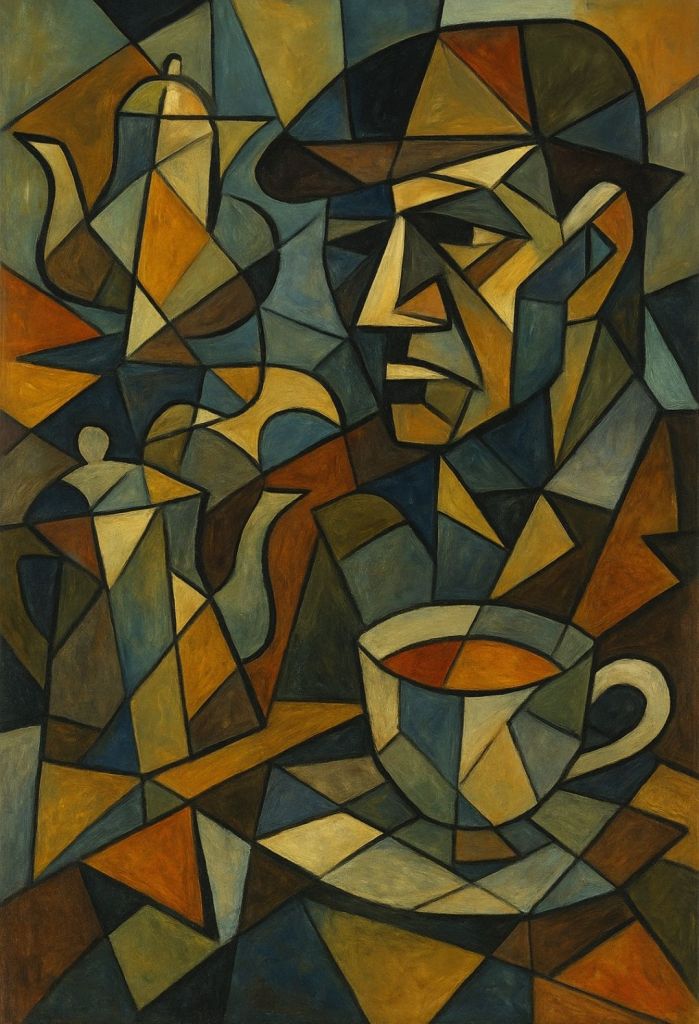
This Cubist-Surrealist composition captures the ritual of morning reflection through fractured geometry and layered symbolism. A contemplative male figure, angular and abstracted, gazes toward a steaming teacup — both cup and kettle rendered in intersecting planes, as if time and thought had splintered them into memory and motion. His gaze is both inward and outward, suggesting a mind suspended between the persistence of habit and the weight of philosophical inquiry.

The teapot, exaggerated in form and floating above its base, suggests ascension — a small act made sacred. The teacup below, perfectly imperfect in its construction, glows with a golden infusion, hinting that within the mundane lies transcendence.

A swirling interplay of light and shape evokes the fragmented texture of lived experience — the grind of the daily, the serenity of ritual, and the silent clarity that comes only in stillness.

This piece is a meditation on devotion to the ordinary, the sacred rhythm of repetition, and the quiet heroism of a man making tea while rebuilding himself.

Perfect for a study, reading nook, or reflective space where ideas steep as slowly and powerfully as the perfect cup.

Piercing, Prophylactic & Perspicacity


25-4-22-Tu
112 ⏳ 253 🗓️ W17
RMSDJ  📖 ✍🏽 
🌡️74° – 51°  🌤️
🌘  ♒ ♓


Piercing, Prophylactic & Perspicacity

After yesterday’s arduous workout—nearly fifty minutes of weight training followed by forty minutes of water aerobics and an ab wheel finale that could only be described as penulating—my lower back issued its own sharp rebuke. The piercing pain in the lumbar region greeted me unbidden upon rising. A signal. A flare. A body no longer in the incipience of strength, but in the fugacious dance with recovery.

I deputed myself immediately to pain management: two Aleve, two caffeinated acetaminophen, and, in a rare act of medicinal diplomacy, ibuprofen. I rarely layer these substances, but a priori knowledge told me one remedy wouldn’t suffice. I opted to forfend a downward spiral into immobility.

My morning routine, normally a kinetic liturgy of thirty minutes, was pared to a gentle fifteen. A whisper of movement. Abdominal stretches. Calf extensions. A brief communion with stillness. My body seemed to whisper: oblige me. So I did.

💡 Marcus Aurelius: You have power over your mind—not outside events. Realize this, and you will find strength.

His aperçu met me this morning in the silence between stretches. Strength, in this case, meant restraint. Power, the decision to pause.

Pain triggered fear. Not panic—but that quiet, epistemic fear that lives beneath the ribcage. The kind that reminds you how close the body stands to the edge, even when the mind feels distant from danger.

The remainder of the morning was devoted to the epistemic labor of marketing strategy. I returned to the scaffolding of Questions of Value, a task both invigorating and exacting. It demanded clarity, resilience, and eptitude. The idea of launching a “Quote of the Day” campaign held promise, particularly when imagined as a series of reels infused with poetic brevity. Another concept—a downloadable Reflection Companion Guide—felt both elegant and functional. I’m less certain about the workbook suggestion; while innocuous in nature, it may risk diluting the philosophical heft of the project.

💡 Søren Kierkegaard: Life can only be understood backwards; but it must be lived forwards.

And so, with Kierkegaard echoing in my ear, I sifted thought from thought—each one a ledger entry in the economy of purpose. These thoughts, though taxing, never felt prodigal. They were investments. Strategic contemplations forged through careful listening to what the work itself demanded.

💡 Question: What are you doing today that your future self will thank you for?

By afternoon, the medication had softened the ache. I felt restored, if not fully renewed. I wanted to continue my training—sensibly, deliberately. And so I made my way to the Zone Gym. Nothing excessive. Just a circumambient stroll among machines, a light flirtation with effort, and a commitment to healing.

💡 Epictetus: It’s not what happens to you, but how you react to it that matters.

Even healing, as Epictetus taught, is an act of discipline.


RMSDJ


Title: Piercing, Prophylactic & Perspicacity

Medium: Oil on Canvas
Reflecting Randy Sydnor’s application of his unique technique, Mnephonics, this medium blends visual storytelling with symbolic language to evoke memory, learning, and reflection.

Style of Art: Symbolic Surrealism with Geometric Cubism

Dimensions: 24” x 36”

Copyright: Randy Sydnor, The Mnephonist

Description:


Three forces—penetration, protection, and perception—converge in this visual meditation. Piercing, Prophylactic & Perspicacity explores the inner architecture of discernment: how we see, shield, and strike through the noise of experience.

(Medium and Technique – The Artist’s Craft)
This vivid oil painting uses layered Cubist geometry to fragment and reassemble meaning. Mnephonics, Randy Sydnor’s signature technique, pulses through the piece—each angle, hue, and shadow embedded with symbolic resonance. The surrealist elements offer dream-logic clarity, where sharp objects coexist with metaphysical insight.

(Central Figure or Focus – The Visual Heart of the Piece)
At the center, an all-seeing eye floats in a lattice of intersecting shapes. It is not passive. The eye pierces. Around it, a translucent orb hints at a membrane—a visual stand-in for prophylaxis, protection not through avoidance but through lucid boundary. Cutting across this vision is a syringe: sleek, severe, almost luminous in its symbolic sharpness. It is both literal and allegorical—suggesting healing, disruption, and the urgent necessity of precision.

(Supporting Elements – Symbolic Imagery and Details)
Above the composition, a radiant sun unleashes a beam that intersects with the syringe’s path. The beam becomes both a scalpel and a spotlight—lighting the terrain of thought and slicing through the veil of confusion. The lower quadrants, composed of angular clouds and warm-toned shadows, speak of things half-seen, half-felt: the emotional debris of daily perception. Every corner of the image offers fragments that refract the core message.

(Philosophical or Artistic Reflection – The Soul of the Piece)
W.E.B. Du Bois might have seen this image as the veil lifted. Simone Weil would have seen it as attention crystallized. The piece wrestles with the nature of clear thinking in murky times. Perspicacity is not granted; it is carved. The prophylactic layer is not denial—it is sacred space. And the piercing force is not violence—it is insight made surgical.

(Color and Composition – The Visual Language)
Deep teals and umbers clash and embrace with saffron, crimson, and gold. The palette hums with tension, then relents into harmony. Sharp diagonals guide the eye along a trajectory—sun to syringe, orb to iris—constructing a rhythm of cognition. The geometry is both architecture and aperture, shaping what is seen and what is still veiled.

(Closing Thought – Invitation to Reflect)
How do we guard what matters while seeing what is? This piece suggests that wisdom lies not in hiding from the world, but in choosing how we let it enter. Carefully. Courageously. With clarity.


© Randolph M. Sydnor
Prints and digital sale of work is available
email for more information: rsydnor@mnephonics.com

Anatomy of the day

25-4-21-M
111 ⏳ 254  🗓️ W17
RMSDJ  📖 ✍🏽
🌡️78° – 52°  🟡
🌘  ♒


Anatomy of the Day

Last night granted me a full harvest of rest—nine uninterrupted hours. I retired around 2200 and rose just after 0700. The conclusion felt inarguable: my physiology does not merely request nine hours—it demands them. When the body engages daily in intellectual marathons and physical exertions spanning up to two hours, eight hours of rest becomes a kind of mythological ideal—chiseled into our culture but misaligned with real recovery. Perhaps that has been the missing link all along: sleep not as indulgence, but as strategy.

I began my fast early, around 1700. When it breaks today, the fast will have lasted approximately 19 hours. More than the duration, it marked a quiet discipline: my first evening without sustenance, a liminal passage between hunger and intention. There was clarity in that pause. Hunger sharpened my resolve.

Upon waking, a necessary omission from Questions of Value became apparent. How could one write a book of questions without first exploring what makes a question good? The absence felt like a philosophical casus belli—a just cause for immediate revision. I devoted the morning to crafting “Anatomy of a Question,” a 2,000-word inquiry into the very architecture of asking. I sent both the text and its accompanying artwork to Steve Harris at Amazon KDP. The piece will anchor the reader to a deeper inquiry, one that does not merely scratch but pierces.

Sergio from One Generation stopped by with what he described as a pre-packaged ten-meal portion of chicken Alfredo. In truth, it resembled a bland arrangement of chicken and soggy broccoli, steamed into submission and leaking an odor faintly sulfuric. I quietly discarded the vegetables once he left. Still, the intention mattered more than the meal. As Epictetus reminded us, “Wealth consists not in having great possessions, but in having few wants.” I accepted it with gratitude.

He mentioned that his Easter unfolded beautifully. Arren passed by just as Sergio departed. He confirmed receiving my Easter message but somehow missed the artwork. Timing, as always, governs more than we admit.

Caesar Cervantes—leasing agent, local Caesar—drifts through the complex like a man born for dominion but fated to paperwork.

A flicker of pain nudged the base of my spine. I’d handled the Ab Carver cautiously, so perhaps my morning stretches had overreached. Two Aleve and a caffeine-acetaminophen blend provided a chemical shield. Better precaution than pain.

10:58: Arrived at the Zone.
11:00: Serratus crunch.

Later, I found myself cheek by jowl with the inefficiencies of modern telecom. I began by contacting T-Mobile customer service—not because of the issue with Jonathan’s call initially, but to address Billy’s line. Since the number remains occasionally useful, I wanted to preserve it without incurring unnecessary expense. The only viable option involved converting the line into a data-and-text-only plan at $20 per month. I stripped away a host of redundant services tethered to that number, trimming the fat from an overfed billing structure.

While reviewing the account, I discovered my assumption about complimentary Netflix access had been misplaced. The plan only included the most rudimentary tier—Netflix Basic. Meanwhile, we still paid $18 monthly for the premium version. A subtle sleight of hand, more omission than deception. I considered downgrading, but the prospect of intrusive advertising felt unbearable. Some things simply aren’t negotiable. As Marcus Aurelius reminds us, “The impediment to action advances action.” In this case, inconvenience reaffirmed the value of tranquility.

With that matter resolved, the representative kindly transferred me to technical support. I explained a separate issue: my attempt to call Jonathan Nguyen, my long-time auto mechanic, triggered an odd message—my phone allegedly lacked permission to make outgoing calls. Jonathan’s line had been disconnected during his recent move. The technical agent listened with genuine care. Together we reset the network, and order returned.

Thanks to her initiative—and my having Jonathan’s direct number—she reached him on my behalf. He confirmed that his move from Northridge to Sylmar had proven arduous, tangled in setbacks and delays. City permits slowed their pace, old parts went missing, and the new garage had yet to feel like home. He permanently closed the old shop. The new location, Mad Auto—named for his father’s garage—now carries the family legacy. I’ll bring him the car Monday for its smog inspection. Not convenient, but loyalty rarely is.

In a welcome coda, my phone bill dropped from $165 to $118—a modest but meaningful victory.

On my way back from taking out the trash, I crossed paths with Brian. He shared concern about a tenant creating disruption—loud, belligerent. We joined Aaron in the hallway, a man of formidable size and surprising grace. His steps, though heavy, held an odd precision. We walked together to investigate. There we found the source: a man I’ve passed often, now drunk and disheveled, stirring up noise and tension. Two Black men now stood cheek by jowl—one in a dudgeon, the other in a stupor. Being drunk does not make one evil, but it does fog the moral compass. And by midday, the fog thickens.

After reviewing the Landrum Law Firm contingency agreement for settlement purposes only, I encountered Fred Robey, the building manager. He looked worn—his shirt half-untucked, his face marked by sleepless nights. He mentioned stress: this building, the house he’s constructing from scratch, his wife, his kids. A life crammed full, resilience stretched taut.

Two checks arrived: one for $6,000 from Landrum Law Firm, the other a $60 cashback reward from Costco. The latter will fund my next Costco pilgrimage. The former likely finds its way into the Chase account. I may transfer $1,000 to Bank of America—a redistribution of liquidity.

Late afternoon brought the pool. A 40-minute water workout—side shuffles, high knees, backward sprints. The water held me like an old friend. I ran, bounded, floated. Fred passed by and granted me access to the Jacuzzi. Repairs begin tomorrow. I pray it won’t return in some jimcrack approximation of a spa. For today, I soaked for 30 minutes, letting warm water unknot my spine. An Audible selection on Michelangelo kept me company. Who knew he built fortifications? I do now. And his unfinished sculptures—those raw, yearning blocks—speak more loudly than polished marble. Perhaps completion is an illusion.

Back upstairs, I gave my abdominals five minutes of disciplined attention. Cautious, methodical. Dinner followed: brown rice, grilled chicken breast, pumpkin seeds, and cashews. I blended a vegetable-fruit smoothie in the Vitamix, rich and clean. No waste.

As I reflected on the day, a line from Lao Tzu came to mind: “To attain knowledge, add things every day. To attain wisdom, remove things every day.” Today removed clutter—mental, digital, dietary—and revealed a shape more whole.

RMSDJ

Wall Art Description Prompt

Title: Anatomy of the Day

Medium: Oil on Canvas
Reflecting Randy Sydnor’s application of his unique technique, Mnephonics, this medium blends visual storytelling with symbolic language to evoke memory, learning, and reflection.

Style of Art: Surreal Cubism

Dimensions: 24” x 36”

Copyright: Randy Sydnor, The Mnephonist

Description:

(Opening Statement – Establish the Central Theme or Emotional Tone)
What if each day were not a blank slate, but a living anatomy—veins of time, a skeleton of habit, muscles of meaning? Anatomy of the Day explores this unspoken biology of experience through fractured geometry and radiant form.

(Medium and Technique – The Artist’s Craft)
Crafted in vibrant oil, the piece captures the muscular expressiveness of Cubism fused with the symbolic intention of Mnephonics. Every shard of color acts as a mnemonic trigger, guiding the viewer through the psychological topography of time and purpose. Randy Sydnor’s brush does not simply depict—it deciphers.

(Central Figure or Focus – The Visual Heart of the Piece)
A human figure stands as the core—torso angular, chest exposed in planes of sienna, gold, and umber. The form, stripped of superficial detail, radiates a sense of interior purpose. Neither static nor in motion, the figure appears to contain the day itself, eyes fixed on something beyond the horizon of obligation.

(Supporting Elements – Symbolic Imagery and Details)
The sun bursts behind the figure—shattered into geometric rays that flood the canvas with amber and lemon hues. Below, a clock anchors the lower quadrant, hands pointing to 7:25—an hour

The Grace of Returning

The painting evokes a dreamlike atmosphere, rendered in soft, luminous tones of gold, blue, and earthy pastels. At its center stands a stone archway, glowing with warm, otherworldly light that spills gently into the surrounding space. A solitary human figure, abstract and ethereal, approaches the threshold—neither hurried nor hesitant, but with a sense of quiet purpose.

In the foreground, a single red lily emerges from the earth, vivid against the muted ground—a symbol of life, renewal, and fragile beauty. The composition blends surrealism with impressionistic softness, creating a visual meditation on return, resurrection, and the grace of quiet beginnings. The image feels both sacred and personal—an invitation to step into light, to rise without spectacle, and to remember that even the smallest bloom can mark the start of something extraordinary.

25-4-20-S
110 ⏳ 255 🗓️ W17
RMSDJ  📖 ✍🏽
🌡️79° – 53° 🌤️
🌗 ♑ ♒


🎶 A Song That Prayed Back

This morning began with reverence. I sent forth my Easter message—a small offering stitched with meaning, accompanied by a luminous image that felt like a stained-glass whisper. Sixty-five souls in my circle received it, and the response was warm. Affirming. The kind of kindness that arrives without fanfare but leaves a scent in the room after it’s gone.

Eugenia Dillard replied with a gift of her own—a YouTube link, simple and unassuming, but behind it: a voice, a cry, a prayer. Gladys Knight’s rendition of I Know That My Redeemer Liveth wasn’t merely sung. It rose. It trembled through her silky alto and then settled somewhere unspoken—less a song than a devotion in velvet form. A sanctified hush in musical shape.

I wrote her back: It felt more like prayer than performance. Eugenia responded with one line: Exactly. No need for elaboration. When truth lands properly, it requires no echo.

I knew the days ahead might deny me my sanctuary in the Jacuzzi—maintenance or fate or some unseen inconvenience—so I carved space for it today. Water greeted me as a friend who remembers. My body moved in arcs and bounds—38 minutes of flowing resistance: sprints, bounding strides, lateral glides. The sun flirted with clouds, casting gold one moment, shadow the next.

Then came the soak—25 minutes, limbs submerged, thought suspended. Aristotle joined me via Audible, unfolding his vision of politics, virtue, and the shape of the good life. His voice through another’s voice, resonating in the space between jets and philosophy.

Back at the apartment, I broke my fast late and lavishly. Lasagna and a salmon sandwich laced with blue cheese, followed by an indecent parade of chocolates, all crowned by a black coffee symphony I’ve nearly perfected. A touch of port wine, a lift of creatine, BCAA, glucosamine, cinnamon, vanilla, stevia—and it sings. Not a drink. A ritual. A concoction of sustenance and self-regard.

No feast today of grandeur, no crowds of believers, but in the song and in the soak, I found resurrection of another kind. Something rose in me—not grand, not loud—but quietly enduring.

RMSDJ.

Easter Message: The Grace of Returning

This Easter, I find myself thinking less of hallelujahs—and more of quiet beginnings.

A flower pressing up through cold soil.
A voice calling after long silence.
A door left open—not wide, but enough.

I’ve been reflecting on how some things return not with trumpets, but with tenderness.
Not in victory, but in vulnerability.

Not everything that rises makes a sound.
Some resurrections are quiet.
They begin with a breath, a glance, a decision to try again.

This, too, is Easter.
Not just the triumph over death,
but the patience it takes to live again.

To forgive.
To reach out.
To hope where we once hardened.

True beauty lies not in what comes back unchanged,
but in what returns carrying grace.

May this season meet you gently.
May you recognize your own return in small things.
And may you know: love still rises.
It always has.
It always will.


P.S.

Questions of Value: Volume One – Foundations of Becoming will be released in two weeks. I’ve spent the past two months arduously laboring over its pages—combing scripture, philosophy, and lived questions to shape something both thoughtful and enduring. I hope it meets you where you are—and offers a light worth carrying.

✍🏽 Drift, Discipline & Da Vinci

25-4-19-Sa
109 ⏳ 256  🗓️ W16
RMSDJ  📖 ✍🏽
🌡️77° – 51° 🟡
🌘 ♑


✍🏽 Drift, Discipline & Da Vinci

I awoke early—6:47 to be precise—but lingered in the space between sleep and waking, that half-lit threshold where dreams dissolve and reality waits. I drifted, unmoored, back into slumber, only to rise again at 9:05, surprised by the passage of time, as though it had tiptoed past while I remained suspended in stillness.

The morning unfolded with its usual rhythm: stretches, breath, and that slow awakening of the body that invites gratitude. I thought about the good—about the weight and wonder of completing Volume I: Questions of Value. It stands now not as a project, but as a testament. A contribution. A quiet beacon, forged in solitude, destined to outlive its author. I feel that. I feel its echo already stirring beyond me.

Yesterday’s call with Mike Kia carried the sharp tang of reality. He offered a proposed split—70/30—favoring Beachfront Properties. At this juncture, I’ll take what I can. If the settlement falls between $100,000 and $200,000, I will consider it fair, even if I suspect it may fall short. Still, something is owed. Not for aspiration, but for the daily wear of habitability—the leaks, the mold, the broken promises of shelter. That, at least, has a value.

Mike and I must speak again soon. There is nuance here, the kind that law rarely captures but life remembers.

Admittedly, I felt a pang of disappointment—no, not sorrow, but a muted ache—for not writing more in my diary. Questions of Value absorbed me entirely. But now the pendulum swings back, and other projects call: a long-overdue review of Love, Death & Robots on Netflix, a retrospective of Do the Right Thing, and a meditation on 1923—Paramount’s gritty and evocative saga that deserves its due. The work remains, and I return to it with eagerness.

Later in the afternoon, I sank into the Jacuzzi for 45 unhurried minutes, letting the heat unknot my muscles while Walter Isaacson’s voice unspooled the final chapters of Leonardo da Vinci. Genius, curiosity, and obsession—Da Vinci did not live around life but through it. He sketched the muscles of man and the flight of birds with equal reverence. Isaacson reminded me that true creativity often lies not in invention but in the meticulous observation of what we dare not overlook. I plan to share these insights with Azra; they will nourish her hunger for learning, as they nourished mine.

To my culinary astonishment, the lasagna—rescued from the deep crypt of my refrigerator where it had slumbered for months—was not only edible but delicious. A gustatory resurrection. I’ve resolved: going forward, all prepackaged delights from Costco will be preserved in freezer bags, sealed like scrolls, and tucked into the freezer—perhaps the wisest $200 I’ve ever spent. That machine prolongs the life of nourishment, and sometimes, of intention.

Later, I watched the Clippers relinquish a winnable game to Denver. It was a tight contest, poorly sealed. Kawhi Leonard played with the kind of elegant restraint that makes chaos look like choreography. Nikola Jokić, enigmatic as ever, missed three free throws in the final moments—proof that even the masters falter under pressure. Still, I believe the Clippers will recover and take the next in Los Angeles. Defense will decide this series.

I spoke at length with Anna and Brian, leasing agents at Meridian Point. We circled around the dismissal of Jonathan—the man whose flirtations through text escalated into something darker. I had warned him, gently, a week prior. He didn’t listen. When Anna arrived, his interest was immediate, too eager, and too practiced. She said nothing—but her silence carried weight. The kind that ends careers. We pivoted to lighter ground, discussing the Easter message I’d sent out. They appreciated it—thoughtful, they said. Necessary, even.

Later, I ventured to LA Fitness for a modest workout—abdominals and spinning. Enough to sweat, enough to reset. I left quickly, compelled by hunger and the quiet joy of anticipation. I stopped by Walmart for spinach, grapes, and cheese—essentials now that my tastes lean toward simplicity. I kept to the list, spent precisely $36, and was out within 25 minutes. I’m more focused now. Purposeful.

From there, I stopped at Ace Hardware—nestled in the shopping center that once housed Toys “R” Us. I purchased a modest clamp for the aerator. A small device, easily overlooked, but perhaps the very thing to prevent another eruption when the water pressure surges. Sometimes, peace is mechanical. And sometimes, salvation comes not with trumpets, but with tubing.

The day passed not in grandeur, but in calibration. I didn’t seize the day—I aligned it. Between creation and stillness. Between Leonardo’s sketches and lasagna’s steam, there was life—quiet, textured, precise. As the old saying goes, I kept my powder dry—resisting the pull of extravagance, choosing instead the slow burn of preparation.

Augustine once observed, The soul is restless until it rests in Thee. Today, I felt that rest—not in withdrawal, but in motion directed inward. In tasks made holy by their intent. In quiet victories no one sees but which shape the soul all the same.

RMSDJ.

What Actors Know (Summary)

https://aeon.co/essays/acting-is-an-ancient-tool-of-connection-we-can-all-play-with

1. INTRODUCTION

John Britton argues that acting is not merely performance but an ancient human technology for connection.

He believes that contemporary culture has traded embodied presence for digital illusion.

The essay explores how acting reconnects us with ourselves, with others, and with the collective wisdom of ritual and art.

Britton positions the actor not as an entertainer but as a guide back to relational presence.

He challenges the reader to rediscover what humans have always known but too easily forget: connection is a practice, not a product.

Through storytelling, anthropology, and philosophy, he suggests that the tools of the actor are available to all who wish to listen, respond, and belong.

2. SECTION-BY-SECTION COMMENTARY

Opening Section – Naming the Disconnection

Britton opens by naming the paradox of modern loneliness amidst technological abundance.

He cites a 2023 Harvard study reporting that 50% of Americans experience loneliness, grounding the essay in present-day data.

He references the U.S. Surgeon General’s warning that loneliness can be as dangerous to health as smoking 15 cigarettes a day.

This section establishes the urgency of the problem and frames acting as a surprising but ancient solution.

Britton sets the emotional and intellectual stakes: in a hyperconnected world, we feel more severed than ever.

Middle Section – What Actors Know

Britton introduces “What Actors Know” as a set of relational tools that anyone can learn.

He insists acting is not deception but devotion to presence, attention, and mutuality.

He writes that acting teaches us how to connect with ourselves and with others in real time.

He argues that the actor’s task is not simply to perform but to listen, respond, and remain open.

This section reframes performance as a human ritual of attunement, not a theatrical trick.

Historical Section – Shamanic Lineage

Britton links modern acting to ancient communal practices such as shamanic rituals and priestly storytelling.

He references Inside the Neolithic Mind to show how early human societies used performance to bind communities together.

These roles, he argues, were not marginal—they were central to meaning-making, healing, and shared identity.

This section expands the scope of the argument by placing acting within the lineage of sacred roles and ancestral memory.

Philosophical Section – The Myth of the Isolated Self

Britton critiques the Western “Story of Separation,” which promotes the self as autonomous and independent.

He quotes neuroscientist Anil Seth to affirm that our inner world is deeply connected to nature and to others.

This section integrates philosophical and scientific thought to dismantle the illusion of individualism.

The actor’s relational intelligence is presented as an antidote to egoic fragmentation.

Practical Section – Embodied Connection

Britton shifts from theory to practice, emphasizing that acting is not reserved for the stage.

He encourages readers to reclaim presence in everyday life using what actors know: attention, breath, stillness, and responsiveness.

He asserts that we can all become “actors” in the sense of becoming more alive to one another.

This section makes the essay actionable and inclusive, inviting transformation rather than observation.

Closing Section – The Invitation to Remember

Britton ends with a call to remember what we already know in our bones—that connection is essential and ancient.

He urges the reader not to adopt new tools but to reactivate old ones.

The final tone is reverent, hopeful, and participatory, positioning acting as both an art and a birthright.

3. KEY CONCEPTS AND WORDS

Disconnectedness
Definition: The state of being emotionally or relationally detached despite technical or digital connectivity.

Sentence from article: Britton says, “Despite our growing reliance on external technology… we are losing human technologies of connectedness.”

This highlights that convenience has not led to closeness, and in fact, has distanced us from presence.

What Actors Know
Definition: A term coined by Britton to describe the relational and embodied skills actors develop through performance.

Sentence from article: “You do not have to be an actor to use What Actors Know.”

This concept democratizes acting, reframing it as a universal human inheritance rather than a specialized craft.

Story of Separation
Definition: A worldview, popular in Western thought, that treats individuals as isolated and fundamentally apart from others and nature.

Sentence from article: Britton invokes Charles Eisenstein’s notion of “the Story of Separation” to critique modern individualism.

This phrase serves as a philosophical target, symbolizing the root of societal and interpersonal fragmentation.

Presence
Definition: The act of being fully physically, emotionally, and mentally engaged in the moment with another.

Sentence from article: “The actor’s job is not to act, but to connect—first with themselves, then with others.”

Presence, here, is not passive awareness but an active relational offering.

Embodied Connection
Definition: A form of communication rooted in physical, sensory, and emotional awareness rather than intellectual abstraction.

Sentence from article: “We engage with our breath and our body and our audience and our presence.”

This phrase underscores the importance of the body in establishing trust, empathy, and belonging.

Shamanic Function of Performance
Definition: The idea that early performers—shamans, priests, seers—served a spiritual and social purpose beyond entertainment.

Sentence from article: Britton writes, “The lineage of the actor includes the shaman, the priest, and the storyteller.”

This positions acting as a sacred practice, connecting individual experience to collective meaning.

4. THEMATIC EXPANSION

Theme: Acting as Connection Rather than Deception

Britton reframes acting not as pretending but as the practice of profound connection.

He writes, “It is not through performance that we deceive; it is through performance that we connect.”

This theme invites a philosophical reversal—truth emerges not in stepping back, but in stepping into presence.

Theme: The Reclamation of Ancient Practices

Britton draws a line from the modern actor to the ancient shaman, priest, and ritual healer.

He references Inside the Neolithic Mind to show that communal performance once held society together.

This theme ties the practice of acting to sacred cultural memory, not mere entertainment.

Theme: The Body as Instrument of Meaning

Britton repeatedly affirms that acting begins in the body, not the brain.

“We engage with our breath and our body and our audience and our presence,” he writes.

This emphasis on embodiment resonates with somatic philosophy and challenges hyper-intellectualized communication.

Theme: The Failure of Digital Communication
Britton critiques screens and social platforms as poor substitutes for presence.

He writes that these tools offer a “facsimile of connection without the fabric.”

This theme highlights the emotional bankruptcy of virtual interaction and suggests that connection requires physical vulnerability.

Theme: The Myth of the Isolated Self
Britton challenges the Western ideal of radical autonomy.

He quotes neuroscientist Anil Seth: “Our inner universe is part of, and not apart from, the rest of nature.”

This theme draws from both neuroscience and Eastern philosophy to argue for an interdependent understanding of selfhood.

Theme: Acting as an Everyday Discipline
Britton emphasizes that “What Actors Know” is not limited to the stage.

He writes that these practices belong to anyone who wishes to be fully present with another.

This theme elevates acting from art form to ethical practice, available to all humans regardless of profession.

5. KEY SENTENCES AND ARGUMENTS

“Without connection, there is no communication.”

This aphorism crystallizes Britton’s thesis and anchors the entire essay in one immutable principle.

“You do not have to be an actor to use What Actors Know.”

This sentence democratizes the wisdom of performance and invites the reader into active participation.

“It is not through performance that we deceive each other; it is through performance that we connect.”

This line flips the popular notion that performance equals inauthenticity and offers connection as its truer end.

“We engage with our breath and our body and our audience and our presence.”

This sentence exemplifies embodied interaction as a layered and intentional practice, not a passive occurrence.

“We are losing human technologies of connectedness.”

This metaphor reframes ancient social instincts as endangered systems, lost in the shadow of digital convenience.

“Our inner universe is part of, and not apart from, the rest of nature.”

This quote from neuroscientist Anil Seth reinforces the essay’s philosophical core—that self and world are not separate.

“Zoom calls connect us across continents, but still leave us hollow in our own kitchens.”

This juxtaposition reveals the central irony of digital life: global reach with emotional absence.

6. VOCABULARY AND CRITICAL ANALYSIS

Phantasia
Definition: A Greek term for imagination or mental imagery, especially in the context of vivid inner experience.

Sentence from article: Britton implies that performance is rooted in the actor’s capacity to summon emotion and image from within.

This term reinforces the essay’s emphasis on the imaginative as a sensory, embodied act—not just an intellectual exercise.

Spect-actor
Definition: A concept developed by Augusto Boal referring to audience members who participate in performance rather than passively observe.

Sentence from article: Britton draws upon the lineage of participatory theater to show that audiences and performers are not separate.

This concept supports his call for relational co-creation over traditional performance hierarchies.

Embodiment
Definition: The integration of mind, body, and emotion in action; a state of fully inhabiting one’s physical presence.

Sentence from article: “The actor’s first and most important job is to connect.”

This idea highlights that performance is not projection but presence—the actor becomes an instrument of awareness.

Clarity
The article excels in clarity by stating its claims directly and avoiding academic jargon.

Each core idea is repeated in multiple forms—narrative, metaphor, and aphorism—for ease of comprehension.

Accuracy
Britton supports his claims using reputable sources like the U.S. Surgeon General and neuroscientist Anil Seth.

This adds scientific and social credibility to his argument, grounding the poetic in the empirical.

Relevance
The topic of loneliness and technological saturation is both timely and culturally urgent.

Britton’s approach to healing this through performance gives the essay wide appeal across disciplines.

Logicalness
The essay’s structure is coherent, moving from diagnosis to solution with a rhythmic build.

Each section contributes to a layered and expanding thesis.

Depth
Britton draws from psychology, ritual studies, neuroscience, and performance theory.

His inclusion of shamanic and anthropological references deepens the philosophical scope.

Breadth
The essay engages multiple traditions—Western, Indigenous, Eastern—without privileging one.

This inclusive framing enhances both the argument’s humanity and universality.

Precision
Britton’s word choices are evocative yet focused, never meandering.

Each metaphor is deliberate, and his aphorisms distill complex insights into memorable phrases.

Completeness
The essay addresses emotional, philosophical, historical, and practical dimensions of connection.

Nothing essential feels omitted, making the argument holistic and well-rounded.

Fairmindedness
Britton acknowledges that digital tools have value, especially during moments like the pandemic.

He critiques without condemnation, always seeking integration over polarization.

7. STRENGTHS AND WEAKNESSES

Strength: Interdisciplinary Breadth
Sentence from article: Britton references neuroscience, anthropology, performance studies, and spiritual traditions.

This diversity strengthens the essay’s intellectual depth and widens its relevance across fields.

Strength: Emotional Resonance
Sentence from article: “Zoom calls connect us across continents, but still leave us hollow in our own kitchens.”

This sentence delivers an emotionally piercing truth about modern life, increasing the essay’s impact.

Strength: Conceptual Clarity
Sentence from article: “Without connection, there is no communication.”

The essay presents its core ideas with clarity and repetition, allowing readers to grasp the message intuitively.

Strength: Invitation over Instruction
Sentence from article: “You do not have to be an actor to use What Actors Know.”

This inclusive tone welcomes the reader into reflection rather than preaching a doctrine.

Weakness: Lack of Practical Guidance
Sentence from article: While the tools are mentioned—breath, attention, stillness—the essay does not explain how to cultivate them.

Readers may feel inspired but unsure where to begin implementing these tools.

Weakness: Idealization of Performance
Sentence from article: Britton romanticizes ancient practices without fully addressing their cultural specificity or limits.

This may oversimplify the complexity of applying sacred traditions across modern secular contexts.

Weakness: Limited Counterarguments
Sentence from article: The piece critiques digital interaction but rarely explores its potential for meaningful connection.

This creates a slight imbalance in the argument, reducing the essay’s dialectical range.

8. IMPLICATIONS

Implication: Acting techniques could be used beyond the stage in therapy, education, and leadership.

Sentence from article: “You do not have to be an actor to use What Actors Know.”

This suggests that presence, breath, and attention are universal tools for relational intelligence.

Implication: Performance practices may help combat the epidemic of loneliness and emotional disconnection.

Sentence from article: “We are losing human technologies of connectedness.”

By reclaiming embodied interaction, societies could reduce isolation and increase emotional well-being.

Implication: Digital communication, while efficient, is inadequate for sustaining deep human connection.

Sentence from article: “Zoom calls connect us across continents, but still leave us hollow in our own kitchens.”

This highlights the emotional poverty of screen-mediated relationships and calls for alternatives rooted in physical presence.

Implication: Reframing performance as sacred practice could renew respect for artists and healers alike.

Sentence from article: “The lineage of the actor includes the shaman, the priest, and the storyteller.”

This repositions the actor as a facilitator of meaning, not a performer of distraction.

Implication: The body must be restored as a site of wisdom, not merely performance.

Sentence from article: “We engage with our breath and our body and our audience and our presence.”

This speaks to a larger cultural need to move from abstraction to embodiment in relationships and institutions.Here is Section 9 – Rhetorical Devices and Language, Coach.

9. RHETORICAL DEVICES AND LANGUAGE

1. Anaphora
Definition: The repetition of a word or phrase at the beginning of successive clauses.

Sentence: “We question its truth. We question its intent. We question its value.”

The repetition mirrors the reader’s own doubt, emphasizing cultural fatigue with mediated experience.

2. Metaphor
Definition: A comparison between two unlike things without using “like” or “as.”

Sentence: “We are losing human technologies of connectedness.”

This metaphor treats empathy and presence as endangered systems, reframing instincts as ancient tools.

3. Aphorism
Definition: A concise, memorable expression of a universal truth or principle.

Sentence: “Without connection, there is no communication.”

This line distills the entire essay into one resonant truth, echoing through each section.

4. Antithesis
Definition: The direct contrast of opposing ideas in a parallel structure.

Sentence: “It is not through performance that we deceive each other; it is through performance that we connect.”

This contrast corrects a common misconception and reframes acting as authenticity rather than artifice.

5. Chiasmus
Definition: A mirrored reversal of structure in two related phrases.

Sentence: “The actor connects with themselves to connect with others, and connects with others to better understand themselves.”

This balance captures the reciprocal nature of relational growth and self-awareness.

6. Allusion
Definition: A reference to a well-known idea, text, or figure outside the immediate text.

Sentence: Britton references Inside the Neolithic Mind to trace acting back to ritual performance.

This allusion lends historical depth and aligns modern performance with ancient spiritual practice.

7. Isocolon (Tricolon)
Definition: Three parallel phrases or clauses with similar length and rhythm.

Sentence: “To listen fully, to respond freely, to be present completely.”

This tricolon adds musical cadence while reinforcing Britton’s central values of presence and attention.

8. Alliteration
Definition: The repetition of the same consonant sound at the beginning of nearby words.

Sentence: “Presence, practice, and performance produce possibility.”

The repeated “p” sound adds rhythm and memorability to the core concepts.

9. Juxtaposition
Definition: Placing contrasting ideas next to one another to highlight their differences.

Sentence: “Zoom calls connect us across continents, but still leave us hollow in our own kitchens.”

The sentence exposes the gap between technological function and emotional fulfillment.

10. Polysyndeton
Definition: The repeated use of conjunctions to slow pace and emphasize each item.

Sentence: “We engage with our breath and our body and our audience and our presence.”

The abundance of “and” forces the reader to feel each element as essential.

11. Asyndeton
Definition: The deliberate omission of conjunctions to quicken pace or intensity.

Sentence: “Listen, respond, feel, connect.”

This rapid rhythm mimics the immediacy of authentic, embodied communication.

12. Personification
Definition: Assigning human characteristics to abstract ideas or inanimate objects.

Sentence: “Loneliness whispers louder than the pings of connection.”

This gives loneliness agency and voice, intensifying its presence and emotional impact.

13. Rhetorical Question
Definition: A question asked to provoke thought, not an answer.

Sentence: “If God exists, why do we call God He?”

This question disrupts assumed language and invites philosophical reflection, aligning with the essay’s existential tone.

14. Analogy
Definition: A comparison made to clarify or explain an idea.

Sentence: “Just as a musician tunes their instrument, so must a human tune their presence.”

This analogy translates emotional calibration into a familiar and physical act.

15. Litotes
Definition: A form of understatement made by negating the opposite.

Sentence: “It is not merely actors who need these tools.”

This phrasing quietly insists that everyone needs them, without sounding didactic.

16. Paradox
Definition: A statement that appears self-contradictory but reveals a deeper truth.

Sentence: “We are more connected than ever, and yet more alone than ever.”

This paradox anchors the central irony of the digital age and sets up the essay’s call to return to presence.

10. ECHO DEVICES

Echo: “What Actors Know”
This phrase appears multiple times as both a title and conceptual refrain.

Its repetition anchors the essay’s thesis and creates a structural rhythm that circles back to the accessi

25-3-20-Th 🤔 RMSDJ 💬✍🏾

25-3-20-Th
79 ⏳ 286  🗓️ W12
RMSDJ  📖 ✍🏽 
🌡️75° – 51°  ☀️
🌖  ♐

🧠 Metacognition & Serendipity: The Dance of Discovery

I received a text message from AD, who was attending a VA event for veterans seeking housing assistance. I told him to handle his business, and we’d catch up later.

By 0900, I was deep into my writing, exploring a concept that had been circling my mind for weeks: What is the question really asking? That inquiry feels deceptively simple, yet within it lies the foundation of true understanding.

A great question doesn’t just seek an answer—it demands a response that reshapes how we think. Asking What is the question really asking? forces us to pause, to probe beneath the surface. It reveals the unspoken assumptions that quietly steer our conclusions. This kind of inquiry reflects the heart of metacognition—thinking about thinking—and echoes the Socratic method, where wisdom emerges not from swift answers but from patient questioning.

For hours, I wrestled with that idea. By 1400, I had formulated a dialogue exploring this method, a conversation between myself and Maestro that I immortalized in Evernote—a codex of evolving ideas. The notes remain untitled for now, but I’ll return to them soon to refine and expand their meaning. Clarity demands patience.

Interestingly, the entire process felt guided by something more elusive—serendipity. As I shaped my thoughts, unplanned ideas began to surface, like scattered puzzle pieces falling into place. Much of what I wrote felt like a collection of fortunate accidents—a reminder that discovery often emerges not from design but from the unexpected. Serendipity, that benevolent trickster, had once again played its part.

I revised the book’s introduction to better align with this new direction. What began as a series of fragmented thoughts had now coalesced into something purposeful—a philosophical framework that places great questions at the heart of meaningful thinking.


🏡 A Surprise Encounter with Fred

At 1030, I peered out my door and startled Fred, our manager at Meridian Point Properties. He jumped back, his face momentarily frozen.

“Man,” he said, laughing, “you scared the hell out of me! I didn’t expect to see you like that.”

I grinned and told him I’d sent an email to him and his assistant property manager, Nuha, about veteran housing. Fred nodded and shared some valuable insights.

“Veteran housing is tricky,” he said. “Yeah, the government pays on time—but only if the vet keeps their paperwork straight. If they forget to file those forms—especially near the end of the year or at the close of tenancy—the payments stop.”

That bureaucratic wrinkle struck me. It’s not enough to secure government support; veterans must remain vigilant with paperwork or risk losing that essential aid. Fred’s perspicacious grasp of these complexities revealed just how deeply he understood the bureaucratic landscape.

Fred’s explanation reminded me that systems that seem straightforward often conceal unexpected complications—a reality that prefigured my later frustrations at Costco.


🍽️ Breaking the Fast

By 1230, I had clocked 16½ hours of fasting. The reward? A surprisingly enjoyable meal: tamale pie paired with black beans—a bold combination that worked better than I expected. The tamale pie, with its rich corn base and spiced filling, felt indulgent yet satisfying. I rounded off the meal with coffee, chocolates, a medjool date, and a glass of carrot juice. It wasn’t the most conventional lineup, but the flavors—earthy, sweet, and slightly bitter—created a curiously satisfying balance.

That meal left me pleasantly farctate—full yet content.


🏋️‍♂️ Fitness, Choices & Frustrations

I’d planned to reward myself with a jacuzzi soak, but the day demanded a trade-off. Luxuriate in warm water or commit to a workout? I chose the latter.

Discipline is an injunction I return to often—a voice within that orders me to push harder when comfort beckons. Today was no different.

At Los Angeles Fitness on Reseda, I tackled my abs on the LifeFitness abdominal machine before spending 20 minutes on the stationary bike. The workout was progressing smoothly until an unwelcome disruption.

A man strolled in, walked straight to the light switch, and flipped it on without so much as a glance at the rest of us. I shut the lights off and reminded him that they had been dimmed before his arrival. He stared at me, seemingly surprised that anyone would object. His casual arrogance annoyed me—a perfect example of presumption wrapped in carelessness.

I moved on to the LifeFitness calf extension machine—recently repaired after three frustrating weeks out of order. That long-overdue fix provided a satisfying sense of closure. Afterward, I did 10 strong sets on the Nitro chest machine before finishing with six sets of 10 repetitions on the LifeFitness abductor machine. Each set felt like progress, and progress has a rhythm all its own.


🍗 The Costco Conundrum

By 1626, I found myself at Costco, determined to grab a rotisserie chicken and a few essentials. The air outside carried a hint of warmth—nearly 80 degrees—a reminder that next week’s predicted 91-degree weather would have me spending more time in the pool.

While scanning the aisles, I noticed Costco had swapped their sturdy green food bags for thin, flimsy substitutes. They felt disposable in the worst sense—cheap, fragile, and seemingly destined to fail. I’ll be having a word with Alfie, the manager. Standards matter, and even small changes like this can quietly diminish a store’s reputation.

While hunting for bread, I ran into Sihan, a dark-skinned man with a friendly smile who always greets me warmly. We spoke about Leo, a former Costco employee who had vanished from view.

“I’ve tried calling him,” I said. “No response.”

“Yeah,” Sihan sighed. “He’s hard to reach.”

I shared the news about Ron’s passing—a quiet moment of reflection in the middle of Costco’s chaotic bustle. Loss has a way of casting shadows—even in a place lined with oversized carts and towering shelves.

Sihan also mentioned that Leo’s personal life had grown complicated. He’d married a longtime Costco employee, but the relationship ended badly. Later, Leo briefly dated a woman who contracted COVID during her reckless outings. When her behavior jeopardized her family’s health, the relationship collapsed.

It struck me how thin the threads of connection can become—how quickly they fray under strain.


⚖️ Legal Matters

While still at Costco, Mike Kia called me about the OPS versus Billion Me case. He mentioned interrogatories and documents that required filing at the Los Angeles courthouse. The financial reality hit hard: no law firm would take the case on contingency, and I lacked the funds to wage a drawn-out legal battle.

Still, persistence carries its own power. With a fee waiver in hand, I’ll gather the necessary documents and chart my path forward. Some victories are won by endurance alone.


📱 Experimenting with GPT Note

Later that evening, I revisited the GPT Note application—a tool I hadn’t touched in almost a year. Its interface felt both familiar and foreign. Like dusting off an old chessboard, I wondered what strategies it might reveal with fresh eyes.


Reflections of Gratitude

Today carried a surprising clarity—each moment layered with questions, conversations, and decisions. My dialogue on metacognition underscored the importance of asking better questions. Fred’s insights reminded me that success often hinges on preparation, while my time at Costco reaffirmed the power of small standards.

I’m grateful for AD’s commitment to veterans, for the return of functional gym equipment, and for my own ability to adapt—whether in court, in conversation, or at the dinner table.

Socrates once said that an unexamined life is not worth living. Today reminded me that an unexamined question is equally lifeless. True growth requires the courage to ask, What is the question really asking? The answers that follow may surprise us.

RMS DIARY

25-3-16-S 🎬  A Cloistered Battle: Faith, Power, and Hidden Truths


Few films capture the labyrinthine politics of faith with such quiet intensity as Conclave (2024). Directed by Edward Berger — known for All Quiet on the Western Front — this adaptation of Robert Harris’s novel delves into the veiled world of Vatican power. Rather than relying on heightened theatrics, Berger crafts a contemplative thriller, one that thrives on whispered confessions, unspoken rivalries, and the shadow of spiritual compromise.

While comparisons to The Two Popes are inevitable, Conclave feels less personal and more procedural — a methodical examination of power disguised as humility. It is a film that demands patience, rewarding those willing to listen to what is not said as much as what is spoken.


Overview

The film begins with the sudden death of Pope Gregory XVII, sending the College of Cardinals into an immediate conclave to elect his successor. The process unfolds within the Sistine Chapel’s closed doors, where no communication with the outside world is permitted. Cardinal Thomas Lawrence (Ralph Fiennes), the Dean of the College, assumes responsibility for guiding the conclave.

From the outset, tensions emerge among the leading candidates:

Cardinal Aldo Bellini (Stanley Tucci) — A liberal American whose progressive ideals align with the late Pope’s reforms.

Cardinal Joshua Adeyemi (Sergio Castellitto) — A Nigerian conservative advocating for traditional Church values.

Cardinal Joseph Tremblay (John Lithgow) — A rigid Canadian traditionalist seeking to restore the Church’s more austere past.

Cardinal Goffredo Tedesco (Isabella Rossellini) — An outspoken Italian figure known for opposing modernizing efforts.


The conclave’s atmosphere tightens when an unexpected figure arrives: Archbishop Vincent Benítez (Clifton Collins Jr.), a missionary recently appointed as cardinal in secret by the late Pope. His presence sparks suspicion and unease.

As the voting process continues, rivalries deepen. Whispered alliances form behind closed doors, each faction maneuvering to secure power. The political nature of the conclave becomes increasingly evident — votes are exchanged like currency, and ambition slowly overshadows humility.

Midway through the film, shocking revelations emerge. Benítez is revealed to be the late Pope’s biological son, the result of a long-hidden relationship. This scandal sends ripples of disbelief throughout the College of Cardinals, challenging the Church’s core principles of celibacy and purity. Some members see Benítez’s presence as a stain on the Vatican’s moral standing; others view it as a sign of God’s mysterious will.

Despite the turmoil, Cardinal Lawrence pushes for calm. In a powerful sequence, Lawrence’s internal conflict reaches its peak as he kneels in a candlelit chapel, whispering a confession: “I no longer know if I am serving God or myself.” The moment captures the weight of conscience and the burden of leadership — a man navigating faith in the shadow of doubt.

The final ballot proves decisive. In a moment of profound tension, the urn lid creaks open to reveal that Benítez has been elected as Pope. He takes the name Innocent XIV, a choice that carries profound irony and significance.


Symbolism & Subtext

1. The Turtle Motif


Archbishop Benítez’s connection to turtles reflects resilience and patience — qualities that define his arc. Turtles symbolize quiet endurance; they move slowly yet persist despite obstacles. Benítez’s emergence as Pope signals the Vatican’s own slow evolution — a symbolic reminder that change, while delayed, remains inevitable.


2. The Innocent Paradox


Benítez’s decision to adopt the papal name Innocent XIV invites immediate reflection. The term “innocence” — a symbol of purity — contrasts with his controversial origins as the Pope’s son. Yet his election also hints at redemption: an institution marred by politics and deceit finds hope in a man defined by grace under scrutiny.


3. The Crucifix Scene


Cardinal Tremblay’s trembling crucifix — gripped tightly in the heat of argument — reflects faith under siege. The symbol of Christ’s sacrifice becomes an emblem of doubt and panic, underscoring Tremblay’s weakening resolve as his influence slips away.


4. The Candlelit Confession


Cardinal Lawrence’s whispered prayer — “I no longer know if I am serving God or myself” — occurs under flickering candlelight. The wavering flame mirrors Lawrence’s inner turmoil, symbolizing the fragile balance between spiritual clarity and self-interest.


5. The Final Ballot


The urn lid’s creak in the climactic vote becomes a metaphor for the Church’s burdened history — a reminder that power is never achieved without consequence. The moment’s silence is deafening, as if the weight of centuries hangs in the air.


Memorable Moments & Key Details

The closing shot — Benítez, cloaked in papal white, standing in quiet reflection — lingers in the mind. His expression is serene yet shadowed by uncertainty, reinforcing the film’s suggestion that leadership often invites more questions than answers.

The corridor procession — a crimson wave of cardinals moving beneath towering frescoes — embodies the weight of tradition, each step a march toward either renewal or regression.


Strengths & Weaknesses

Berger’s direction thrives on restraint. The film’s meditative pacing echoes the solemnity of the conclave itself — a space where power is wielded quietly, yet with seismic consequence. While some viewers may find its quiet intensity demanding, those willing to engage will discover a narrative rich in depth and meaning.

Ralph Fiennes embodies Cardinal Lawrence with understated dignity, capturing a man burdened by duty and haunted by self-doubt. Stanley Tucci’s Cardinal Bellini blends charm with calculated manipulation, while John Lithgow’s Cardinal Tremblay embodies the desperation of a man clinging to fading influence.


Production Design & Costumes

The film’s visual language evokes both reverence and foreboding. The Vatican’s grand interiors — bathed in muted gold and shadow — reinforce the theme of power concealed beneath layers of ritual. Costume designer Lisy Christl’s meticulous work ensures each cardinal’s garments reflect their ideological stance: Bellini’s relaxed attire suggests adaptability, while Tremblay’s tightly drawn robes mirror his inflexible worldview.


Writing Style & Literary Devices

Peter Straughan’s screenplay marries precision with restraint. Dialogue carries a ritualistic cadence, heightening the film’s meditative tone. The absence of excessive dialogue creates space for the symbolic language to emerge — a quiet yet powerful commentary on faith, ambition, and deception.


Comparative Analysis

Where The Two Popes humanized Church leaders through dialogue, Conclave emphasizes quiet manipulation and political maneuvering. Its moral complexity aligns it with Spotlight, yet it sidesteps outright condemnation in favor of exploring power’s quieter manipulations.


Verdict

Conclave offers a contemplative meditation on power and spiritual fragility. Its measured pacing and symbolic richness demand patience, but for those willing to listen, the film reveals profound insights about faith’s delicate balance with politics.

Final Score: 3.8/4.0 (A-)

Legacy Factor: Conclave lingers as a reflection on leadership burdened by compromise — a reminder that in matters of faith and power, truth often remains shrouded in silence.

25-3-15-Sa 🎬 Kraven the Hunter (2024): A Film Torn Between Instinct and Execution


The modern superhero film no longer exists solely to entertain; it is now expected to interrogate its own mythology, deconstruct its archetypes, and deliver something deeper than mere spectacle. Kraven the Hunter (2024) positions itself within this darker tradition, attempting to strip away the polish of the Marvel formula in favor of something more primal—more brutal. Yet, despite its promise of visceral intensity and character-driven storytelling, the film hesitates when it should strike.

Directed by J.C. Chandor, Kraven the Hunter aims to be a feral revenge thriller, a psychological study of a man battling both his lineage and his own animal instincts. But it lacks the discipline to fully realize that vision. The result is a film that lunges toward greatness but ultimately pulls its punches, leaving it in the liminal space between ambition and execution.


Storyline & Themes

Kraven the Hunter reinvents the origin story of Sergei Kravinoff (Aaron Taylor-Johnson), a man forged by violence and abandoned by his father, Nikolai Kravinoff (Russell Crowe). Where the comic book version of Kraven is defined by his unparalleled hunting skills and strategic brilliance, this adaptation introduces a controversial change—imbuing him with supernatural abilities after an encounter with a lion’s blood. In doing so, the film undercuts the very essence of the character, turning a master tactician into something more akin to a beast-in-the-making.

Kraven’s vendetta against his father forms the emotional core of the film, with Nikolai representing a worldview built on dominance and survival of the fittest. As Sergei dismantles his father’s criminal empire, he is forced to confront his own identity—whether he is truly different from the man who shaped him, or if he is merely fulfilling a preordained cycle of violence.

Calypso (Ariana DeBose), a voodoo priestess with a history intertwined with Kraven’s, serves as a spiritual guide but remains frustratingly underdeveloped. In the comics, she plays a complex role in Kraven’s descent into madness, yet here she is reduced to offering cryptic warnings and fleeting moments of insight. The potential for her to be a true catalyst in Sergei’s journey is squandered.

Dmitri Smerdyakov (Fred Hechinger), Sergei’s half-brother, lurks in the background, his presence a subtle nod to his future as the Chameleon. While his role is largely expository, it lays the groundwork for potential sequels.

Aleksei Sytsevich (Alessandro Nivola), better known as Rhino, undergoes a grotesque transformation, abandoning the mechanical suit approach seen in The Amazing Spider-Man 2 in favor of a more organic, monstrous aesthetic. While visually striking, his introduction feels abrupt, as though inserted more for spectacle than storytelling.

Though the film teases weighty themes—inheritance, nature versus nurture, the illusion of control—it never fully commits to exploring them. Instead, it prioritizes its kinetic action sequences, leaving its philosophical inquiries as mere subtext. Had the film spent as much time sharpening its themes as it did its knives, Kraven the Hunter might have had more bite.


Strengths & Weaknesses

Aaron Taylor-Johnson delivers a physically commanding performance, embodying Kraven’s feral energy. His presence is magnetic, though the script does not always give him enough to work with. Russell Crowe dominates as Nikolai Kravinoff, exuding a cold, patriarchal menace that looms over the entire film. The action sequences are unflinchingly brutal, providing a level of violence rarely seen in modern superhero cinema. Cinematography and practical effects create a tactile, grounded aesthetic, distancing Kraven from its more polished Marvel counterparts.

Yet, despite these strengths, the film is weighed down by missteps. Calypso (Ariana DeBose) is underutilized, failing to leave a meaningful impact despite her narrative significance. The decision to grant Kraven supernatural abilities undermines the essence of his character, making him feel less like a hunter and more like an enhanced predator. Dmitri Smerdyakov (Fred Hechinger) and Rhino (Alessandro Nivola) are included more for setup than substance, their roles feeling more like placeholders for future developments. The film struggles to maintain a consistent tone, wavering between revenge thriller and heightened comic book spectacle.


Production Design & Performances


The film trades the lush jungles associated with Kraven’s legacy for an urban battlefield, opting for a setting that feels more grounded in modern crime drama than traditional comic book fare. While this choice enhances the film’s realism, it also limits its visual distinctiveness, making it feel interchangeable with other dark, city-based action films.

Performances:

Aaron Taylor-Johnson is physically convincing as Kraven, though the script does not allow him to fully explore the character’s inner turmoil. Russell Crowe imbues Nikolai Kravinoff with gravitas, his presence elevating every scene he inhabits. Ariana DeBose struggles to make an impact as Calypso, constrained by an underwritten role. Fred Hechinger sets up future developments as Dmitri Smerdyakov but remains largely in the background. Alessandro Nivola’s Rhino is visually impressive but narratively thin, appearing too late to be a true antagonist.


Comparative Analysis

Similar Films:

Logan (2017) – A masterclass in blending action with character study, offering what Kraven aims for but never fully achieves.

Venom (2018) – Another Sony antihero film, though Kraven attempts a more serious, less comedic tone.

The Batman (2022) – Shares a similarly dark aesthetic, but where The Batman meticulously constructs its world, Kraven feels thematically unfocused.


Longevity & Genre Impact:

While Kraven the Hunter introduces a more violent, stripped-down aesthetic to the Marvel landscape, it fails to carve out a unique identity. It neither redefine the genre, nor does it offer a character study compelling enough to stand apart from the growing sea of antihero narratives.


Verdict

Kraven the Hunter is a film at odds with itself. It has the raw ingredients of a brutal, psychologically complex character study, yet it hesitates to fully embrace that identity. Instead, it straddles the line between grounded realism and heightened spectacle, never quite mastering either.

The film’s action sequences deliver the promised savagery, and Russell Crowe’s commanding presence provides moments of gravitas, but an underdeveloped supporting cast, an inconsistent tone, and a fundamental misunderstanding of Kraven’s essence prevent it from rising above mediocrity.

While Kraven the Hunter is not a failure, it is also not the definitive take on the character that many had hoped for. Instead of a film that stalks its prey with precision, it pounces too soon, leaving it somewhere in the middle of the cinematic food chain—fierce but unfocused, powerful but not fully realized.


Final Score:

Letter Grade: B-

4.0 Scale: 2.8/4

Percentage: 78%

25-3-13-Th  ✍🏾 Strength Through Stillness

25-3-13-Th 
72 ⏳ 293  🗓️ W11
RMSDJ  📖
🌡️55° – 42°
⛈️ 🌦️ ☔ 🌬️    
🌕  ♍ 

🎯 Strength Through Stillness


I slept deeply yesterday — not the kind of restless slumber where dreams flicker like broken film reels, but a heavy, consuming rest that felt like being drawn into the earth itself. My body, taxed from the previous day’s exertion, demanded recovery, and I surrendered.

The soreness in my shoulders lingered — an ache that felt earned, not unwelcome. After nearly 100 minutes of combined effort — push-ups followed by a demanding session in the Zone workout room — my muscles carried the fatigue like a soldier returning from battle, stiff but satisfied. The tightness seemed to hum beneath my skin, a quiet reminder that progress carries a price.

Recovery, I’ve learned, is not just passive. It’s a form of discipline — a conscious acceptance that growth requires both tension and release. Muscles break down to rebuild; strength rises from the ruins of exertion. Marcus Aurelius observed, “What stands in the way becomes the way.” My soreness, though inconvenient, was a sign that I had moved forward. I would embrace it.


🎬 Standing the Test of Time — A New Creative Endeavor

An idea surfaced unexpectedly — perhaps not an idea so much as a conceit, one that bloomed while I washed my face… or perhaps while on the toilet. Inspiration seldom follows a dignified path.

The concept was simple yet promising: a new section on my blog called “Standing the Test of Time.” The purpose? To revisit classic films — those that once resonated with audiences and still pulse with relevance today. Films that transcend their original context to become timeless reflections on human nature.

One example leapt to mind immediately: Do the Right Thing. Released in 1989, its vibrant tapestry of race, culture, and social tension feels even more urgent today than when it first premiered. Revisiting such films wouldn’t merely be an exercise in nostalgia — it would be an exploration of their lingering truths, their stubborn relevance in an ever-changing world.

This retrospective approach carries weight. Films that endure — those that linger in public consciousness for a decade or more — often do so because they capture something eternal: our fears, our flaws, our capacity for hope or destruction. By revisiting such films, I could explore how art not only mirrors society but sometimes foretells it.

A section like this would elevate my blog’s depth, offering readers both critical insight and cultural reflection. Reviewing newer releases may satisfy curiosity, but exploring older works allows for richer exploration — an excavation of ideas that have proven their resilience.

I believe Standing the Test of Time could be a brilliant addition — a bridge between past and present, inviting readers to see that wisdom, like film, gains clarity with distance.


📺 RMS INSIGHTS — A Channel with Purpose

Another idea struck me — a new YouTube station titled RMS INSIGHTS. The aim is modest: to create a small yet meaningful extension of my blog. I don’t expect rapid growth or viral success — but I believe its value lies in something greater than numbers.

The channel would serve as a platform to introduce my writing to those who might never stumble across it otherwise. People seeking insight — not just content, but ideas that nourish the mind — may find themselves drawn to what I offer. The channel’s purpose isn’t to shout for attention but to whisper to those who listen deeply.

In a world saturated with content, RMS INSIGHTS would stand apart by embracing richness over rapidity. It would be for those who crave reflection rather than distraction — a space where language becomes art, and ideas demand pause.

My invitation would be simple yet powerful:

“If you seek wisdom, if you hunger for deeper thought, if you believe in the power of words to sharpen the mind and enrich the soul — join me. Embrace the art of the rich and word. You might find it to be extraordinarily insightful.”

I believe this channel has potential — not just to expand my audience, but to shape thoughtful discourse. The goal isn’t fame — it’s resonance. And that is far more enduring.


Reflections of Gratitude

Today’s reflections have reminded me that creativity thrives when we allow space for both rest and inspiration. Soreness from effort affirms growth. New ideas, when nurtured, blossom into meaningful pursuits.

While my body rested, my mind refused to be idle. Standing the Test of Time and RMS INSIGHTS emerged not as scattered thoughts, but as reflections of something deeper — the need to explore, reflect, and share what I’ve learned.

Marcus Aurelius reminds us, “What stands in the way becomes the way.” Obstacles — whether physical fatigue or creative uncertainty — are not roadblocks but catalysts. They compel us to rethink, recalibrate, and rediscover.

As I look ahead, I recognize that each ache — each challenge — carries with it the potential for something remarkable. Pain signals progress. Uncertainty inspires creation. And in that tension between effort and reflection, I find renewal.


Affirmation

I will embrace both struggle and stillness as necessary partners in growth. I will trust that ideas — no matter how unlikely their arrival — are often born from discomfort. Each ache, each obstacle, each restless night is an invitation to reflect, recalibrate, and rise

25-3-14-F 👩🏾‍🎨 The Unshaken Flame

Title: The Unshaken Flame


Medium: Digital Art

Reflecting Randy Sydnor’s application of his unique technique, Mnephonics, this digital piece blends visual storytelling with symbolic language to evoke memory, learning, and reflection. The digital medium’s dynamic textures and layered contrasts enrich the symbolic depth of the composition.

Style of Art: Symbolism with elements of Surrealism


Dimensions: 1024 x 1024


Copyright: Randy Sydnor, The Mnephonist


Description

Resilience is not found in retreat, but in quiet defiance — the unyielding choice to stand firm while chaos swirls around you.

This image captures the tension between inner stability and external turmoil — a visual meditation on Epictetus’ timeless wisdom: “It’s not what happens to you, but how you react to it that matters.”

The lone figure stands in the eye of the storm — battered but unbowed — a testament to the enduring strength that arises when the mind refuses to yield.


Medium and Technique – The Artist’s Craft

The digital medium lends itself beautifully to the interplay of shadow and light. Layers of jagged rain, textured winds, and fractured skies swirl in violent motion, contrasting the figure’s calm stillness. Randy Sydnor’s Mnephonics technique enhances this symbolism, embedding visual metaphors that invite deeper reflection.

The warm glow emanating from the figure’s chest — an anchor of composure amid the tempest — reflects Mnephonics’ focus on memory and emotional resonance. The glow is not simply light; it is strength remembered, resilience recalled — a reminder that inner calm is often a lesson learned through hardship.


Central Figure or Focus – The Visual Heart of the Piece

The figure stands erect, unwavering, his face calm yet purposeful. His eyes are not closed in denial but fixed ahead — a silent declaration that no storm, no matter its force, will shake his resolve. The warm glow radiating from his chest carries symbolic weight — the enduring flame of self-possession, a quiet assertion of strength drawn from within.

The figure’s clothing — dark, rain-slicked, and heavy — clings to his body, yet there’s no hint of collapse. His shoulders square against the wind, a man who has accepted hardship yet refuses to crumble beneath its weight.


Supporting Elements – Symbolic Imagery and Details

The storm is no mere backdrop; it is a character in its own right — a living tempest that claws at the figure with jagged fingers of wind and rain. The clouds churn in frantic swirls, yet there is order within the chaos — a spiraling pattern that echoes the circular nature of hardship.

In the distance, faint rays of sunlight pierce the clouds — slender yet significant. They whisper that no storm, however violent, is eternal.

The storm represents uncertainty, hardship, and the inevitable unpredictability of life. The sunlight represents hope — quiet, understated, yet always present for those who endure long enough to see it.


Philosophical or Artistic Reflection – The Soul of the Piece

Epictetus wrote: “It’s not what happens to you, but how you react to it that matters.”

This piece captures that very spirit. A man struggles — debts, disappointments, and relentless anxiety — are the storm. His greatest challenge is not to control those forces, but to master his response. The figure’s inner glow embodies that mastery — the quiet, powerful decision to remain composed when life’s circumstances rage out of control.

Epictetus reminds us that hardship is not a choice, but suffering is. True strength lies not in eliminating discomfort, but in learning to face it without surrender.

This image urges viewers to ask: What light do I carry within me? And how brightly will it burn when the storm arrives?


Color and Composition – The Visual Language

The composition hinges on contrast — dark storm clouds dominate the scene, yet the figure’s glowing chest draws the eye like a beacon. This interplay of shadow and warmth reinforces the central idea: strength thrives in adversity.


The storm’s jagged edges — chaotic and untamed — surround the figure’s calm, upright stance, creating a visual tension that echoes the philosophical one: the world rages, yet the mind endures.


Closing Thought – Invitation to Reflect

Strength isn’t always loud. Sometimes it’s quiet — a flame that refuses to flicker out. This piece invites you to reflect not on what you’ve suffered, but on how you’ve responded — and to remember that your greatest power lies in that response.

© Randolph M. Sydnor
The Mnephonist