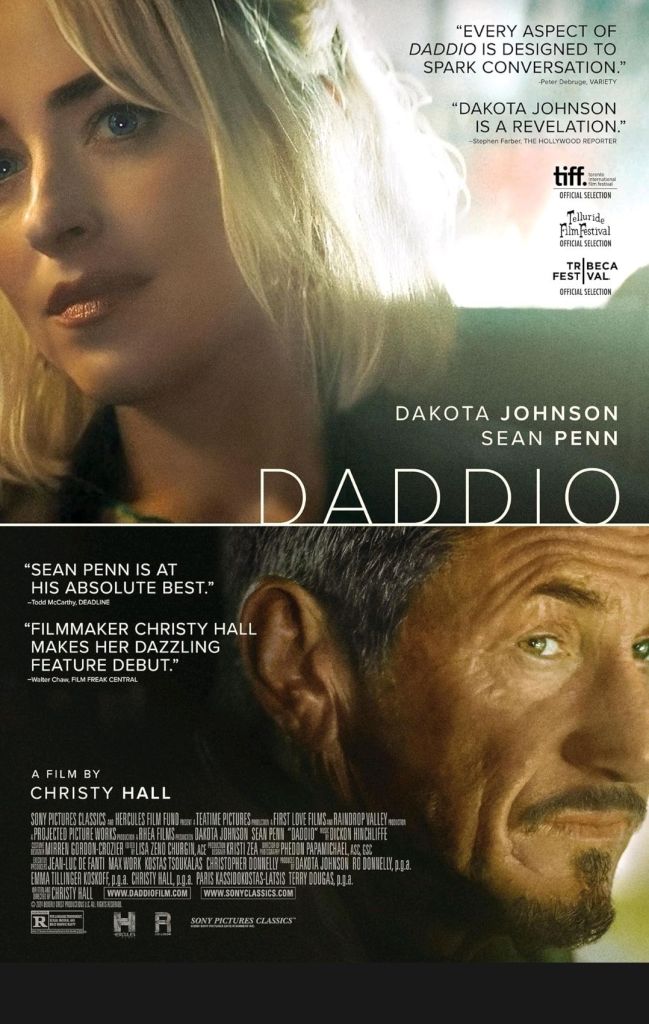
Daddio (2023)
Confessions in Transit: Daddio and the Cartography of Connection
📌 Opening Commentary
In an era where cinematic spectacle often overshadows subtlety, Christy Hall’s Daddio emerges as a cinematic haiku—brief, bounded, but resonant. Hall, adapting her own play and stepping confidently into the director’s seat, strips storytelling to its bones. No chase scenes, no cutaways—just two people in a cab, and a conversation that peels back layers faster than any thriller could. It’s a bold debut, one that invokes Before Sunrise, My Dinner with Andre, and even Hitchcock’s taste for confined spaces. Yet Daddio does something altogether its own: it uses dialogue as a scalpel, not a sponge.
Overview
After landing at JFK, a woman—known only as “Girlie” (Dakota Johnson)—slides into the back seat of a yellow cab driven by Clark (Sean Penn). The city pulses outside; inside, something quieter begins to stir.
What begins with small talk about traffic and smartphones soon spirals into the intimate. She’s involved with a married man; he’s a veteran of love and divorce. Beneath the surface chatter, emotional fissures begin to show. Questions turn philosophical, flirtation turns introspective.
Clark challenges Girlie’s assumptions. Girlie needles Clark’s self-mythology. Their exchange becomes less a dialogue and more a kind of psychological jazz—improvised, searching, occasionally discordant, but brimming with truth.
In a moment of vulnerability, Girlie breaks—confessing that what masquerades as power in her affair is, in truth, loneliness. Clark responds not with pity but perspective, offering a challenge: maybe what she fears most isn’t abandonment but authenticity.
As the cab glides to a stop, they part. No grand gestures. No promises. Just two strangers altered by the collision. We never learn their full stories, but we understand them—deeply, briefly, fully.
Symbolism & Subtext
The taxi becomes both vessel and crucible—a symbol of transition. Trapped in metal and motion, the characters are both nowhere and on the verge of somewhere. The window between them and the world reinforces the theme: proximity does not always mean connection, and distance does not preclude intimacy.
Clark’s cigarettes, the glow of dashboard lights, even the endless hum of the city—all serve as ambient reminders that sometimes, in the most mundane places, the sacred can happen. Their talk of love, ethics, and desire functions less as confession than excavation—digging down to the bedrock of who they are beneath the masks.
Memorable Moments & Key Details
Girlie’s quiet deletion of a message she almost sends speaks volumes about her longing and restraint.
The entire film unfolds in the claustrophobic cocoon of the cab, yet the cinematography creates visual space—intimate, but never static.
Clark’s line—“We all lie. The trick is knowing why.”—echoes long after the meter stops running.
Strengths & Weaknesses
Directorial Vision
Hall’s restraint is her genius. She allows silences to breathe and lets discomfort fester—trusting her audience to lean in, not lean back.
Cinematography
Jordan Parrott’s lens never lets the cab feel like a trap. Instead, it becomes a stage for human drama, lit in chiaroscuro, framing thought as much as face.
Screenwriting
Hall’s script reads like a long-form poem, its rhythm rooted in emotional truths rather than plot mechanics.
Pacing & Structure
Some may find the single-setting format limiting. But if you’re tuned to its frequency, the film offers profound rewards.
🎭 Performances
Sean Penn, a two-time Oscar winner, reminds us why he remains one of cinema’s most formidable actors. As Clark, he sheds the bravado of past roles for something more weathered, more humane. Every shrug, every half-smile, every tightening of the eyes reveals a man who’s seen too much—and forgotten too little. This is not a “role” so much as a slow inhabitation. Penn doesn’t act next to the dialogue—he mines it, finding new seams of meaning in every pause.
Dakota Johnson, often underestimated, emerges here as a revelation. Her “Girlie” begins composed but not cold—her defenses carefully curated. Yet as the ride stretches on, we see them falter. Her voice catches at just the right moment; her gaze hardens when necessary, softens when safe. This is a performance of restraint, made electric by what she chooses not to say.
Together, Penn and Johnson achieve what few film duos manage: two fully inhabited characters who evolve in real time—without a single change of scene.
🎭 Production Design & Costumes
The set design—minimal as it is—reflects the authenticity of the city. Worn vinyl, flickering neon, streaked windows—everything feels lived in. Girlie’s wardrobe shifts subtly from armor to skin as the evening unfolds, while Clark’s workmanlike layers hint at a man who carries emotional weight like a weathered coat.
🖋️ Writing Style & Literary Devices
Metaphor: The cab ride becomes an emotional pilgrimage.
Paradox: Intimacy between strangers feels more genuine than decades of partnership.
Allusion: Hall’s writing borrows the soul of modern theater—Mamet, Shepard, LaBute—but tempers their cruelty with grace.
Irony: The cab, designed for transit, becomes a moment of stillness in both their lives.
🔄 Comparative Analysis
Daddio belongs to a rarefied lineage of confined-location films—Locke, Buried, Phone Booth—but it trades tension for introspection. It also echoes Before Sunrise’s conversational dance but infuses it with more psychological heft and moral ambiguity. Whether it will be canonized remains to be seen, but it certainly refuses to be ignored.
🏆 Verdict
A two-character character study that transcends its premise, Daddio reminds us that a well-timed conversation can do what car chases never will—change someone.
Final Score: 3.7 / 4.0 — A-
Legacy Factor
Though modest in scope, Daddio may prove timeless—an intimate whisper of a film in a world that too often shouts.
AUDIO REVIEW
 RMS INSIGHTS ✍🏾