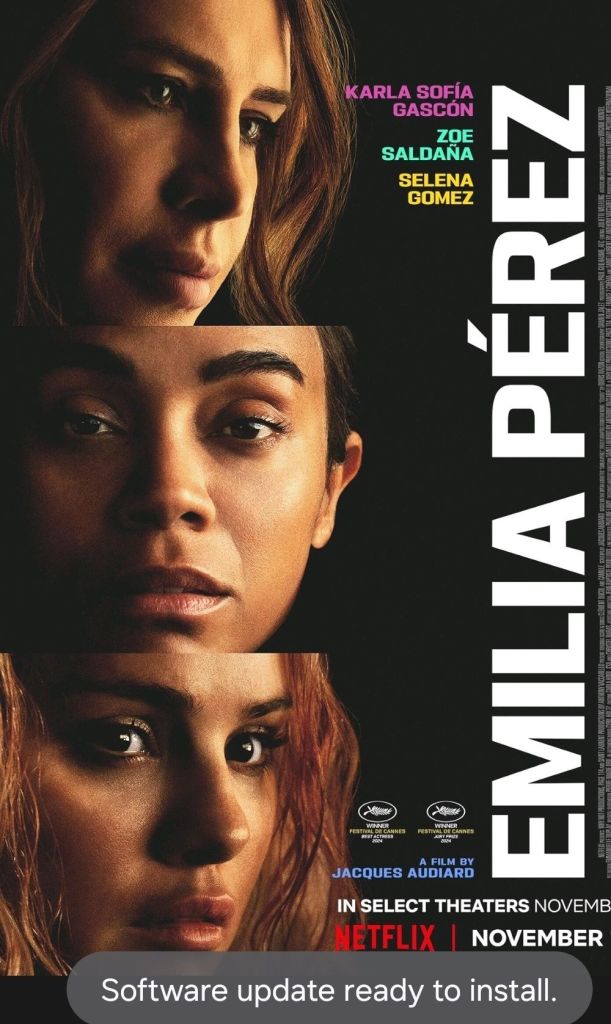
A lawyer, a kingpin, and a secret that changes everything. When Rita (Zoe Saldaña), a brilliant but weary attorney, is kidnapped by Manitas Del Monte, Mexico’s most feared drug lord, she expects a death sentence. Instead, she receives an offer—one that will alter the course of her life. Manitas, seeking escape from the empire of blood he has built, wants Rita to orchestrate his ultimate transformation: into the woman he has always been inside. Four years later, the world believes Manitas is dead, but Emilia Pérez (Karla Sofía Gascón) strides into Rita’s life, reborn and determined to right the wrongs of her past.
A genre-defying film that fuses crime thriller, opera, and social drama, Emilia Pérez is a sweeping, kaleidoscopic experience about metamorphosis—not only of gender but of power, identity, and redemption.
A Bold, Unapologetic Performance Core
At its core is a performance that will be remembered for generations. Karla Sofía Gascón does not merely play two roles; she embodies two souls in one. Her transformation from Manitas to Emilia is so seamless, so lived-in, that it evokes the ancient concept of metempsychosis, the transmigration of the soul into another body. In this case, Gascón does not just change gender on screen; she undergoes a complete metamorphosis, a rebirth that is as spiritual as it is physical.
As Manitas, Gascón is a force of nature—gravel-voiced, domineering, a man who commands power with a glance. When she reemerges as Emilia, there is no trace of the crime lord, only a woman who carries the weight of her past like a penitential cloak. Her movements, her voice, her very essence are transformed. The transition is so organic that audiences may find themselves forgetting they are watching the same actor. It is, quite simply, a masterclass in acting.
Critics have hailed Gascón’s performance as one of the most daring and profound of the year. The depth with which she captures the internal struggle, the need for redemption, and the sheer exultation of finally existing as one’s true self, is nothing short of revelatory. And while Emilia Pérez is an ensemble piece, its soul belongs to Gascón.
Zoe Saldaña’s Rita is our anchor, navigating a moral and emotional labyrinth with fierce intelligence. There is a controlled precision to her performance, a lawyer’s careful restraint giving way to something rawer as she finds herself bound to Emilia’s journey.
Selena Gomez, as Jessi, the kingpin’s neglected wife, brings old-Hollywood grandeur to the role—a tragic heroine whose wounds sing louder than words. She is a vision of quiet desperation, her scenes vibrating with a mixture of longing and resignation. Yet, when the music takes her, she is luminous, her voice trembling on the edge of sorrow and defiance.
And Adriana Paz, as Epifanía, Emilia’s unexpected love, infuses the film with quiet grace, proving that transformation is not only personal but communal. Her character, a widow seeking justice, mirrors Emilia’s own struggle—both women trying to carve something sacred out of the wreckage of violence.
Music as Memory, Music as Identity
What sets Emilia Pérez apart from any standard crime melodrama or biographical tale of transformation is its use of music. Camille Dalmais’s compositions are more than just a score—they are the soul of the film. Audiard does not treat these musical numbers as interruptions but as revelations. The songs do not pause the narrative; they propel it forward, illuminating the unspoken truths of each character.
One of the most powerful moments comes when Emilia, now fully herself, sings to her son—who only knew her as the monstrous Manitas. The lullaby is gentle, almost hesitant, yet piercing in its tenderness: a mother trying to reassure a child who only remembers the shadow of a father. “Pop, pop, pop—you smell like Papa,” he sings back, the words half-playful, half-wounded. It’s a moment that bridges past and present, love and trauma, showing that identity is not rewritten in an instant but lived and reconciled over time.
A Visual and Thematic Triumph
Paul Guilhaume’s cinematography is exquisite, capturing both the intimate and the operatic, the brutal and the beautiful, with an eye for contrast that deepens the film’s themes. Neon-soaked club scenes are juxtaposed with the raw, unfiltered light of Mexico’s deserts. The Swiss safe house where Jessi and her children hide is a sterile, golden cage—opulence masking isolation. And when Emilia finally emerges in her true form, stepping into the streets of Mexico City, she is framed with a reverence that recalls classic Hollywood star entrances—a new kind of leading lady, one who rewrites the genre itself.
Audiard, a director of boundless ambition, wields his craft like a maestro, blending crime thriller, melodrama, and musical into a singular, transcendent work. He does not simply tell Emilia’s story; he performs it, conducting each element—acting, cinematography, choreography, score—with the precision of a symphony.
Beyond the Spectacle: The Film’s Lasting Impact
But Emilia Pérez is more than spectacle. It is a story of courage—both in its subject matter and in the sheer fearlessness of its execution. It asks difficult questions and does not flinch. It does not seek easy resolutions but instead offers something greater: a vision of change that is both intimate and sweeping, painful and exhilarating.
There will be those who dismiss Emilia Pérez as too grand, too operatic, too indulgent in its theatricality. But that is precisely its strength. It does not shy away from being a film, a piece of art that embraces the full spectrum of cinema—musical, political, romantic, and mythic all at once.
This is not just a film to be seen; it is a film to be felt. A film that lingers in the soul, that dares to believe in transformation, and that sings—loudly, defiantly, beautifully.
Final Notes on Its Oscar Legacy
As France’s submission for the Academy Awards, Emilia Pérez is more than a contender—it is a historic landmark. With 13 nominations, it has shattered records, becoming the most-nominated non-English-language film in Oscar history. Karla Sofía Gascón’s Best Actress nomination marks a transformative moment for representation, and Audiard’s direction ensures that this film will be remembered as a turning point in cinema.
Whether it sweeps the Oscars or not, Emilia Pérez has already won in a more significant way—it has proven that cinema can still be bold, daring, and utterly, unapologetically operatic.








 RMS INSIGHTS ✍🏾