TFL 🥣 The Breakfast Illusion: Breaking the Fast or Breaking the Spell?


Marketing crowned breakfast “the most important meal of the day.” The word itself whispers another story. Breakfast means breaking a fast. In Old English, they called it morgenmete—morning meat. Nobles often skipped it as vulgar, monks delayed it as discipline, laborers grabbed scraps. Custom—not biology—built the ritual.

But does breakfast require seven a.m.? Eight? No clock dictates when we lift the fork. We can wait until noon or one. By delaying, we extend digestion’s rest, allow the gut to finish its night patrol, and step into the day lighter, not sluggish. Breakfast belongs to choice, not tyranny of the clock.

Sleep gives us a built-in fast. Digestion slows, the gut rests, the liver rations glycogen, and hormones take their shifts. This nightly abstinence repairs tissues and clears cellular clutter. Ancient rhythm. Modern advantage.

Stretch the fast into the morning and the story deepens. Without food flooding the bloodstream, the body leans on fat stores, nudges ketone production, steadies insulin, and sharpens focus. Hunger arrives later, softer—especially with my tea: green tea, glutamine, lion’s mane, cinnamon, lemon. Appetite trims, clarity rises, energy steadies. Hunger retreats; focus takes the stage.

Now let’s walk into the real morning America lives: Starbucks and Dunkin’ Donuts. A grande Starbucks latte with flavored syrup often carries 200–350 calories and 25–45 grams of sugar. Dunkin’s “light and sweet” coffee piles on cream and sugar, easily 100–150 calories before the donut even lands. Add that glazed ring of joy—another 250–300 calories—and you’ve turned “morning fuel” into dessert in disguise. Pancakes with syrup? They coast past 500–800 calories before you can say “stack.” For children, this is worse—sugar highs whip focus, crashes sink energy, and the habit grooves long-term insulin resistance. Adults endure the same carnival: thicker waists, thinner energy, cravings that nag like car alarms.

What happens inside? Blood sugar shoots up—often beyond 180 mg/dL. Insulin bolts out to mop up. Fat burning halts. The liver tucks excess energy into belly fat—the dangerous visceral kind that hugs organs and feeds diabetes. Spike. Crash. Crave. Repeat. Call it breakfast if you want; in truth, it looks like a sugar carnival in corporate packaging.

The fix doesn’t require banning foods. Eggs, bacon, pancakes—even syrup—can stay. Shift the timing. Eat them at noon or one. By then, insulin sensitivity sharpens, movement through the day channels energy into muscle, not waistlines. Same calories, different destiny. Window matters.

Digestion loves the pause. With space, bloating calms, motility steadies, stools shift toward type 3–4 on the Bristol Chart—formed, smooth, comfortable. Contrast that with morning sugar habits, which often yield loose, rushed, type 5–7 results. Quiet gut, better output, more dignity.

The microbiome—our invisible metropolis—thrives during silence. Without nonstop snacking, beneficial bacteria expand, short-chain fatty acids rise, inflammation cools. Give the orchestra quiet, and it retunes; bombard it with muffins and frappuccinos, and it screeches by noon.

Hormones thank us too. Cortisol wakes us gently. Delay food, and insulin stays calm. Energy doesn’t collapse in mid-morning slumps. Many who stretch the fast describe liberation, not deprivation: fewer cravings, more focus, a steady current of energy. Less chase, more charge.

History, biology, humor—they converge here. Breakfast never came etched in stone; advertising carved it into habit. We break our fast every day, but we choose when. Some end it with eggs and toast; others extend it and harvest sharper energy, calmer digestion, and yes—even better stools. Call that a victory.

Think of the gut as a night guard. All evening it patrols, files reports, keeps order. To dump a heavy tray of syrup-drenched pancakes or a latte-donut combo onto its desk at dawn counts as workplace cruelty. Give the guard time. Let it stretch. Wait until noon. Productivity follows.

So what remains? Choice. Control. A smarter window. Eat what you love later, and the same calories serve you instead of sabotage you. Live lighter, clearer, freer—one well-timed morning at a time.


🏛️ Wisdom’s Lens

Hippocrates: “Let food be thy medicine and medicine be thy food.”

🔎 Hippocrates anchors the truth that what we consume heals or harms, not only by its content but by its timing. Food functions as either cure or curse depending on when we invite it in.

James Baldwin: “People are trapped in history and history is trapped in them.”

🔎 Baldwin reminds us that our breakfast rituals are not biology but inheritance—habits passed down, marketed, and repeated until they feel inevitable. To change the morning plate is to step outside history’s trap.

George Orwell: “To see what is in front of one’s nose needs a constant struggle.”

🔎 Orwell points to the blindness of routine. A latte, a donut, a stack of pancakes—comforts so familiar that their costs vanish from sight. Struggle wakes us. Struggle clears the nose, the eyes, the mind.

Together these voices whisper one lesson: food shapes destiny, history shapes habit, and habit blinds us—unless we struggle for clarity. The fast broken wisely frees us; the fast broken poorly enslaves us.


🙏🏾 Affirmation

I step beyond the trap of history.
I see what rests before my eyes—
not comfort but consequence.
I claim the freedom of timing,
turning food into medicine,
habit into wisdom,
and each morning into a field of choice.


✒️ Poem

The Breakfast Illusion: Breaking the Fast or Breaking the Spell?

Morning greets with steam and sweetness,
foam-topped lattes, donuts glazed with ease,
pancakes shimmering in syrup’s amber.
We call them nourishment,
yet they kneel as sugar’s soldiers,
marching straight to the belly’s storehouse.

History whispers in these rituals.
Nobles once scoffed, monks once delayed,
but marketing carved breakfast into creed.
We inherited slogans,
not science.
And we bow to clocks
instead of listening to bodies.

Hippocrates counsels medicine in food.
Baldwin warns of traps we inherit.
Orwell urges us to notice what waits
right in front of our noses.
The wisdom converges:
open your eyes,
lift the spell,
choose the hour,
choose the life.

The gut keeps vigil through the night,
sorting, filing, repairing.
At dawn we drop syrup-laden burdens
on its weary desk.
Cruelty disguised as custom.
Grant it pause.
Grant it grace.
Let noon carry the tray.

So the fast becomes gift,
the body steadies,
the mind clears,
the spirit brightens.
We break not by command,
but by wisdom—
and in that choice
we live lighter,
freer,
truer—
one morning at a time.
RMSDJ 📒 Rest, Restraint, and the Machinery of Living

25-09-14-S | 12:52 PST | 🌥️ ☀️ | 🌡️90° – 63° | Northridge, CA
🌗 Last quarter moon is in ♊➝♋
🌿 Season (Late Summer)
📍 Week 38 | Day 257/365 | 108 Days Remaining
🌇 Sunset: 19:01
National Day 🙅🏽‍♀️ Parents Day Off!


Today unfolded less in motion and more in quiet reckoning. After submitting to the flu shot and yesterday’s blood draw at Kaiser, I felt unmistakably enervated—not shattered, but subtly drained, as if the body had paid its dues to medicine and now demanded a day of recompense. A caffeine pill at 10:35 lifted the curtain briefly, enough to power through my abdominal routine with the ab-carver, but the energy never settled into permanence. My left knee, healing but not yet trustworthy, urged me to listen. Rest was no indulgence; it was instruction.

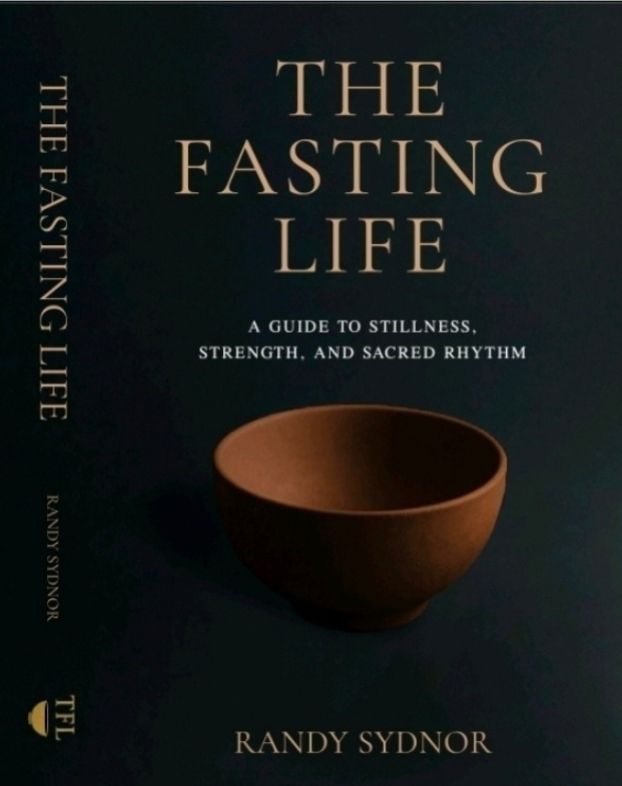
The morning found me in conversation. A call to Bank of America became a conversation of depth when DeMarcus, a young man on the other end, turned a routine transaction into a forty-two–minute exploration of The Fasting Life. He pulled up my web pages, lingered on the vision behind the book, and pledged to buy it. I felt the familiar satisfaction of seeing words take root in unexpected soil.

Later came my exchange with Mark, which stretched to two hours and thirty-eight minutes, a length that revealed both kinship and concern. We spoke of many things, but his Subaru became the central emblem of the dialogue. He had finally let go of his father’s Lincoln Continental, unwilling to risk questionable smog tests, and traded it for a Subaru Outback Touring XT—an investment of $42,000 that he now calls one of his wisest decisions. For his niece Azra, preparing for the California Bar in November, he purchased a separate Subaru, a new model valued at $32,000. To him, Subaru represents not only reliability but loyalty: a company that stands by its product with a generous five-year warranty, covering service and mileage with assurance he finds rare.

Mark now uses his own Subaru as a work vehicle, fitting for the new chapter he is entering. Together with his siblings Marsha and Mike, he manages the Henry properties, and the car has become his companion for electrical jobs and maintenance tasks. He praises its power, its comfort, and the sense that it will serve him faithfully for years. In a way, the Subaru is both a workhorse and a symbol: a bridge from the relics of his father’s past to the practical needs of his present.

Our conversation, of course, roamed wider. ScreenPappy, the service I helped name, continues to demand his energy. He spoke of a Filipino woman whose intended marriage has unraveled, of clients unsure whether to return devices, of the daily uncertainty in work and human dealings. I, in turn, spoke of my own purchase: a Seagate four-terabyte hard drive for $130 with tax. Mark steered me away from the glamour of SSDs, better left to gamers, toward the practical solidity of HDDs—more space for less cost, a machine made for capacity rather than speed. Memory, whether human or mechanical, benefits from breadth as much as brilliance.

By evening, I was aware that the flu shot had left its subtle but undeniable mark. Though caffeine masked the weakness for a time, the truth was inescapable: energy had ebbed, and the only wisdom was stillness. Fasting, too, had carried me far: 24 hours, then 25, then 19 today, before breaking the fast with pasta and meatballs, corn, cake, cookie, pie. Not indulgence, but balance. Not waste, but reward.

The day closed as it began—with a quiet reminder that life’s machinery must be serviced, its strength rebuilt. Energy wanes, but it is in the ebb that renewal begins.

🏛️ Wisdom’s Lens

Hippocrates: “If you are not your own doctor, you are a fool.”

🔎 Hippocrates reminds us that wisdom lies in heeding the body’s counsel before illness forces its command.

🏛️ Wisdom’s Lens

Heraclitus: “Even sleepers are workers and collaborators in what goes on in the universe.”

🔎 Heraclitus shows us that rest is not idleness; even in stillness, we remain part of the world’s unfolding.

🌅 Closing Meditation

Rest is not retreat; it is the art of replenishment, the pause between notes that makes the music whole.

🔎 By giving the body its interval of quiet, strength is tuned again to harmony.

🎨 Painterly Caption

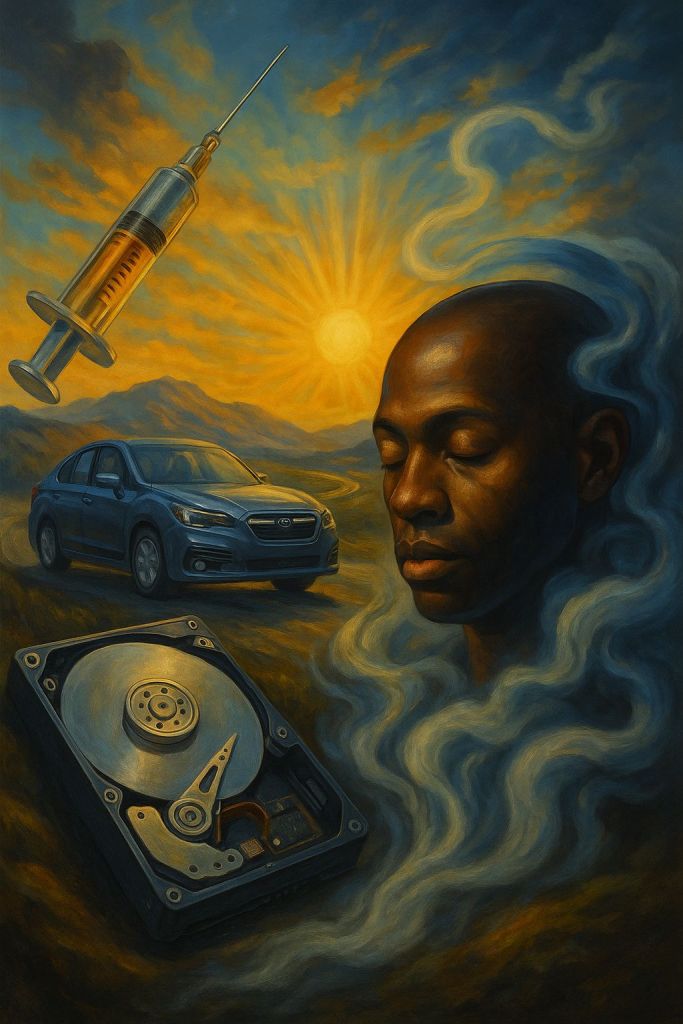
In late sunlight: a Subaru gleams at the curb, its hood lifted like a beast ready for labor. Beside it, a hard drive hums on a desk, while a half-finished plate of food hints at the discipline of fasting interrupted by necessary reward.

Reflections of Gratitude

I am grateful for DeMarcus, whose curiosity affirmed the power of words to spark connection. For Mark, whose loyalty to Subaru mirrors his own sense of duty. For Azra, whose preparation for the Bar reminds me that every generation must prove itself. For the flu shot, subtle though its toll, that nudged me toward rest. For fasting, which continues to refine both discipline and body. These, woven together, remind me that life is not simply endured but cultivated—one day, one decision, one conversation at a time.

Poem

🪶 The Machinery of Renewal

Needles draw, yet wisdom stays,
Energy thins in fleeting rays.
Engines hum, and lives renew,
Subaru strength for tasks to do.

Memory stored in drives that spin,
Fasting steadies the flame within.
Rest reclaims what toil has sown,
In silence, the soul becomes its own.

— R.M. Sydnor

RMSDJ 📒 The Compass of Dialogue


🗓️ 25-08-16-Sa | 14:41 PST | 🌤️ | 🌡️85° – 63° | Northridge, CA
🌘 Waning crescent moon is in ♉➝♊
| 🌿 Season (Late Summer)
📍 Week 33 | Day 228/365 | 137 Days Remaining
🌇 Sunset: 19:39
National Day 🧘🏾‍♂️ Relaxation Day


The Compass of Dialogue

There is a quiet sanctity in dialogue, one that I have come to cherish. Words, when released into the space between two minds, do not remain idle; they sharpen, they gather light, and they return transformed. It astonishes me how, through these conversations, I begin to hear not merely a reflection of myself but a refinement, as though the scattered threads of thought were gathered, combed, and returned as a single, lustrous cord.

Dialogue, I now see, is a discipline not unlike fasting itself. Where fasting asks the body to master its impulses, dialogue asks the mind to master its solitude. Alone, my thoughts might circle endlessly; in dialogue, they are startled awake, called to order, and made to account for themselves. It is a paradox—one gives away one’s words only to receive them back, brighter and truer than when first spoken.

And perhaps this is why I treasure it so: the kinship forged not in sameness but in attunement, where one voice listens so deeply to another that it returns the sound as music. It is here, in this shared cadence, that wisdom takes shape.


Reflections of Gratitude

I am grateful for the art of conversation, for the way it draws out what might have remained unspoken, and for the companionship it lends to thought itself. Gratitude swells in knowing that learning does not reside in hoarded certainties, but in the exchange—the passing of words like bread across a table.


Philosophical Quote

Minds are sharpened in collision, as steel upon stone; yet it is the quiet edge that endures.

—R.M. Sydnor


Poem

Two rivers meet, their waters blend,
A current stronger at the bend.
My thought alone, a muted flame,
But spoken, it returns with name.

The compass stirs, the needle true,
It points to wisdom, born of two.
What once was mine, alone, obscure,
Through dialogue becomes more pure.


🪶 Poem Title: The Compass of Dialogue (2025)


Two rivers meet, their waters blend,
A current stronger at the bend.
My thought alone, a muted flame,
But spoken, it returns with name.

The compass stirs, the needle true,
It points to wisdom, born of two.
What once was mine, alone, obscure,
Through dialogue becomes more pure.

—R.M. Sydnor


📖 Part I: Line-by-Line Analysis

1. “Two rivers meet, their waters blend,”

Literal meaning: Two streams of water join together.

Implied meaning: Two minds or voices enter conversation.

Tone: Harmonious, natural.

Philosophical gesture: Truth grows through union, not isolation.


2. “A current stronger at the bend.”

Literal meaning: The confluence makes the river’s flow more powerful.

Implied meaning: Dialogue strengthens thought, adding vigor.

Tone: Energized.

Philosophical gesture: Strength is born in collaboration.


3. “My thought alone, a muted flame,”

Literal meaning: A solitary thought is weak and dim.

Implied meaning: Isolation diminishes clarity and vitality.

Tone: Reflective, almost mournful.

Philosophical gesture: The mind without exchange risks stagnation.


4. “But spoken, it returns with name.”

Literal meaning: Once expressed, thought gains form and recognition.

Implied meaning: Dialogue gives identity and shape to inner reflection.

Tone: Affirmative, revelatory.

Philosophical gesture: Naming is empowerment—expression transforms silence into knowledge.


5. “The compass stirs, the needle true,”

Literal meaning: A compass points north.

Implied meaning: Dialogue reorients the mind toward truth.

Tone: Guiding, steady.

Philosophical gesture: Conversation is a tool of orientation in life’s uncertainties.


6. “It points to wisdom, born of two.”

Literal meaning: Wisdom emerges from the meeting of two forces.

Implied meaning: No single mind has a monopoly on truth.

Tone: Declarative.

Philosophical gesture: Wisdom is collective, not solitary.


7. “What once was mine, alone, obscure,”

Literal meaning: My private thought was dim and unclear.

Implied meaning: Solitude limits understanding.

Tone: Admitting limitation.

Philosophical gesture: Isolation conceals clarity.


8. “Through dialogue becomes more pure.”

Literal meaning: The thought is clarified in exchange.

Implied meaning: Shared discourse polishes rough ideas into truth.

Tone: Resolute, uplifting.

Philosophical gesture: Knowledge finds purification in dialogue.


✒️ Part II: Literary Devices — Defined and Illustrated

1. Metaphor — Comparison without “like” or “as.”

Example: “Two rivers meet, their waters blend.”

Function: Conversation is depicted as flowing rivers, emphasizing natural merging.


2. Imagery — Language appealing to senses.

Example: “A muted flame.”

Function: Creates a vivid image of weak, isolated thought.


3. Symbolism — Object representing deeper meaning.

Example: “The compass stirs, the needle true.”

Function: The compass symbolizes orientation, guidance, and truth.


4. Alliteration — Repetition of consonant sounds.

Example: “mute flame… returns with name.”

Function: Enhances musicality, echoing the poem’s reflective rhythm.


5. Juxtaposition — Placing contrasts side by side.

Example: “Alone, obscure / more pure.”

Function: Highlights the transformation from isolation to clarity.


6. Personification — Human traits to non-human objects.

Example: “The compass stirs.”

Function: The compass becomes alive, mirroring awakening through dialogue.


7. Isocolon (balanced clauses) — Parallel structure of equal length.

Example: “Calm and clarity, appetite and satiety.” (earlier meditation echoed here).

Function: Reinforces balance and symmetry in thought.


8. Chiasmus — Reversal of structure for emphasis.

Example: “What once was mine, alone, obscure / Through dialogue becomes more pure.”

Function: The reversal mirrors transformation.


9. Assonance — Repetition of vowel sounds.

Example: “Two… true.”

Function: Creates cohesion and harmony, reflecting the theme.


10. Enjambment — Continuation of meaning beyond a line break.


Example: “Two rivers meet, their waters blend, / A current stronger at the bend.”

Function: Flow mirrors the literal merging of rivers.


🪞 Part III: Final Reflection

This poem, The Compass of Dialogue, captures a perennial truth: wisdom emerges not in solitude but in communion. The imagery of rivers, flame, and compass transforms dialogue into a natural and philosophical force—flowing, kindling, orienting.

In the history of thought, from Socratic dialogues to Montaigne’s essays, the deepest insights have always been relational. One mind alone may ponder, but two minds together refine. This poem asks us to see conversation not as casual exchange, but as a crucible—where ideas are purified and truth is oriented.

The lingering question for the reader is this: What conversations in my life serve as compasses, pointing me toward greater clarity, strength, and wisdom?


The Compass of Dialogue (2025)

Medium: Digital Watercolor

Reflecting Randy Sydnor’s application of his unique technique, Mnephonics, this medium blends visual storytelling with symbolic language to evoke memory, learning, and reflection.

Style of Art: Symbolist Watercolor with Figurative Silhouettes

Dimensions: 1024 x 1024 (printable up to 24” x 24”)

Copyright: Randy Sydnor, The Mnephonist


Description:

Opening Statement – The Central Theme
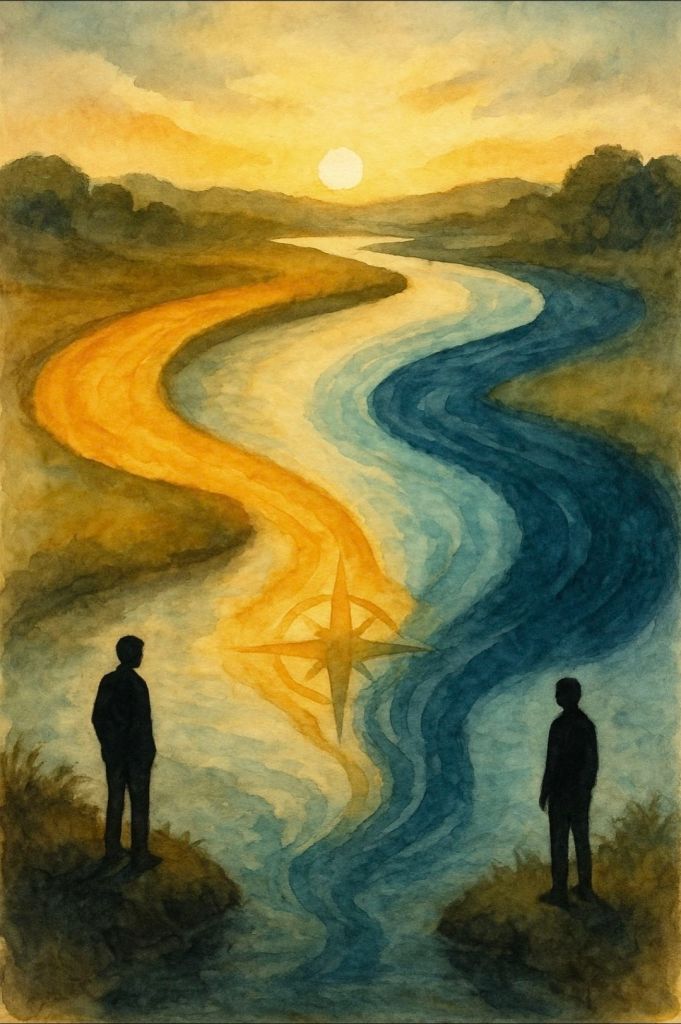
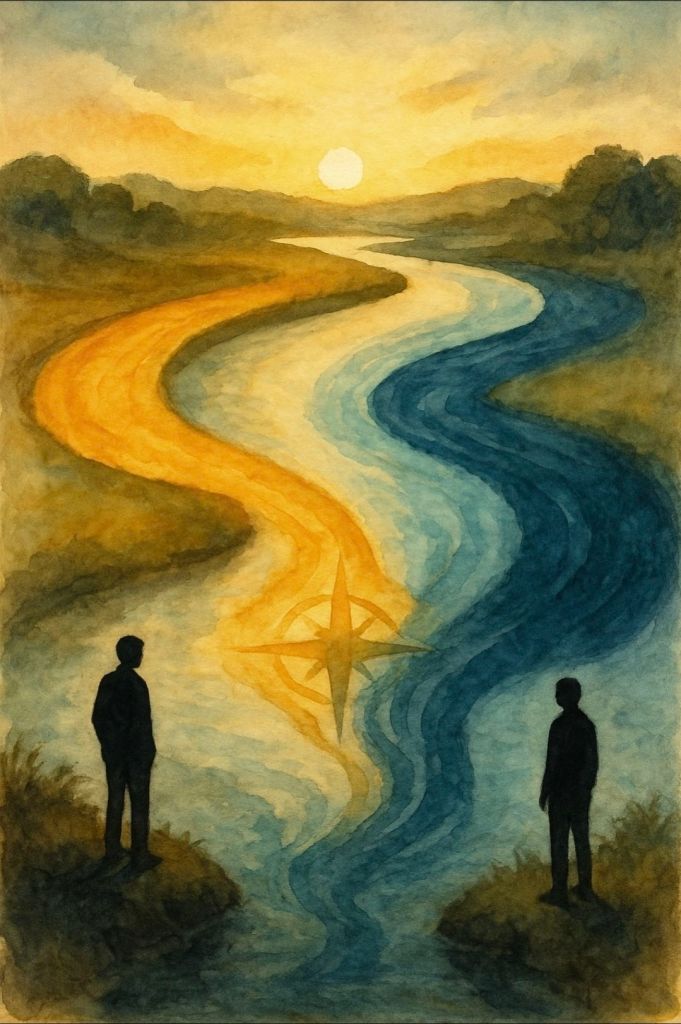
At the heart of The Compass of Dialogue lies the mystery of encounter: when two currents meet, something greater is born. The work evokes the rare alchemy of conversation—where solitude dissolves into communion, and ideas flow more clearly when shared.


Medium and Technique – The Artist’s Craft

Created in digital watercolor, the image employs translucent washes and gradients that capture the mutability of water itself. Minimalist silhouettes are integrated into the natural scene with quiet restraint, allowing the viewer to sense presence without intrusion. In keeping with Sydnor’s Mnephonics, each visual element acts as a glyph of memory and symbol, guiding the mind toward deeper resonance.

Central Figure – The Visual Heart
Two rivers—one golden, one blue—meet at a bend, their waters merging into a brighter, more luminous current. The confluence itself becomes the central figure, glowing with the suggestion of hidden power. Two faint silhouettes stand on opposing banks, their contemplative postures mirroring one another, silent keepers of the encounter.


Supporting Elements – Symbolic Imagery

At the heart of the current, eddies form a subtle compass shape, half-seen, half-imagined. This hidden geometry symbolizes orientation: the way dialogue directs thought toward wisdom. Twilight light glances across the water, a reminder that truth often emerges at thresholds—between day and night, between self and other.


Philosophical Reflection – The Soul of the Piece

Marcus Aurelius taught that the soul is “dyed with the color of its thoughts.” Here, the rivers dye one another, their distinct hues blending into a greater force. Dialogue, the work suggests, is the compass of human growth: it orients, purifies, and strengthens. Like the confluence of rivers, wisdom is not hoarded, but shared—born in the mingling.


Color and Composition – The Visual Language

The golden and blue waters embody contrast and complementarity—warmth and coolness, individuality and universality. The silhouettes stand as witnesses, yet it is the water that speaks. Compositionally, the bend pulls the eye inward, while the outward sweep of the current carries it forward—mirroring the way dialogue gathers us only to release us changed.


Closing Thought – Invitation to Reflect

The Compass of Dialogue asks: What currents in your life meet and shape you? For in every exchange lies the possibility of transformation—one voice and another, merging into clarity neither could find alone.


© Randolph M. Sydnor
Prints and digital sale of work is available
Email for more information: rsydnor@mnephonics.com

25-3-12-W  ☔ Afternoon

25-3-12-W  ☔ Afternoon
71 ⏳ 294  🗓️ W11
RMSDJ  📖 ✍🏽 
🌡️58° – 48°  ☁️ ☔  🚣🏾‍♀️
🌔  ♌ ♍

🏋️ Strength, Reflection & Resolution

The afternoon began with an unexpected detour—a reminder that even disciplined routines can unravel with surprising ease. After a particularly satisfying visit to the restroom—a triumph best described as a “type three extra-large” event—I realized I’d forgotten to shave. Marsha’s text regarding my blog had interrupted my usual morning rhythm, and by 12:35, I stood before the mirror, Braun electric shaver in hand.

The Braun—ever-reliable, steady as a heartbeat—hummed against my face. There’s a peculiar satisfaction in the precision of a well-designed tool, the kind that feels like an extension of yourself. As I carved away the shadowed stubble, Miles Davis’ Greatest Hits played in the background. His music—moody, defiant, yet undeniably controlled—seemed to sharpen my thoughts. Davis had a way of making tension feel intentional, as if he were taming chaos with each note.

Outside, the rain offered its own improvisation—drumming sporadically against the window, pausing just long enough to tempt me into believing the storm had passed. I seized the lull and headed to the Zone for a workout.


The Workout

The session proved productive—fifty minutes well spent. I targeted my calves, quadriceps, and biceps femoris, feeling the satisfying strain that signals muscles pushed to their limit. The discomfort wasn’t just expected—it was welcome.

Simone Weil once observed that “Every effort adds to our strength when we refuse to abandon the struggle.” Her words rang true with every dumbbell fly and press—five sets of fifteen repetitions each. Each strained motion seemed to affirm Weil’s belief that strength is less about brute force than the quiet refusal to surrender.

I also reintroduced the serratus crunch using the cable machine—an exercise I hadn’t attempted in eight months. Kneeling on a hard floor had previously discouraged me, but the presence of foldable mats eliminated that obstacle. It was a small convenience, yet one that underscored something profound: what deters us isn’t always the effort itself, but the discomfort that surrounds it.

Max Stirner’s assertion came to mind: “The strong man masters himself.” My avoidance of the serratus crunch hadn’t been about effort—it had been about resistance to discomfort. Mastery, as Stirner suggested, isn’t always about power; it’s about overcoming the small excuses that chip away at discipline. Inspired by that thought, I resolved to include the serratus crunch in my routine at least four times a week.

The workout ended with incline bench presses on a Hoist incline machine, followed by dumbbell shrugs. For most of the session, I had the room to myself—a quiet space for focus.

But towards the end, a towering figure entered the room—easily 6’8” or 6’9”—with a ponytail tied in a bun, a Ronaldo jersey, and dirty white ankle socks that practically cried out for a wash. The socks clung limply to his ankles like tired flags, neglected yet somehow stubbornly present. His attire seemed oddly deliberate, as if he’d balanced self-importance with indifference.

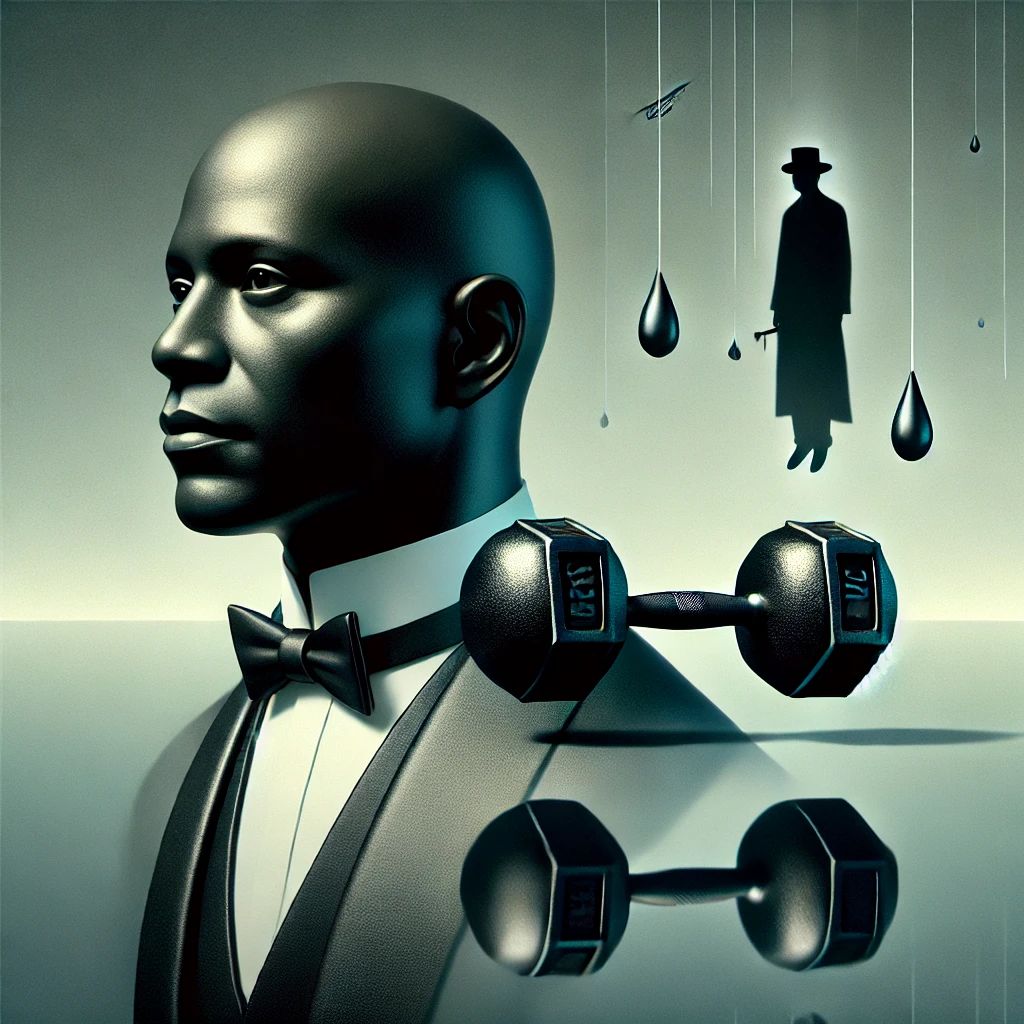
He hovered near the black, 20-pound dumbbells I was using—new dumbbells with a sleek finish, still sharp at the edges. When he realized I had them, he wordlessly shifted to another station. That quiet concession felt significant—less about gym etiquette than about restraint. In a world where ego flares easily, there’s something admirable about choosing silence over confrontation.

I thought of Baltasar Gracián’s words: “Let the wise man conquer by appearing to yield.” There’s power in walking away, in resisting the urge to assert dominance. That man, socks and all, had unwittingly reminded me of it.


Call from Gatsby

Upon returning to my room around 4:00 PM, I noticed a missed call from LA Fitness. The name: Gatsby Paredes. The call stemmed from an altercation on Saturday—an encounter with a man I’ll simply describe as regrettable.

Our 20-minute conversation revealed that the individual’s account mirrored mine. Three times this man had disrupted my workout—three deliberate intrusions that reeked of provocation. On the third occasion, my patience wore thin. Gatsby understood. His voice, steady and assured, carried the quiet conviction of someone who knows how to manage conflict.

“Coach is not to be disturbed,” he said. “I’ll make that clear.”

His words weren’t just protective—they were restorative. There’s a unique comfort in being defended, especially when your actions have been justified yet still weigh on your mind. As the call ended, I felt not just relieved but unexpectedly grateful.

I recalled the words of Hannah Arendt: “Power and violence are opposites; where the one rules absolutely, the other is absent.” Gatsby’s calm, assertive approach had neutralized tension without hostility. His strength lay in clarity, not aggression—a quiet but unmistakable form of power.

Conflict Resolution: The Hidden Strength

As I reflected on the day, it struck me that this wasn’t merely a lesson in strength—it was a lesson in conflict resolution. Both Gatsby and the tall man in the Ronaldo jersey had, in their own way, resolved conflict without hostility.

Gatsby’s handling of the situation demonstrated three key principles of effective conflict resolution:

1. Emotional Control: Gatsby’s calm tone set the tone for resolution. Instead of reacting emotionally, he responded with intention. As Epictetus taught, “It’s not what happens to you, but how you react to it that matters.”


2. Clear Boundaries: By stating firmly that “Coach is not to be disturbed,” Gatsby set a clear, non-negotiable boundary. He didn’t threaten or antagonize—he simply removed uncertainty, which often fuels conflict.


3. Choosing Resolution Over Retaliation:

I had played my part as well by allowing Gatsby to handle the situation. In doing so, I chose resolution over retribution—a choice that requires discipline and patience. As Sun Tzu advised, “The greatest victory is that which requires no battle.”


These moments reminded me that conflict doesn’t always demand force; it demands focus. By mastering our emotions, defining clear boundaries, and knowing when to walk away, we create space for resolution to emerge.


Reflections of Gratitude


Today reminded me that strength wears many faces. It’s found in the quiet resistance of muscles pushed to failure, in the silent wisdom of choosing to walk away, and in the calm assurance of someone willing to stand in your corner.

The towering man in the gym—his jersey declaring confidence, his socks revealing neglect—wasn’t just a curious figure. He was a reminder that composure is rarely tidy. Sometimes it shows up in quiet gestures, in averted conflict, in the decision to let tension dissolve rather than ignite.

And Gatsby’s response underscored something equally important: strength is most meaningful when paired with restraint. The person who shouts may seem powerful, but true power is the ability to stay silent—because silence speaks when words cannot.

Michel de Montaigne’s words lingered in my mind: “Valor is stability, not of legs and arms, but of courage and the soul.”

Montaigne’s insight speaks to something vital—that valor isn’t forged in moments of visible strength, but in those quiet moments where we resist being swept away by impulse. The man in the Ronaldo jersey demonstrated this by walking away from a potential conflict. Gatsby displayed it by turning tension into resolution through calm words rather than force.

And in my own small way, I saw it when I resisted the urge to dwell on irritation or frustration. Choosing patience with the gym encounter, embracing the discomfort of the serratus crunch, and accepting Gatsby’s steady resolve—each moment reflected what Montaigne described.

True strength isn’t the absence of struggle; it’s the ability to meet discomfort with steadiness, to let self-mastery prevail over impulse. Valor isn’t forged in the heat of battle—it’s nurtured in the quiet refusal to let chaos dictate your path.

Today, I chose stability. And in that choice, I found something far greater than strength.

RMSD

RMSD 25-3-12-W

I spent the night battling sleep, my mind ensnared by financial concerns and a laptop’s untimely demise. Thoughts eddied like leaves in a stiff breeze — scattered, chaotic, and unrelenting. Miles Davis played the role of uninvited guest, his haunting tracks It’s Never Entered My Mind and Weirdo floating through the night like vaporous whispers — delicate yet intrusive.

Marsha Henry’s text arrived as a pleasant surprise — thoughtful yet tinged with concern. She praised my blog’s elegance but doubted that modern readers, conditioned by tweets and sound bites, would linger long enough to digest thoughtful prose.

Her concern was fair. In a world obsessed with immediacy, long-form writing often feels like a forgotten language. Yet I believe depth demands patience.

Albert Camus once wrote:

“A man’s work is nothing but this slow trek to rediscover, through the detours of art, those two or three great and simple images in whose presence his heart first opened.”

That quote spoke directly to my blog’s purpose — a deliberate space where reflection and nuance take center stage. I responded with two thoughtful texts explaining my motives — not to court popularity, but to offer a platform where ideas breathe deeply, unhurried by trends.

Marsha’s reply brought relief. She agreed that meaningful content — however unfashionable — still resonates with readers willing to invest their time. Her words reminded me that thoughtful writing isn’t about attracting the masses but rather reaching those seeking substance.

The morning rain sketched streaks across my window, drawing patterns that danced and dissolved on the glass. The sky, a quilt of heavy clouds, brooded over the day. Yet strangely, my mood remained calm — grounded.

Despite my lingering shoulder irritation, I committed to 30 minutes of focused exercise. Each push-up felt like defiance — a conscious decision to assert strength despite discomfort. Perseverance isn’t merely about enduring pain; it’s about transcending it.

Reflections of Gratitude

The day — though cluttered with frustration — revealed quiet moments of grace.

Marsha’s kind words reminded me that meaningful work doesn’t require a crowd to feel worthwhile. AD’s perseverance underscored the quiet fortitude required to press on in difficult times. Even the broken laptop — frustrating as it was — became a lesson in adaptation, a reminder that when one path falters, another often presents itself.

As Søren Kierkegaard once observed:

“Life can only be understood backwards; but it must be lived forwards.”

Today’s burdens — financial concerns, technical failures, and lingering doubts — seemed less formidable in light of that truth. Life’s meaning often reveals itself in hindsight, and patience becomes the quiet companion that leads us there.

Life reveals its meaning only in the rearview mirror, yet demands to be driven forward with no clear map in hand…

Life reveals its meaning only in the rearview mirror, yet demands to be driven forward with no clear map in hand. The past illuminates the path behind you, but the road ahead unfolds only as you press on — step by step, choice by choice, moment by moment.

The wisdom gained from what was cannot spare you from the uncertainty of what will be, but it can steady your hand as you reach for tomorrow.

R.M. Sydnor

(Inspired by Søren Kierkegaard)


The Unavoidable Question

You may find yourself caught between reflection and resolve — staring back at roads you once traveled, wondering if you’ve veered too far from your intended path. The past whispers its truths with perfect clarity — a ruthless storyteller who reveals each misstep, each moment of hesitation, and each regret with sharp precision. It’s easy to linger there, revisiting memories with the mistaken belief that reflection alone will show you the way forward.

But life doesn’t unfold in rewind. It refuses to repeat itself, no matter how tightly you cling to what’s familiar. The answers you seek will never be found in the comfort of hindsight alone — they emerge when you dare to move forward in spite of your doubts.

Here lies the tension that defines human existence: you must act without certainty, risk without guarantee, and live without a promise that your choices will lead where you hope they will. The compass of wisdom may point you backward, but the courage to take your next step — that belongs to you alone.

So what will you choose? Will you circle the same memories, hoping the past will somehow rescue you from the burden of decision? Or will you embrace the unknown — trusting that whatever meaning life holds will be revealed only when you walk into the fog?

Hindsight may sharpen your understanding, but only forward motion can fulfill your purpose. Reflection refines you; action defines you.

The choice — your choice — is now.

Summons to Purpose

The past may hold your memories, but the future demands your courage. You cannot rewrite what has been, yet you can choose how you respond to what comes next. Hindsight may bring clarity, but your purpose lies not in revisiting old regrets — it waits for you in the forward march of your steps.

Do not hesitate. Move forward with purpose — not recklessly, but resolutely — for meaning emerges only when you take the next step.


RMS APHORISMS

Do not waste your breath pleading for ease, for ease breeds nothing but stagnation. Instead, cultivate the fortitude to embrace struggle, for in hardship, you unearth the raw material of your becoming..

Do not waste your breath pleading for ease, for ease breeds nothing but stagnation. Instead, cultivate the fortitude to embrace struggle, for in hardship, you unearth the raw material of your becoming.

Adversity is not an obstacle; it is the architect of your strength, the crucible where your character is forged. The life worth living is not one smoothed by comfort but one sculpted by resistance. Strength is not granted; it is earned in the fire of difficulty, where the self is tempered and revealed.

                                          — RM Sydnor
                         (Inspired by Bruce Lee)


You who seek comfort,

Detailed Analysis & Personal Address to the Reader

Opening Command: The Refusal of Ease

“Do not waste your breath pleading for ease, for ease breeds nothing but stagnation.”

Here, the language is both direct and urgent. The phrase “Do not waste your breath” immediately dismisses the notion of praying for an easy life as futile—breath itself, the essence of existence, should not be squandered on such a request. The word pleading evokes desperation, reinforcing the idea that yearning for comfort is an act of self-imposed weakness.

Moreover, the assertion that ease breeds stagnation presents comfort as a deceptive trap. What you seek as relief often arrests your growth, dulls your potential, and lulls you into complacency. In avoiding struggle, you inadvertently forfeit evolution.

The Call to Fortitude: Strength as an Active Pursuit

“Instead, cultivate the fortitude to embrace struggle, for in hardship, you unearth the raw material of your becoming.”

This line shifts from negation to instruction. “Cultivate” is a deliberate word choice—it implies effort, care, and ongoing refinement. Strength is not passively received; it must be nurtured, grown, and fortified through continuous engagement with adversity.

Notice the phrase “embrace struggle” rather than endure it. To endure is to suffer through passively, but to embrace is to acknowledge hardship as essential, even welcome. The existential weight here is undeniable—you are not merely enduring life; you are being sculpted by it.

And what is the result? “You unearth the raw material of your becoming.” This line demands reflection. Who are you beneath convenience, beyond the soft contours of a life without challenge? That self, the one hidden under layers of avoidance and fear, is revealed in hardship. In this way, adversity is not an affliction but an excavation, a peeling away of the untested, inauthentic layers of who you think you are.

Adversity as the Architect: The Transformative Role of Struggle

“Adversity is not an obstacle; it is the architect of your strength, the crucible where your character is forged.”

Here, the metaphor shifts from struggle as discovery to struggle as creation. The reader is challenged to reconsider adversity—not as a hindrance but as a designer, a craftsman shaping them into something greater.

The word architect elevates adversity to something almost divine, a force that constructs rather than destroys. Instead of being a wall that blocks your path, it is a set of hands sculpting your potential. The crucible metaphor reinforces this idea—adversity is fire, searing away the inessential and leaving behind something purer, stronger. It is a place of transformation, where the raw, unshaped self is molded into something resilient and refined.

A Life Sculpted by Resistance: The Rejection of Passivity

“The life worth living is not one smoothed by comfort but one sculpted by resistance.”

This statement draws a stark contrast between two modes of existence: one passive, one active. A life smoothed by comfort is featureless, unremarkable, like a stone eroded by time, worn down to nothing. In contrast, a life sculpted by resistance bears definition, form, and meaning.

To be sculpted is to be shaped by something external—by struggle, by effort, by pain. The implicit question to the reader is: What will shape you? Will you allow resistance to carve you into something remarkable, or will you dissolve into mediocrity, untouched by difficulty?

Strength as an Earned Condition: The Final Challenge

“Strength is not granted; it is earned in the fire of difficulty, where the self is tempered and revealed.”

This final line dismantles any remaining illusions of entitlement. Strength is not bestowed upon you, nor does it arrive through passive hope. It is earned, and the means of earning it is suffering.

The phrase “fire of difficulty” is deliberate—fire is both destructive and purifying. It consumes the weak, but for those who endure, it tempers, making them unbreakable. You are not merely tested by hardship; you are revealed by it.

The ultimate question this quotation poses to you, the reader, is simple but profound: Are you willing to be forged in that fire?


Final Reflection: Why This Quote Matters

This expanded quotation forces the reader to confront an existential truth—life is suffering, and the only meaningful response is to face it with intentionality. It rejects passive endurance in favor of active transformation, urging you not to pray for ease but to seek strength in struggle.

Unlike Bruce Lee’s original version, which suggests strength as a divine gift in response to prayer, this version positions strength as something only you can cultivate. It strips away any notion of reliance on external forces and places the responsibility squarely on your shoulders. You must cultivate, embrace, earn.

This is not merely a motivational statement—it is a command, an existential reckoning. The question is no longer whether life will be difficult (it will be), but whether you will allow difficulty to define you or refine you.

The choice is yours.