🗓️ 25-08-23-Sa | 11:55 PST | 🥵 | 🌡️100° – 72° | Northridge, CA 🌒 Waxing crescent moon is in ♍ | 🌿 Season (Late Summer) 📍 Week 34 | Day 235/365 | 130 Days Remaining 🌇 Sunset: 19:30 National Day 🥖 Cuban Sandwich
Time does not tick—it flows. I’ve come to see it less as a clock and more as a current. You may try to measure it with your watch, but that is only the surface. Beneath, the water carries us all the same.
When I fast, I notice this more clearly. The night feels like a deep tide, pulling me downstream while the body repairs itself in silence. And then the day arrives, not with the weight of hours, but with a brightness to each moment. Hunger doesn’t feel like deprivation—it sharpens the senses, pulls me into the present. Breath becomes the tether, the one rhythm I can hold as the river runs on.
I want you to consider this: time is not yours to command, but breath is. You can’t stop the current, but you can choose how to ride it. Every inhale, every exhale, becomes an anchor. And if you let fasting and breath work together, you’ll find yourself steadier even when life rushes hard against you.
I write this because I know how easy it is to feel carried away, as though life is nothing but deadlines and obligations. But it need not be so. The river is vast, yes—but you are not helpless within it. Your breath is enough to steady you.
Reflections of Gratitude
I am grateful that fasting allows me to feel the texture of time—not as a burden to be managed, but as a flow to be trusted. And I am grateful for breath, that quiet anchor, always near, always faithful.
Wisdom’s Lens
Heraclitus: “You cannot step into the same river twice, for other waters are ever flowing onto you.”
🔎 Heraclitus reminds us that change is inevitable, yet not unmanageable. The waters never stop moving, but our breath allows us to meet each new current with steadiness.
The day arrived already ablaze. 102° and climbing—heat that didn’t just descend, but insisted. The clouds, slack and unmoved, hovered without offering anything but presence. Indoors, I chose precision over perspiration. WordQuest stood before me, not in disrepair, but in need of deeper architecture.
The session with Maestro began like a silent duet. We weren’t just editing words—we were shaping resonance. The order of sections in WordQuest had started to feel functional but uninspired. I sensed it first. Then I articulated it. Maestro followed my lead.
We began with the eStory for LIMNED. The story—She Who Traces the Sacred—was already strong, but it lacked framing clarity. We restructured its presentation, created the pairing prompt, and gave it a lyrical entry point:
💡 To limn is not merely to draw—it is to dignify.
❓ What sacred stories am I carrying that have yet to be traced, named, or honored?
From there, the work moved like breath. We revised the SOUND section, stripping away the clutter. I renamed it—just 🗣️ SOUND—nothing extra. Clean. Precise. For verisimilitude, we shaped a sonic hook that felt inevitable:
💡 It doesn’t ring true. It rings real enough to believe.
The spelling structure needed re-sequencing. I instructed Maestro to shift it behind IPA and SOUND—a decision rooted in how the mind naturally absorbs sound before shape.
We finalized the new structure:
IPA
Hyphenated guide
Syllabic segmentation
Visual mnemonic
Aphoristic insight
This gave clarity room to breathe.
Then came the full recalibration of the section order. From recognition to resonance, I laid out the new arc:
💡 Structure is not rigidity—it is reverence for rhythm.
We capped the session by creating the WordQuest Master Template, a clean skeleton built to hold nuance, rhythm, and elegance. Not just a form—but a form that holds feeling.
❓ In what ways am I rearranging my own thoughts to let truth arrive with more grace?
Later in the afternoon, I broke a 19-hour and 30-minute fast. Not because I was weak—but because I was listening. Ground turkey, mashed potatoes with cauliflower—polite but forgettable. Tuna with blue cheese—a bold surprise. Then came the yam: salted, honeyed, and crowned with pumpkin and chia seeds. Faithful, familiar. I saved another yam for the Vitamix—skin and all.
💡 Hunger, when honest, is a form of listening.
❓ What nourishment do I withhold not from wisdom, but from ritual?
Music carried the rest of the hour. Jazz guitar, feathered and light. I visited César Cervantes and Brian Okino—Saturday’s soft crew. I told Cesar that Aliza had email me and I’ll respond tomorrow. Anna Sanchez had the day off. Deservedly so.
💡 Rest isn’t escape—it is alignment.
💡 “Nature does not hurry, yet everything is accomplished.” — Lao Tzu
The day’s work continued. I thought I was done—four words edited, prompts refined, structure in place. But then the text whispered again. Something still needed tuning. Another inconsistency, another dissonant note. But I didn’t resist.
💡 Repetition is not failure—it is refinement disguised as patience.
❓ What might become effortless if I welcomed the labor that precedes it?
A new idea visited near sundown—a vocabulary rap book. Clear definitions. Rhythmic delivery. Bold illustrations. Wordplay with educational teeth. It could teach without preaching. And the eStories? They deserve autonomy—each one a small book, a single word unwrapped in metaphor, character, and consequence.
💡 When language and image walk together, memory lingers longer.
💡 “All truly great thoughts are conceived while walking.” — Friedrich Nietzsche
❓ What great thought has been pacing just behind me, waiting to be invited forward?
Inquiries & Illuminations
💡 The impediment to action advances action. — Marcus Aurelius
💡 First say to yourself what you would be; then do what you have to do. — Epictetus
💡 Waste no more time arguing what a good man should be. Be one. — Marcus Aurelius
💡 He who has a why to live can bear almost any how. — Friedrich Nietzsche
💡 Stillness is not inaction—it is invitation.
❓ When do I confuse movement with meaning?
❓ What am I holding apart that longs to be united?
❓ What silence have I mistaken for emptiness?
❓ Is my why durable—or merely decorative?
❓ What might sharpen if I allowed fewer words and deeper truths?
🙏🏾 Gratitude
I’m grateful for the clarity that comes not in thunder but in adjustment.
For structure that sings, for Maestro’s adaptability, for the humble yam, and the surprise of blue cheese on tuna.
I’m grateful for Chekhov’s quiet scalpel, for Eliza’s small reaching out, for Saturdays without demands.
And I’m grateful that rhythm—true rhythm—always returns, if I make space for it.
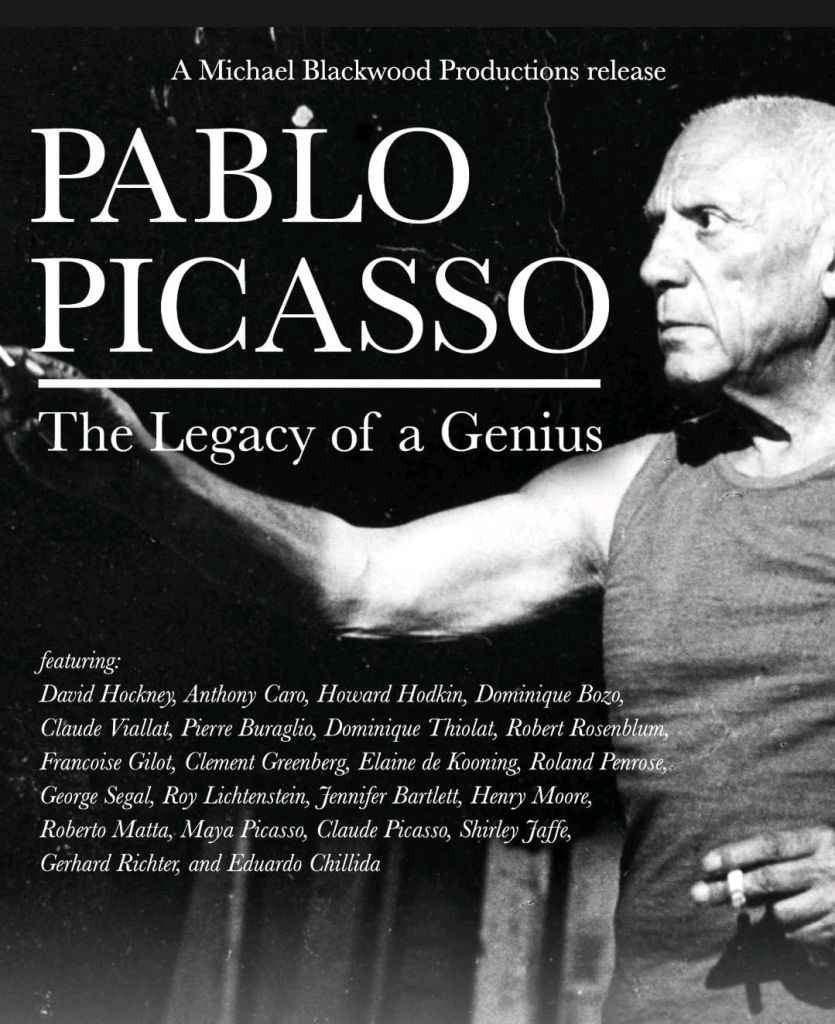
Michael Blackwood’s Legacy of a Genius offers an expansive and illuminating portrait of Picasso’s life, artistry, and the people who shaped his world. Through a meticulous blend of archival footage and intimate testimonials from family members and acquaintances, the documentary constructs a multifaceted image of the man behind the genius. But does it fully capture the complexity of his legacy, or does it leave gaps in its exploration of his artistic and personal evolution?
Direction – A- (3.7/4.0)
Blackwood’s direction is confident, allowing Picasso’s story to unfold naturally through the voices of those who knew him. The decision to interweave film archives with contemporary reflections creates a layered narrative that respects both history and personal memory. While comprehensive, the documentary occasionally glosses over some of Picasso’s more controversial aspects, opting for admiration over deep critique.
Writing & Narrative Structure – B+ (3.4/4.0)
The film is structured across multiple episodes, each examining different facets of Picasso’s life. The pacing is steady, but some sections meander, particularly when delving into well-trodden territory. A tighter thematic focus could have heightened the impact of certain revelations.
Cinematography & Visual Composition – A (3.8/4.0)
Visually, Legacy of a Genius excels in its use of archival footage, seamlessly blending past and present. The restoration quality is impressive, and the juxtaposition of Picasso’s artworks with his personal life adds depth to the storytelling.
Interview Quality & Subject Depth – A (3.9/4.0)
The documentary’s greatest strength lies in its interviews. The participation of family members and women who shared personal relationships with Picasso brings authenticity and emotional resonance. These firsthand accounts illuminate the artist’s temperament, creative process, and relationships in ways that go beyond mere biography.
Editing & Pacing – B (3.2/4.0)
The film’s multi-part format allows for a thorough exploration of Picasso’s life, but at times, the pacing drags, particularly in sequences that reiterate known aspects of his persona. A more streamlined approach could have kept the momentum stronger.
Research Depth & Accuracy – A (3.9/4.0)
Blackwood’s team has clearly done their homework. The documentary covers Picasso’s artistic innovations and personal struggles with a richness that reflects extensive research. However, a more critical lens on his personal controversies could have balanced the narrative further.
Sound Design & Score – B+ (3.4/4.0)
The soundtrack complements the film well, with musical selections that evoke Picasso’s era and artistic intensity. At times, however, the score feels slightly repetitive, relying on familiar motifs instead of fully embracing Picasso’s own relationship with sound and movement.
Cultural & Social Impact – A- (3.7/4.0)
Legacy of a Genius contributes significantly to Picasso’s enduring cultural relevance. It reinforces his artistic innovations while reminding viewers of the personal and societal forces that shaped his work. While it may not challenge prevailing narratives, it enriches them with personal depth.
Final Score: A- (3.7/4.0) – 92.5%
Verdict:
Michael Blackwood’s Legacy of a Genius is a masterfully constructed documentary that offers an intimate and historically rich portrait of Picasso. While it leans toward admiration rather than deep interrogation, its extensive use of archival footage and personal testimonies makes it an essential watch for art enthusiasts and historians alike.
COACH SYDNOR’S GRADE: A-
Featured Subjects:
• Jennifer Bartlett – Renowned painter known for her conceptual and minimalist works.
• Dominique Bozo – Former director of the Musée Picasso in Paris.
• Pierre Buraglio – French artist associated with the Supports/Surfaces movement.
• Anthony Caro – Influential British sculptor recognized for his abstract metal works.
• Eduardo Chillida – Spanish Basque sculptor famed for his monumental abstract works.
• Elaine de Kooning – American abstract expressionist painter and art critic.
• Françoise Gilot – Accomplished painter and author, and Picasso’s former partner.
• Clement Greenberg – Prominent American art critic closely associated with modern art.
• David Hockney – Celebrated British painter and photographer.
• Howard Hodgkin – British painter known for his abstract works.
• Shirley Jaffe – American abstract painter based in France.
• Roy Lichtenstein – Leading figure in the pop art movement.
• Henry Moore – Eminent British sculptor known for his semi-abstract monumental works.
• Roland Penrose – English artist, historian, and biographer of Picasso.
• Claude Picasso – Photographer, filmmaker, and Picasso’s son.
• Gerhard Richter – German visual artist known for his abstract and photorealistic paintings.
• Robert Rosenblum – American art historian and curator.
• George Segal – American painter and sculptor associated with the pop art movement.
• Dominique Thiolat – French artist and art critic.
• Claude Viallat – French painter and a founding member of the Supports/Surfaces movement.
• Maya Widmaier Picasso – Art historian and Picasso’s daughter.
Filmmaker Context:
Michael Blackwood is a veteran documentarian known for his work chronicling the lives and influences of major artists, architects, and cultural figures. His films often adopt a patient, observant style that allows subjects to narrate their own stories through interviews and archival material. Legacy of a Genius aligns with his broader commitment to documenting the arts, though it leans toward celebration rather than critical dissection.



 RMS INSIGHTS ✍🏾