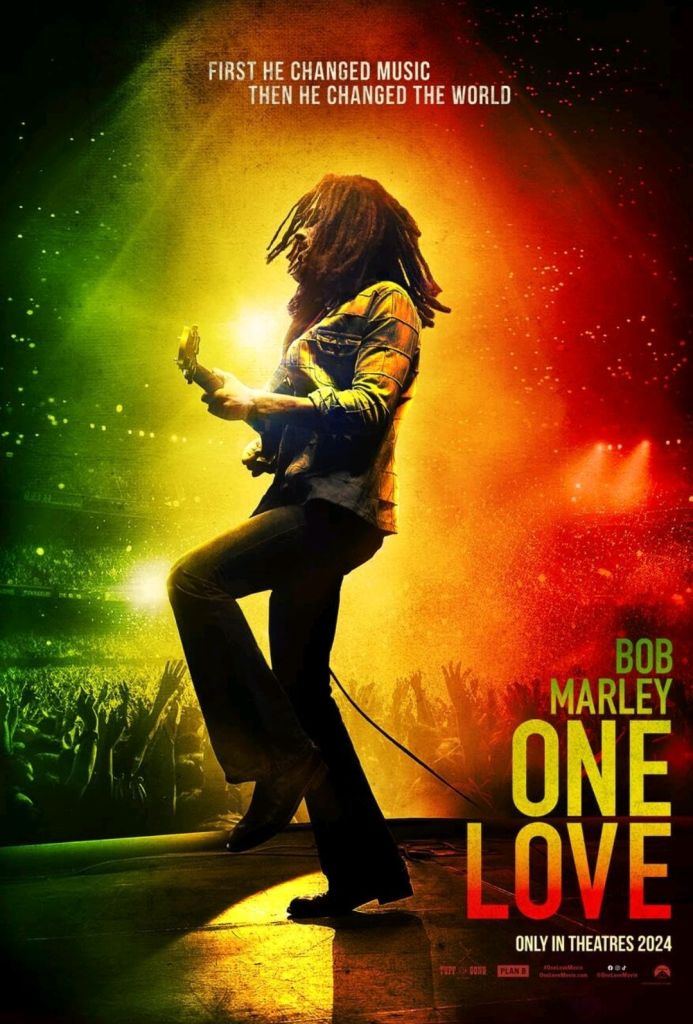
Bob Marley: One Love aspires to encapsulate the essence of the reggae legend, yet its execution leaves much to be desired. While visually immersive and bolstered by a charismatic lead performance, the film struggles with narrative cohesion, often presenting a series of vignettes rather than a fully realized biopic. Despite its reverence for its subject, it ultimately lacks the depth and complexity necessary to honor Marley’s multifaceted legacy.
A significant factor influencing the film’s outcome is the extensive involvement of the Marley family—Ziggy, Rita, and Cedella Marley—alongside Hollywood figures such as Brad Pitt, Dede Gardner, Jeremy Kleiner, and Robert Teitel. Their collective vision aimed to balance authenticity with mainstream appeal, but the result is a film that occasionally feels over-curated. The multitude of voices in the creative process may have led to a diluted singular vision, causing One Love to oscillate between a reverential tribute and a compelling cinematic narrative. This is evident in its structure, which at times lacks fluidity, as if each contributor had a slightly different perspective on portraying Marley’s story.
🎬 Direction – B- (3.0/4.0)
.
Director: Reinaldo Marcus Green (King Richard) approaches Marley’s life with affection but inconsistency. While he adeptly recreates the era’s atmosphere, his storytelling lacks the depth and focus required to fully engage with the complexities of Marley’s journey. The film often resembles a highlight reel rather than a cohesive narrative, prioritizing reverence over revelation. Green’s direction excels in musical sequences, particularly in recreations of Marley’s live performances, but falters when delving into his internal conflicts and ideological struggles.
The numerous producers, many with personal stakes in Marley’s legacy, may have contributed to the film’s cautious approach, resulting in a reluctance to explore more challenging aspects of his life.
🎭 Acting – B+ (3.5/4.0)
Kingsley Ben-Adir delivers a dedicated portrayal of Bob Marley, capturing his mannerisms and stage presence with impressive fidelity. However, the screenplay does not afford him the opportunity to fully explore the musician’s inner conflicts. While his physicality and vocal inflections are convincing, the material lacks the depth needed to convey the emotional complexities behind Marley’s public persona.
Lashana Lynch shines as Rita Marley, infusing the role with quiet resilience and emotional gravity. She provides some of the film’s most poignant moments, depicting Rita’s strength as both a partner and an artist in her own right. The chemistry between Ben-Adir and Lynch is palpable, offering some of the film’s most engaging scenes.
Supporting performances include James Norton as Chris Blackwell, Tosin Cole as Tyrone Downie, and Umi Myers as Cindy Breakspeare. While these actors contribute competently, their characters are not sufficiently developed to leave a lasting impact.
✍🏾 Writing – C+ (2.7/4.0)
The screenplay offers glimpses into Marley’s artistic and political influences but fails to construct a compelling narrative arc. It presents key events in Marley’s life without weaving them into a larger, emotionally resonant story. The dialogue occasionally feels forced, relying too heavily on exposition rather than organic interactions. While the film highlights his role as a unifier during Jamaica’s political unrest, it does not fully explore the ideological weight behind Marley’s activism. The lack of deeper insights into his spirituality and struggles results in a film that acknowledges his significance but does not allow the audience to experience it profoundly.
One of the film’s most significant oversights is its superficial exploration of Rastafarianism—a faith central to Marley’s music, philosophy, and life. The narrative touches on Haile Selassie’s influence but fails to provide sufficient context on how Rastafari connects to biblical prophecy, the African diaspora, and Marley’s spiritual mission. His music was not merely about peace and love; it was a call for justice and divine revolution. The absence of a deeper discussion on this aspect weakens the film’s ability to convey the full weight of his message.
📽️ Cinematography – B (3.3/4.0)
Cinematographer: Robert Elswit (There Will Be Blood) delivers a rich visual palette, effectively capturing the vibrancy of 1970s Jamaica and London. The concert sequences pulsate with energy, immersing the viewer in the experience of a live Marley performance. The lighting and framing successfully capture the intimate and electric nature of these events. However, the film does not take many creative risks, often defaulting to conventional biopic compositions. A more daring visual approach—perhaps embracing the surrealism of Marley’s spiritual visions—could have provided the film with a distinctive visual identity.
✂️ Editing & Pacing – C+ (2.8/4.0)
Editor: Pamela Martin (The Fighter) struggles to maintain a consistent rhythm. Some sequences flow naturally, while others feel abrupt or meandering. The film’s fragmented structure hampers its emotional impact, making it difficult to fully invest in Marley’s personal and political struggles. Transitions between his personal life, music, and activism lack fluidity, leaving key moments feeling disjointed rather than interconnected. A more cohesive editing strategy could have enhanced the film’s momentum and emotional depth.
🎨 Production Design & Costumes – A- (3.7/4.0)
Production Designer: Chris Lowe (Bohemian Rhapsody) meticulously recreates Marley’s world, from recording studios to concert stages. The detailed set designs transport the audience to pivotal moments in his life, grounding the film in historical authenticity.
Costume Designer: Caroline Duncan (Respect) ensures period accuracy, dressing characters in era-appropriate attire that enhances the film’s immersive quality. The wardrobe choices not only reflect the 1970s aesthetic but also subtly highlight Marley’s evolving identity—from a burgeoning artist to an international icon. This attention to detail bolsters the film’s credibility, even when the storytelling falters.
🎼 Sound & Score – B (3.2/4.0)
The soundtrack, featuring Marley’s timeless hits, stands as the film’s most robust element. However, the sound mixing and score could have been leveraged more effectively to enhance emotional beats, often serving as a passive backdrop rather than an active storytelling component.

🤔 COACH SYDNOR’S GRADE: B- (76%)
Essential Film Information
🏢 Production Company: Plan B
🎞️ Distributor: Paramount Pictures
🎬 Director: Reinaldo Marcus Green
📝 Screenwriters: Terence Winter, Frank E. Flowers, Zach Baylin, Reinaldo Marcus Green
🎥 Cinematographer: Robert Elswit
✂️ Editor: Pamela Martin
🎭 Main Cast: Kingsley Ben-Adir, Lashana Lynch, James Norton, Tosin Cole, Umi Myers
🎨 Production Designer: Chris Lowe
👗 Costume Designer: Caroline Duncan
🎼 Music Composer: Kris Bowers
📇 Producers: Ziggy Marley, Rita Marley, Cedella Marley, Robert Teitel, Dede Gardner, Jeremy Kleiner, Brad Pitt
🔗 IMDb Link: https://www.imdb.com/title/tt11199302/
🔗 Wikipedia Link: https://en.wikipedia.org/wiki/Bob_Marley:_One_Love
 RMS INSIGHTS ✍🏾