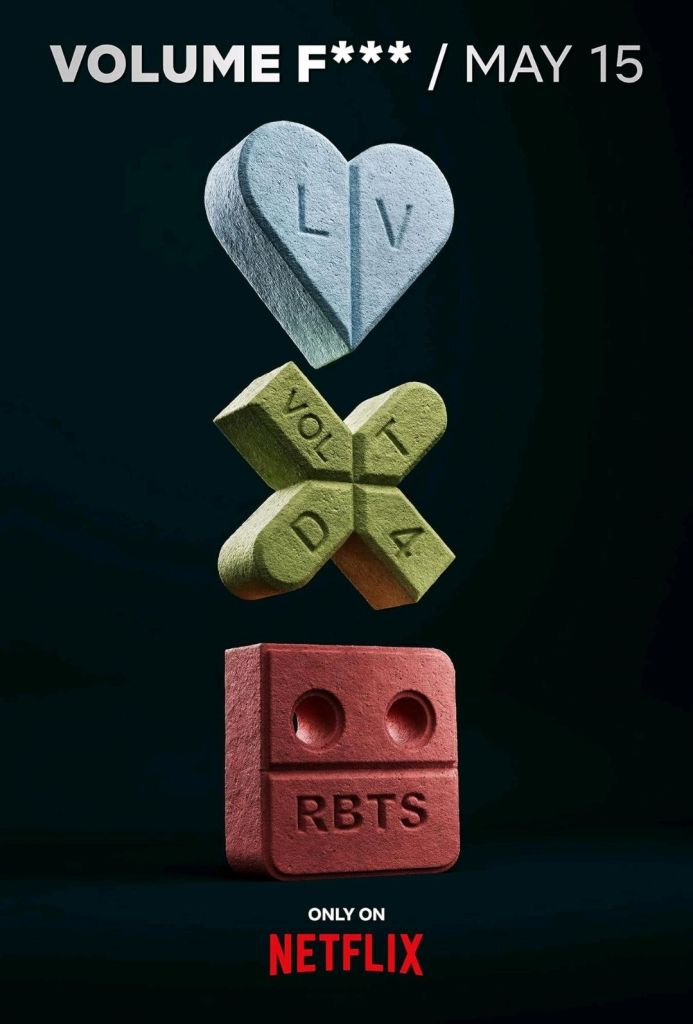
Love, Death + Robots (2019–2025)
Ink, Iron, and Imagination: The Metamorphic Artistry of Love, Death + Robots
No anthology in recent memory has fused science fiction, surrealism, horror, and satire with such visual virtuosity as Love, Death + Robots. Created by Tim Miller and executive produced by David Fincher, this series redefines animated storytelling not as a genre but as a kaleidoscope of possibilities.
Across its three volumes, Love, Death + Robots oscillates between the apocalyptic and the absurd, the poetic and the profane, the sublime and the grotesque — with each short film a self-contained universe of style, story, and speculative inquiry.
If animation has long been dismissed as the territory of children or the kitsch-prone, this series is the rebuttal — an operatic chorus of artistic ambition. Every episode (ranging from photo-realistic CGI to stark black-and-white ink strokes) offers not just a story, but a different soul.
This is not one show, but many masks worn by the same archetype: humanity, questioning itself in myriad futures. And in its best moments, Love, Death + Robots doesn’t just entertain — it haunts, provokes, and elevates.
Narrative Overview
As an anthology, Love, Death + Robots resists a traditional plot summary. Instead, it is a constellation of narratives — each complete, self-contained, and yet thematically tethered by a fascination with humanity’s relationship to creation, control, chaos, and consequence.
Among the most celebrated entries:
“Sonnie’s Edge” sets the tone with cybernetic gladiators and questions of autonomy. A woman weaponizes her trauma, channeling it through a bioengineered beast. The twist: the creature is her.
“Zima Blue” transforms from a sci-fi profile piece into a metaphysical meditation on art and origin. A cosmic muralist reveals he was once a pool-cleaning robot, seeking to return to simplicity — a modern-day Icarus unlearning his wings.
“Three Robots” offers satirical respite, as post-apocalyptic androids tour human ruins like a safari. Their deadpan curiosity mocks and mourns our extinct habits.
“The Drowned Giant” (narrated like a Borges short story) documents a beached colossus, its awe diminished as the public desecrates it. The giant becomes trash, then myth — a parable of wonder lost.
“Bad Travelling” (directed by Fincher) is a sea-bound gothic nightmare, in which a captain negotiates with a monstrous crustacean. The power struggle plays like Melville meets Machiavelli.
“Jibaro” (Oscar-worthy in style and sound) reinvents the siren myth as a gold-encrusted ballet of lust, greed, and colonial symbolism. With no dialogue, its choreography and sound design strike like a spell.
Each narrative offers a moral or a mirror. Some ask what separates man from machine; others question if that boundary ever existed. Some revel in violence; others recoil from it. Most of these vignettes unfold in ten to eighteen minutes — bursts of concentrated vision that waste no frame. The joy of Love, Death + Robots is not predictability, but provocation.
Symbolism & Subtext
Symbolism in this series is not adornment — it’s architecture. Nearly every episode functions as a parable.
In Zima Blue, color is memory, and abstraction is enlightenment. The final panel — a simple blue tile — is both tombstone and liberation.
Jibaro weaponizes sensory overload. The siren’s gold plating symbolizes colonization — beauty as bait, then conquest. The knight’s deafness, once his shield, becomes his doom when he hears the song too late.
The Drowned Giant reflects society’s diminishing reverence for mystery. The giant becomes not a marvel, but a carcass — a symbol of how spectacle erodes sanctity.
In The Witness, reality loops upon itself — voyeurism becomes a curse, the gaze a prison. The stylized animation enhances the dreamlike horror.
Across volumes, robots symbolize us more than they parody us. Our machines remember us as ironic gods — powerful yet petty, brilliant yet doomed.
Memorable Moments & Key Details
The final shot of Zima Blue: a robot returning to a pool, scrubbing tiles with silent grace — the sublime in the mundane.
In Jibaro, the siren’s glittering tears blend beauty and violence into an elegy of sensory trauma.
The moment the Three Robots find a cat and fear it might explode if they stop petting it — a nod to human superstition embedded in AI logic.
The horrifying elegance of Good Hunting, where a shapeshifting spirit becomes a steampunk sex worker — a collision of folklore and futurism.
Snow in the Desert: an immortal man seeks companionship, only to find that survival means loneliness.
🎥 Strengths & Weaknesses
Strengths:
Animation diversity: From photorealism to hand-painted abstraction, every episode feels like a new visual dialect. This metamorphic aesthetic elevates the anthology into a gallery.
Narrative punch: Most episodes distill philosophical heft into less than 15 minutes — storytelling as short-form surgery.
Sound design: Whether silent (Jibaro) or saturated (The Secret War), soundscapes heighten mood and metaphysical unease.
Creative freedom: Each story bears its own signature, unburdened by franchise bloat or audience appeasement.
Weaknesses:
Tonal whiplash may deter some viewers. The leap from satire to horror to meditative silence isn’t for everyone.
A few weaker entries (Ice, The Tall Grass) feel conceptually thin, more aesthetic sketch than full meal.
🎭 Production Design & Costumes
Each episode’s universe arrives fully formed. From the militaristic grime of Sucker of Souls to the psychedelic futurism of Pop Squad, no two episodes look alike. Costume design, even when rendered digitally, reflects inner character — gold-plated arrogance, leather-clad survival, or the nakedness of vulnerability. Even the robots wear identity like clothes.
🖋️ Writing Style & Literary Devices
The writing across episodes spans satire, tragedy, fable, and allegory. Literary techniques abound:
Irony (robots touring human extinction like tourists).
Allegory (The Secret War as a metaphor for Cold War paranoia).
Hyperbole (The Dump reveling in grotesquerie).
Allusion (classical myth retold in futuristic garb).
Foreshadowing (often nested in silent visuals rather than dialogue).
🔄 Comparative Analysis
Love, Death + Robots descends from the lineage of Heavy Metal, The Animatrix, and Rod Serling’s The Twilight Zone. But unlike those, it does not merely speculate — it interrogates. Its stories do not predict the future; they question whether we deserve one.
Its genre agility and visual ambition make it more than anthology — it’s animation as literature. Where Pixar mines the heart, Love, Death + Robots mines the mind and spirit (often by breaking them first).
🏆 Verdict
Love, Death + Robots is not just a show. It’s a fever dream, a philosophical archive, a love letter to the boundlessness of animation. With two Emmys under its belt and another likely incoming, it redefines what adult animation can achieve. Its beauty lies not in consistency, but in its chaos — and within that chaos, a quiet, persistent search for meaning.
Final Score: 3.95 / 4.0 — A (97%)
Legacy Factor: A cornerstone of 21st-century animated storytelling. Future creators will study it. Viewers will rewatch it. And the robots — they will remember us.
 RMS INSIGHTS ✍🏾