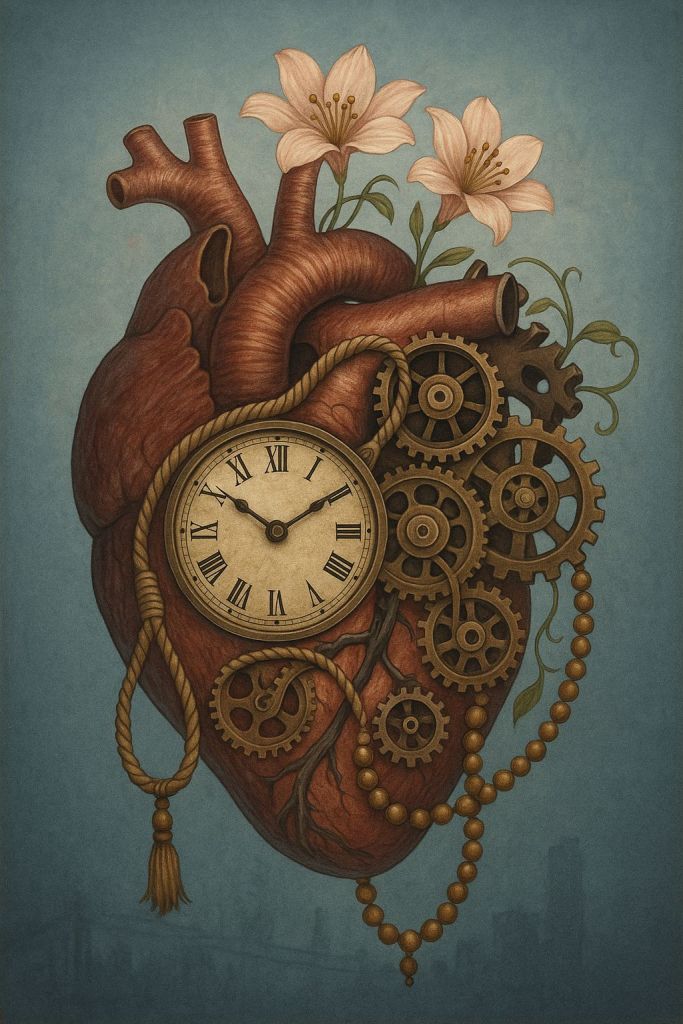
Bandwidth of the Heart


The Exit


The applause began before Malcolm Dorsey finished his sentence.

He stood at the center of the glass-walled atrium that had once been a drafty warehouse and was now a monument to his own restlessness: steel beams, warm wood, discreet art, the faint hum of servers like distant bees. Above him, the Dorsey Systems logo glowed in soft white, already scheduled to be replaced by the acquiring conglomerate’s more muscular brand.

“…and whatever this company becomes next,” he said, pausing for a beat he no longer needed, “I’m proud of what we built together.”

The crowd rose to its feet. Engineers in hoodies, product managers with careful smiles, executives in deliberately casual jackets. Someone popped another bottle of champagne; the cork ricocheted off a beam and drew a ripple of laughter. Phones lifted. A few people wiped at their eyes with the backs of their hands, surprised to find the gesture necessary.

Malcolm smiled, because this was the moment he was supposed to smile. The face on the internal livestream looked composed, a man at peace with walking away. Inside, though, he felt not the hum of a machine shutting down but the sudden hush that follows a wave’s collapse — energy spent, the shore still trembling.

He stepped away from the mic to the chorus of congratulations. Hands gripped his. A young engineer with a nose ring said, “You changed my life, Mr. Dorsey.” A VP clapped him on the shoulder and whispered, “Legend.” HR presented him with a framed early product sketch he barely remembered drawing. People were already nostalgic for a past he hadn’t had time to feel.

“Sam—Malcolm.”

He turned. Lottie corrected herself mid-syllable, laughing softly — a private echo from the years when she’d called him Sam for “Samson,” her name for the way he threw himself against obstacles. She touched his lapel, smoothing a fiber that wasn’t there.

“You did well,” she said. “You even sounded like you meant it.”

“I almost did.” His voice carried just enough amusement to make it safe.

She looked radiant, as she always did in a room full of people: cream silk blouse, tailored trousers, silver hair styled with studied ease. Fifty-two and luminous, she moved through space as if she’d negotiated with gravity and won. Her eyes, though, flickered past him toward the view beyond the glass — Palo Alto receding into dusk, taillights in thin red strings, planes lifting off from SFO like fireflies tracing their routes home.

“Do you realize,” she said, looping a hand through his arm as they drifted toward the balcony, “this is the first time since I’ve known you that your calendar isn’t a battlefield?”

He smiled. “Give the lawyers a day. They’ll find something.”

“No.” She stopped him gently on the threshold, where the conditioned air met the cool breath of evening. “I mean empty. Open. Yours.”

He followed her gaze. The campus looked smaller from here, almost modest. Buildings he’d obsessed over now blended into the larger landscape of tech architecture: glass, steel, the theater of transparency. Beyond that, the hills held their shape, indifferent.

“What do you want to do?” she asked.

He had been asked that question all week, usually by bankers. Start another company? Join a board? Write a book? Mentor founders? His answers had been competent, vague, acceptable. Tonight, none of them felt close enough to touch.

“I suppose,” he said, “I should figure out who I am when I’m not copied on everything.”

Lottie laughed, but her hand tightened on his arm. “I’ve been thinking,” she said. “We should leave. Not just for a week. Properly leave. Paris, London, Rome, maybe Lisbon. A year, at least. See the world before we’re too creaky to enjoy the good walking cities.”

He looked at her profile, the familiar angles softened by the balcony lights. Travel had always been a promise deferred — another funding round, another launch, another crisis. They had postcards from places she’d gone without him, tucked into cookbooks they never used.

“A year,” he repeated.

“Yes.” Her eyes were bright now, not with tears but anticipation. “We’ve spent decades watching the world through screens and quarterly reports. I want to see it up close. People, art, music. Old streets. New conversations. No one calling you at three in the morning because a server farm in Ohio refuses to wake up.”

He considered the idea, turning it over like an unfamiliar object. A year without being necessary to something humming and fragile. A year where silence could mean peace instead of failure.

“What would I do?” he asked lightly.

“You could try this radical thing I’ve heard of,” she said. “It’s called living.”

He chuckled, but the word unsettled him. Living implied that whatever he’d been doing up to now was something else — rehearsal, maybe, or a very elaborate detour.

Behind them, another cheer went up as someone started a slideshow of old company photos. The early days: secondhand desks, bad lighting, too much caffeine, a younger version of him in a T-shirt with a slogan he would not wear now. He watched himself on the screen throw his head back in laughter at some forgotten joke, arms wide, as if claiming the future by gesture alone.

Lottie nudged him. “Look at him,” she said softly. “He thought this was the whole story.”

“And now?”

“Now,” she replied, “we get to find out if there’s another chapter. Maybe even the better one.”

He didn’t answer right away. The sky over the hills darkened from cobalt to ink, the first stars faint against the leftover light. In the atrium behind them, his team toasted the deal that had made him unimaginably rich and, for the first time in years, profoundly optional.

“We’ll go,” he said at last.

She turned to him, surprised by the steadiness in his tone. “You mean it?”

“Yes.” He felt the decision settle into him like a weight and a release. “Book it. The whole cliché. Paris, London, Rome. Anywhere you want.”

She kissed his cheek, quick and pleased. “You won’t regret it,” she said.

He watched his younger self smile again on the screen, pixelated and earnest, and for a flicker of a second, thought he saw in that face both the promise and the cost of all he’d built.


London: The Beginning of Distance

London greeted them with drizzle and understatement. The air smelled faintly of wet stone and diesel, and the Thames moved like a thought half-finished. From their hotel window near Blackfriars, cranes swung methodically over the skyline, metronomes of progress marking a rhythm Malcolm could still hear inside himself.

Their first morning together was briskly polite. She had museum tickets in hand before breakfast; he was already answering emails he had promised to ignore. By noon, they’d divided the day as if by instinct — she to the Tate Modern, he to the TechFront accelerator in Shoreditch.

At the accelerator, a mural of circuitry stretched across one wall, bright as graffiti. The founders looked impossibly young, talking in acronyms and caffeine. They greeted him with reverence, a living footnote in their creation myths. Pioneer, they called him — a word that felt like both medal and headstone.

A boyish CEO asked if he missed the rush of relevance.

Malcolm smiled. “Sometimes the rush outruns the reason.”
The young man nodded, polite but puzzled. When Malcolm shook his hand, he noticed the callouses were from weight training, not work.

Crossing the bridge later that afternoon, he watched the gray water curl around its own current. The city hummed — buses sighing, sirens threading through traffic, street vendors calling from under umbrellas. He realized the sound reminded him of the server rooms back home — relentless, unseen, indispensable.

Across the river, Lottie stood before a Rothko — color bleeding into color like quiet argument. A curator named Amelia, bright and angular, invited her to lunch. At a café overlooking the embankment, they spoke of abstraction and attention, of how commerce had stolen art’s nerve. When Amelia called her vital, Lottie felt herself uncurl, warmed by recognition that had nothing to do with love and everything to do with being seen.

That evening they reunited at a restaurant near Covent Garden, all reclaimed wood and candlelight. The air smelled of truffle oil and the low murmur of couples speaking softly. For a while, the talk was easy — the museum, the accelerator, the weather’s indifference.

“I met a few people today,” she said finally. “They’re organizing a salon in Paris — writers, critics, thinkers. I might help host.”

He nodded. “Sounds interesting. I met some founders from Nairobi. They’re building a platform to teach coding in local dialects. They asked if I’d advise.”

She tilted her head. “So even now, you’re finding another company.”

“And you,” he said gently, “another stage.”

She laughed too quickly, touching his hand in reflex rather than affection. The candlelight trembled between them, flickering in the small current of her movement.

He looked down at his watch — not to check the time, but to give his silence somewhere to go.

Outside, London’s drizzle turned to steady rain, the streetlights shimmering in blurred halos. Inside, their reflections floated in the window glass — close enough to blur, too far to touch.

Paris: The Divergence

Paris opened before them like a film already in progress — all motion, color, and the faint scent of something living too well. Their rented apartment overlooked the Seine, where light moved across the water with a kind of practiced charm. Lottie adored the view; Malcolm admired the engineering of the bridges.

In the beginning, they moved together. Mornings at cafés, afternoons wandering through markets where time slowed long enough for them to pretend it still belonged to them. But soon, the rhythm that had once bound them began to fracture into separate cadences.

Lottie met Adrien Duval at a gallery opening in Le Marais — a French-Moroccan architectural historian with a poet’s diction and a collector’s patience. He spoke of façades as if they were memories, of columns that leaned into history like old lovers. He listened to her stories with a stillness Malcolm had long abandoned. When he called her curious in the best way, something in her — dormant since her thirties — woke up. She began to wear color again.

Malcolm noticed. He also noticed how her laughter now carried new vowels — softer, Parisian. Yet he couldn’t bring himself to resent it. He had once loved the same quality: her ability to absorb a place and reflect it back as light.

While she found attention, he found silence. A week later, over bitter coffee and a headline about global innovation, he met Kofi Mensah — a Ghanaian robotics entrepreneur with the kind of earnestness that cuts through cynicism. Kofi spoke of democratizing prosthetics using recycled tech: “If we can make machines learn compassion, maybe we’ll follow.”

The line stayed with Malcolm all day.

He began spending mornings with Kofi’s team in a borrowed workspace near Montparnasse — a basement humming with code, laughter, and optimism unscarred by markets. For the first time in years, he felt small in the right way.

Lottie, meanwhile, attended lectures, salons, and dinners. Her social calendar began to look like a second passport. She sent Malcolm reminders of events he rarely attended, though she always said we.

One evening, he returned late to the apartment. Adrien’s voice lingered faintly on the speakerphone; she ended the call too casually. The air between them thinned.

“You still live by quarterly returns,” she said, her tone sharp with exhaustion.

“And you,” he replied, “live by who’s watching.”

The silence that followed was longer than the argument that never came. Through the open window, the Seine kept whispering its endless persuasion — that all things flow away eventually.
Rome: The Breaking Point

Rome shimmered like a fever dream—sunlight on stone, the hum of scooters beneath the drone of doves, beauty rehearsing its ruins. They arrived in late May, when the air felt perfumed with dust and memory. For a time, the city disguised their drift. Beauty can do that—it flatters what’s breaking.

They moved through the days like travelers playing versions of themselves. Morning espresso at the corner café. Photos at the Forum, smiling because history required it. Evenings of polished conversation—wine, candlelight, curated ease. Lottie captioned their pictures with fragments of poetry. Malcolm scrolled through them absently, noting that even happiness, once filtered, began to resemble marketing.

At night, the ceiling fan hummed a tired rhythm in their flat near Trastevere. She read until midnight, her lips moving faintly around French phrases she had begun to prefer. He mapped outlines for a mentorship network he might fund in Nairobi, lines of code scrawled into a notebook as if writing could keep him necessary. They were two devotions running parallel—hers to attention, his to usefulness.

Sometimes, she would glance at him from her book and almost speak. Then she would close it instead, as if silence were safer.

One evening, Lottie stood before the mirror, fastening an earring. The gown was bronze silk, backless, unapologetic. The reflection staring back at her was confident, almost defiant, yet she caught a small tremor in her wrist as she adjusted the clasp. For a moment she saw herself as Malcolm once did—curious, luminous, untiring. Then the image shifted, and she saw only the woman determined not to fade.

“You’re sure you won’t come?” she asked without turning.

“I have a call with Kofi’s group in the morning,” he said. “Different kind of soirée.”

She smiled at her reflection. “Ghana,” she said, tasting the word. “You’re retiring into charity now?”

He looked up from the desk. “No,” he said evenly. “I’m retiring into relevance.”

Her laughter, light and edged, filled the room like perfume—pleasant at first, then cloying. She touched his shoulder as she passed, a gesture practiced into civility, and left the faint scent of citrus and resolve.

When she was gone, the apartment felt overlit. He wandered onto the balcony and watched the city pulse below: headlights sliding through narrow streets, a violin’s stray note floating up from the piazza. He imagined her walking into the Villa Medici, radiant under chandeliers, her laughter absorbed by marble. The thought hurt less than it should have.

Near midnight, he saw her name appear online—tagged beside Adrien’s in a cascade of photographs. She stood beside him, glass in hand, her smile exact, her posture fluent in attention. Adrien’s fingers rested at the small of her back. The image glowed on his tablet like an icon of another faith.

Humiliation flared, clean and precise. But beneath it came an unexpected stillness—something like surrender, but not defeat. Perhaps this was what letting go truly felt like: the ache without the argument.

He sat for a long time, watching the Roman night dissolve into its own light. In the quiet, he realized their marriage had become tourism—checking boxes, collecting views, avoiding silence. They had mistaken movement for meaning.

When dawn came, the sky was a pale watercolor of smoke and gold. Church bells tolled across the river. A baker’s cart rattled over cobblestone, the air fragrant with yeast and exhaust. He packed one bag: a few shirts, his worn notebook, the watch Lottie had given him years ago—the only timepiece he never learned to ignore.

Before leaving, he paused by her side of the bed. Her gown from the night before lay draped over a chair, bronze against the morning light. He folded it carefully and placed it beside her perfume on the dresser, a small courtesy to the past.

By the time she returned, barefoot and slightly drunk, the suitcase waited by the door.

“You’re actually leaving,” she said, mascara feathered into irony.

“I am.”

“Where?”

“Accra.”

She blinked, then gave a single incredulous laugh. “Of course you are.”

He nodded. “The flight’s at six.”

He stepped into the hallway as the first bells finished their echo. The city was waking—priests crossing squares, shutters opening, pigeons rising. He wasn’t praying, yet he bowed his head all the same.

Accra: The Encounter

The heat in Accra arrived like an announcement — not oppressive, but certain. It carried the scent of rain on red clay and something faintly sweet, like mango ripening in the sun. Malcolm stepped from the airport into a city that moved to its own percussion: horns, laughter, street radios, the overlapping beat of survival and song.

By the time he reached the conference center, the air-conditioning felt almost alien. Rows of banners proclaimed The Ethics of the Algorithm. His keynote was scheduled last — a position of respect, or exhaustion. Either way, he preferred it. He spoke of responsibility, of technology as mirror and maker. He kept his tone calm, his words precise. When he finished, the applause was courteous but curious; most had come to see what the celebrated founder would say now that he was no longer building anything.

The moderator, Dr. Celeste Okafor, thanked him and leaned toward the microphone. “You’ve taught machines to recognize emotion,” she said, her voice low and measured. “Did you ever worry they’d recognize it better than we do?”

The audience laughed. Malcolm didn’t.

He looked at her — early forties, Nigerian-American, poised without effort. Her eyes held warmth, but also a certain diagnostic clarity. “Every day,” he said.

A silence rippled through the room, not awkward but attentive. She nodded, satisfied, as if he had just passed a test that few knew was being given.

After the session, she found him in the lobby, balancing a paper cup of coffee like an afterthought. “You didn’t dodge the question,” she said. “That’s rare.”

“I used to think answers made me credible,” he replied. “Now I prefer to be accurate about my ignorance.”

Her smile was small but approving. “Walk with me.”

Outside, the streets pulsed with late-afternoon heat. They wound through Makola Market, where stalls overflowed with color — fabrics bright enough to rewire the heart, vendors calling prices with musical precision. Celeste greeted people by name. A boy handed her a bracelet woven from copper wire. She gave him a coin and slipped the bracelet onto Malcolm’s wrist. “To remind you that connection can be handmade,” she said.

They walked on, talking not about profit but pulse — how algorithms were reshaping the informal economies that kept the city alive. She spoke of data colonialism and empathy as infrastructure. He listened — not to content, but to cadence. Each word felt grounded, deliberate, human.

By the time they reached the edge of the market, the sun was falling into the Atlantic, enormous and unhurried. The light turned the air gold, and for the first time in years, Malcolm felt something he didn’t immediately want to name.

That night, in the quiet of his hotel room, he opened a notebook he hadn’t used in decades. He wrote one line before setting the pen down:

“Perhaps what we call innovation is only remembering what we’ve forgotten to feel.”

He closed the book and left it on the table — not finished, but begun.

The Village Visit

The road out of Accra unspooled in long, rust-colored ribbons, the air thick with diesel and promise. Celeste drove the old Land Cruiser with one hand, gospel static murmuring from the radio. Every few miles she slowed for goats, for children carrying buckets, for men pushing bicycles heavy with plantains. The rhythm of the journey was human, not mechanical—pause, wave, continue.

“You’re quiet,” she said.

“I’m listening,” he replied, eyes on the horizon.

“To what?”

He smiled faintly. “Everything I used to filter out.”

She laughed, rich and quick. “Good. Then you’re almost ready for the field.”

After two hours, the city thinned into forest and light. Palm fronds shimmered like coins; the sea wind carried salt and woodsmoke. Celeste turned down a narrow track where the soil blazed the color of brick dust. The school appeared suddenly—three low buildings painted an ambitious blue, their walls patched by hand. On the front, someone had scrawled in chalk: Code the Future.

“This is one of our hubs,” she said. “We started with two tablets and too much faith.”

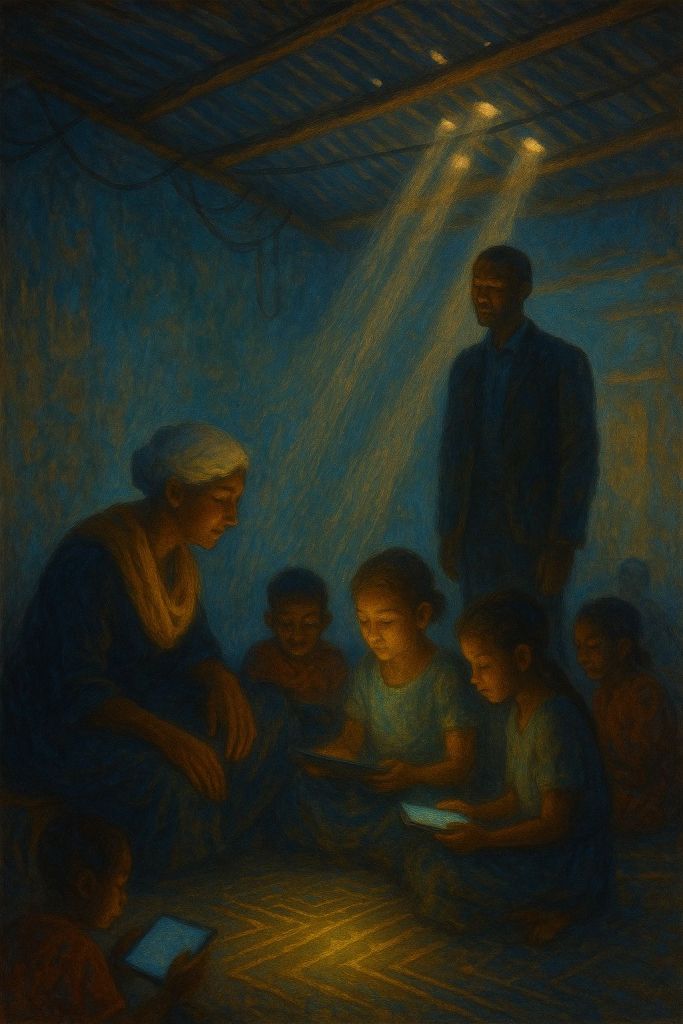
Inside, the heat was thick but joyful. A dozen children huddled around mismatched screens, faces lit by the glow of learning. The hum of a sputtering generator filled the room like a heartbeat. Their teacher, Ama, greeted them with a smile that belonged entirely to the moment.

“Professor Dorsey,” Celeste said, teasingly. “Meet my favorite innovators.”

The children giggled. A boy, barefoot and fearless, tugged Malcolm’s sleeve. “Sir, watch.” He tapped a few commands on a cracked tablet. A small robot—made from a soda can and salvaged wheels—rolled forward with a hiccuping whirr. Laughter erupted.

Malcolm knelt beside the boy, sweat beading on his temple. “How’d you power it?”

“Old phone battery,” the boy said. “Still works.”

He nodded slowly. “Still works,” he repeated, the phrase feeling truer than it should have.

Celeste moved through the room like quiet current—checking connections, translating when Ama’s English slipped into Twi. She leaned toward Malcolm. “When I left academia, my department chair told me I’d vanish. That no one writes footnotes about hope.”

He looked at her. “And yet here you are—published in dust.”

She smiled. “The most peer-reviewed medium there is.”

Outside, the afternoon boiled. They sat beneath a baobab tree, sipping tea that smelled of ginger and smoke. The enamel cups burned their fingers. A radio in the distance played highlife music, its bright guitar skipping over the hum of the generator.

Celeste poured another cup. “These children think coding is like storytelling. They don’t separate logic from rhythm. They build because it feels good.”

He leaned back against the tree trunk, the bark warm through his shirt. “In my world, we coded to escape the feeling part.”

She watched the wind move through the branches. “Maybe you needed to leave your world to remember it.”

He laughed softly. “You sound like a sermon.”

“I left sermons for systems,” she said. “But they keep finding me.”

The generator coughed once, then went silent. A groan rose from inside. For a moment, the air held its breath. Then a girl of about ten—barefoot, determined—picked up a stick and began drawing code into the dirt. Her classmates joined, reading the commands aloud like a chant: If light, then move. If sound, then dance. Their voices rose and fell with the rhythm of possibility.

Celeste’s hand brushed his as she pointed toward them. “Power never really goes out,” she whispered.

Malcolm nodded, unable to speak. The sweat on his forehead stung his eyes, or maybe it wasn’t sweat. He watched the girl write, her small hands confident in the dust. The robot sat motionless nearby, but somehow, everything moved.

When the children dispersed for the day, he stayed behind, staring at the chalk words on the wall: Code the Future. The phrase felt less like instruction, more like permission.

As the sun lowered, the generator ticked softly, cooling down. The light turned amber, painting their shadows long across the ground. Malcolm touched the copper bracelet Celeste had given him in the market. It was warm from his skin, alive with pulse.

He thought: This is what connection sounds like when it stops pretending to be signal.

Lottie’s Letter

The email arrived at dawn, its blue glow soft against the dim room. Outside, the Ghanaian morning was unhurried: roosters crowed at odd intervals, a dog barked once and stopped, and the air held that damp, metallic scent that precedes heat. Malcolm sat at the small table by the window, coffee cooling beside his hand, and opened the message whose subject line read simply: A Kind of Goodbye.

Lottie’s words filled the screen, precise as ever, the elegance of a woman who edited her emotions before sending them into the world.

Paris has turned gray again, she wrote. The Seine is swollen, the trees bare, and the city looks like it’s trying to remember its own reflection. Adrien has moved on, as I suspected he would. I’m staying for now—to find myself again, or perhaps to make peace with the version of me that stopped looking.

She mentioned attending a retrospective at the Musée d’Orsay, where she’d seen a Degas painting they once admired together—the ballerinas in rehearsal, not performing but waiting. I finally understood them, Malcolm. All that balance. All that poise. None of it meant for the audience.

Her tone softened near the end.
You once said ambition was a kind of weather—something that passes through us but never belongs to us. I think I understand now. The storm has moved on. I wish you well. Perhaps we were never lost—only walking different maps.

He read the message twice, then again, slower, letting the words expand in the stillness. The light outside turned honey-colored. He felt no anger, only a thinning of something invisible—like breath released after holding it too long.

He closed the laptop. The cursor blinked once, steady, waiting for a reply that would not come. He pressed delete. No hesitation. No archive. Only completion.

He rose and opened the window. The air was thick with charcoal smoke and laughter from the street below. Two boys kicked a punctured football through the dust, their shouts carrying joy like a contagion. He watched them until their noise blended with the rhythm of his pulse.

Celeste appeared in the doorway, barefoot, her hair caught in the new light. She held two tin mugs of coffee, steam curling between them. “You’ve been up early,” she said.

“Couldn’t sleep,” he replied.

She placed one mug before him, her gaze lingering on the closed laptop. “Bad news?”

He shook his head. “No. Old news finally read.”

She studied him for a moment, as if measuring the distance between grief and peace. “Then let’s make new news,” she said, sitting across from him.

Outside, the village stirred awake — vendors calling greetings, radios sputtering to life, the day gathering courage. Malcolm took a sip of coffee. It was bitter, grounding, alive.

He smiled faintly. For the first time in years, the morning wasn’t a meeting to attend or a calendar to obey. It was simply a beginning.
The New Beginning

Morning arrived without hurry. It slid over the horizon in slow layers of gold and pearl, turning the palm leaves into silhouettes and the zinc roofs into soft mirrors. On Celeste’s veranda, the air was cool for exactly fifteen minutes — that fragile window before the day remembered it was in the tropics.

Malcolm stood at the small gas burner, coaxing coffee to a rolling hiss. The smell rose rich and dark, cutting through the faint tang of sea salt and charcoal drifting up from the road. Inside, two laptops waited on the table: one open to a dashboard of names and time zones, the other to a cluster of student essays, each title earnest and ambitious.

Celeste sat in a cane chair, one leg tucked beneath her, reading. A pencil rested behind her ear, another between her fingers. The light caught in her hair, drawing a thin halo around the edges. Every so often she underlined a phrase, not because it was perfect, but because it was trying.

“You’re frowning again,” Malcolm said, carrying two mugs to the table.

She looked up. “They keep apologizing for their English,” she replied. “The ideas are better than half the journals I used to review.”

He set the mugs down. “Then maybe that’s the abstract,” he said. “Apologies not required.”

Outside the gate, voices were already gathering — children calling to one another, a motorbike coughing awake, someone laughing at a joke that didn’t need translation. The sounds rose in overlapping layers, the day tuning itself.

They began with the ritual they had built between them. Coffee. A quiet scan of the overnight messages. The inevitable brief skirmish with the internet service. Then the platform came alive.

On Malcolm’s screen, small windows blinked open: Ama’s coding hub down the road, another classroom in Kumasi, a borrowed library room in Nairobi, a modest community center in Recife. Names scrolled by—Adjoa, Rafael, Wanjiru, Lina—and next to them, mentors signing in from Tokyo, Toronto, Oslo, Lagos. Some connections crackled; some loaded in sudden clarity, as if distance had never been invented.

“Room Three is live,” Celeste said, tapping a key. “Oslo and Accra are connected.”

He clicked the icon. A new window opened. On one side, a girl from the village grinned into the camera, her braids bouncing as she adjusted the tablet. On the other, a boy with pale hair and headphones sat in a dim Norwegian winter, the window behind him filled with snow.

“Can you hear each other?” Malcolm asked.

There was a moment of lag, then two overlapping yeses and laughter.

“Today you’re trading stories,” Celeste said. “Not code, not theory. Stories about where you live, what a normal day looks like. After that, you’ll decide what kind of program you want to build together. Agreed?”

The girl nodded vigorously. “We will make one that sings,” she said. “With drums.”

The boy smiled. “And snow,” he added. “We can code snow that listens.”

The audio crackled, stabilized. Their voices grew softer as they began, shy at first, then braver. Malcolm listened not to the words, but to the rhythm — the way curiosity flattened accent, the way laughter sounded the same in both climates.

He muted his microphone and leaned back. “They don’t sound like users,” he said quietly. “They sound like co-authors.”

“That’s the idea,” Celeste replied. “No demos. Just lives.”

Later, under the mango tree near the school, they ate lunch from metal bowls — rice, beans, plantain fried to the edge of caramel. The shade flickered in the heat; the air smelled of sap and spice.

“You know,” she said, “the board in New York still thinks this is a pilot. A nice experiment for the annual report.”

“And what do you think it is?” he asked.

She wiped sauce from her thumb with a corner of bread. “An argument,” she said. “Against the way we’ve been measuring intelligence.”

He smiled. “Who’s supposed to win?”

“Not us,” she said. “Them.”

A lizard skittered across the dirt, pausing to consider their shoes. From the classrooms came the faint clatter of keys, a teacher’s voice rising and falling. The generator coughed, gathered itself, and held steady.

“You listen differently now,” Celeste added, not quite looking at him.

“How did I listen before?” he asked.

“Like a man waiting to rebut,” she said. “Now you wait to understand.”

He let the words settle. They felt less like praise than diagnosis.

In the afternoon, he moved through the rooms with Ama, adjusting a camera angle here, showing a boy how to steady a microphone with a folded cloth, translating an error message into reassurance. He didn’t lecture; he asked questions. When something broke, they fixed it together. When the power flickered off for a moment, groans rose in chorus, then turned into jokes. Someone lit a candle and kept explaining loops and branches with a stick on the board.

He caught himself laughing more than once. Not the polite boardroom laugh, but the unguarded kind that surprised his own chest.

Toward evening, the calls wound down. Screens darkened one by one, leaving dusty fingerprints and faint reflections. The sky shifted to amber, then bruised purple. Children spilled outside, their energy still in surplus.

Someone produced a drum. Someone else clapped a rhythm. There was singing — half a song they all knew, half improvisation. In one corner, two students played back a simple melody generated by a program they’d written, the digital notes oddly shy against the boldness of live percussion.

Celeste stood beside him, arms loosely folded, watching. “You remember what you said in your keynote?” she asked. “About teaching machines to recognize emotion?”

“I’ve tried to forget,” he said.

“You worried they’d recognize it better than we do.”

He nodded once.

“So,” she said. “Do they?”

He considered the question, then shook his head. “No,” he said. “They just notice faster. The difference is what we do after we notice.”

She seemed satisfied with that.

The first call to prayer floated over from a distant mosque, threading through the rhythm of drums. A breeze moved through the yard, lifting dust into a soft veil. The light on the veranda clicked on, more out of habit than necessity.

Celeste turned to him. “So you’re staying?” she asked.

He didn’t rush the answer. The word had already been spoken at the shoreline; now it only needed air.

“Yes,” he said. “To listen first. Then build what matters.”

She smiled, small and genuine, as if he’d solved an equation that had been waiting on the board. “That’s a good order,” she said.

From the doorway of the nearest classroom, a girl waved him over, her tablet held high. “Sir,” she called. “It works! It’s dancing!”

On the screen, a small digital figure moved in time with the drum outside — crude, joyful, a little off-beat, following sound instead of a perfect grid.

He walked toward her, the copper bracelet warm against his wrist. Behind him, the laughter of children mingled with the call to prayer and the hum of the waking night — not a signal, not an algorithm, but a kind of music only present hearts could carry.

For the first time in a very long time, Malcolm Dorsey felt that the bandwidth of his life matched the bandwidth of his heart. And it was enough.
Agápē

Borrowing Courage from the Sun

The mornings had grown quieter over the years, though not emptier. Silence, Adeline Carter had come to believe, was a kind of company. It had weight, texture, even rhythm — the way air paused between one heartbeat and the next. She sat at the edge of her bed in that quiet hour before sunrise, her long hair, streaked now with silver, falling forward over her shoulders like the threads of a pale curtain.

On her nightstand lay the small rectangle of devotion that connected her to another world — her phone, facedown beside her reading glasses and a mug faintly perfumed with tea. She reached for it and tapped the screen. The voice that filled the room was light, young, and still searching for melody.

“Hey, Grandmama,” Naomi said, a touch of shy laughter at the edge of her breath. “Here’s my poem for today.”

There was a rustle, the sound of a page being adjusted, and then the words came in a steady, deliberate rhythm, as if the child were learning to match the beat of her own heart.

“The dark before morning
feels like the world holding breath.
I open my eyes
and borrow a little courage
from the sun.”

A brief pause followed, then Naomi’s whisper — tender, conspiratorial.

“Okay. I love you. Bye.”

The message ended, but the warmth lingered. Adeline set the phone down gently, both palms folded around her tea. The room still smelled faintly of sandalwood and laundry soap, of paper and pencil shavings — the familiar fragrance of a teacher’s life distilled into domestic form. Outside her window, dawn had begun to test its colors: the faint blue of hesitation, the pale pink of intention, the slow gold of promise.

She sat still for a while, listening to the distant sound of a bus engine and the whisper of wind moving through the trees. There was peace in the knowing that every morning began with words — hers, someone else’s, it didn’t matter. Poetry was how she measured the pulse of the world.

When she rose, her knees reminded her of the years. They clicked faintly, like polite applause. She smiled at the sound, as if the body itself were affirming her persistence. In the bathroom mirror, her reflection appeared both familiar and strange: the lines beside her eyes, earned from decades of laughter and squinting at chalkboards; the long blonde hair that caught light even on dim mornings; the soft folds of skin at her neck, evidence of a life fully inhabited. She had once been told she was pretty, but she had never believed it. Pretty was for display; she had chosen purpose. What she carried now was something quieter — the kind of beauty that patience bestows.

By habit, she dressed neatly: a cream-colored blouse, dark slacks, a silk ribbon to tie her hair, the small pearl earrings Claire had given her one Christmas when money was thin but love was plentiful. The ensemble wasn’t fashion; it was composure made visible.

Her breakfast was humble — oatmeal with blueberries, a drizzle of honey, and one more mug of tea. She ate standing by the window, gazing at the photo magneted to her refrigerator door. Three generations stared back at her: herself in soft focus, hand resting lightly on her daughter’s shoulder; Claire, poised, forty-three, an architect with a gaze both tender and exacting; and little Naomi, ten, in front, laughing mid-motion, her braids lifting as though in defiance of gravity. The sight filled Adeline with a kind of gratitude that didn’t need words — a gratitude that simply breathed.

After rinsing her bowl, she set it upside down on the drying rack, a ritual of small closure. Then she reached for her worn leather bag, the one softened by years of papers, pencils, and afterthoughts, and slipped Naomi’s voice into her memory like a bookmark she could return to later.

Outside, the morning air met her with that cool, forgiving touch that belongs only to early hours. The neighborhood stirred — a dog barked, a newspaper hit a driveway, someone’s radio murmured gospel faintly through a window. Jefferson Elementary stood three blocks away, modest, sturdy, unpretentious, its brick walls warmed by decades of children’s laughter.

She preferred to walk. The world revealed itself more honestly at walking speed. On the corner, she passed a boy waiting for the bus, backpack slung like a question mark across his shoulder. He looked up, and she nodded. His wave was shy but certain — a small reminder that recognition, too, was a form of love.

The crossing guard lifted a hand in his usual salute. “Morning, Mrs. C.”

“Morning, Joel,” she replied. “Another day to learn how to listen.”

He chuckled, unsure whether she meant it as philosophy or humor, and she smiled, letting him keep the mystery.

By the time she reached the school gates, the sun had climbed past hesitation and begun its steady ascent into certainty. She stood a moment before entering, watching the building breathe children through its doors — laughter, chatter, motion. The scent of pencil lead and cafeteria toast drifted into the air, oddly comforting.

Inside, the hallways pulsed with life — the sound of sneakers on tile, lockers opening with metallic sighs, announcements crackling from unseen speakers. She walked through it all like a conductor moving through an orchestra already in motion, her pace unhurried, her expression calm. Teachers nodded. Students called her name.

“Hi, Mrs. Carter!”
“Morning, Mrs. C!”

Each greeting was a small spark of belonging.

Room 104 waited at the far end of the corridor — her kingdom of paper, light, and small awakenings. The door opened with its familiar creak. She paused at the threshold, taking in the sight she loved: the cranes hanging from the ceiling, folded from poems past; the wall of haikus written in children’s uneven handwriting; the sunlight slicing through the blinds in slender ribbons that fell across the desks. Every object in that room had known her patience.

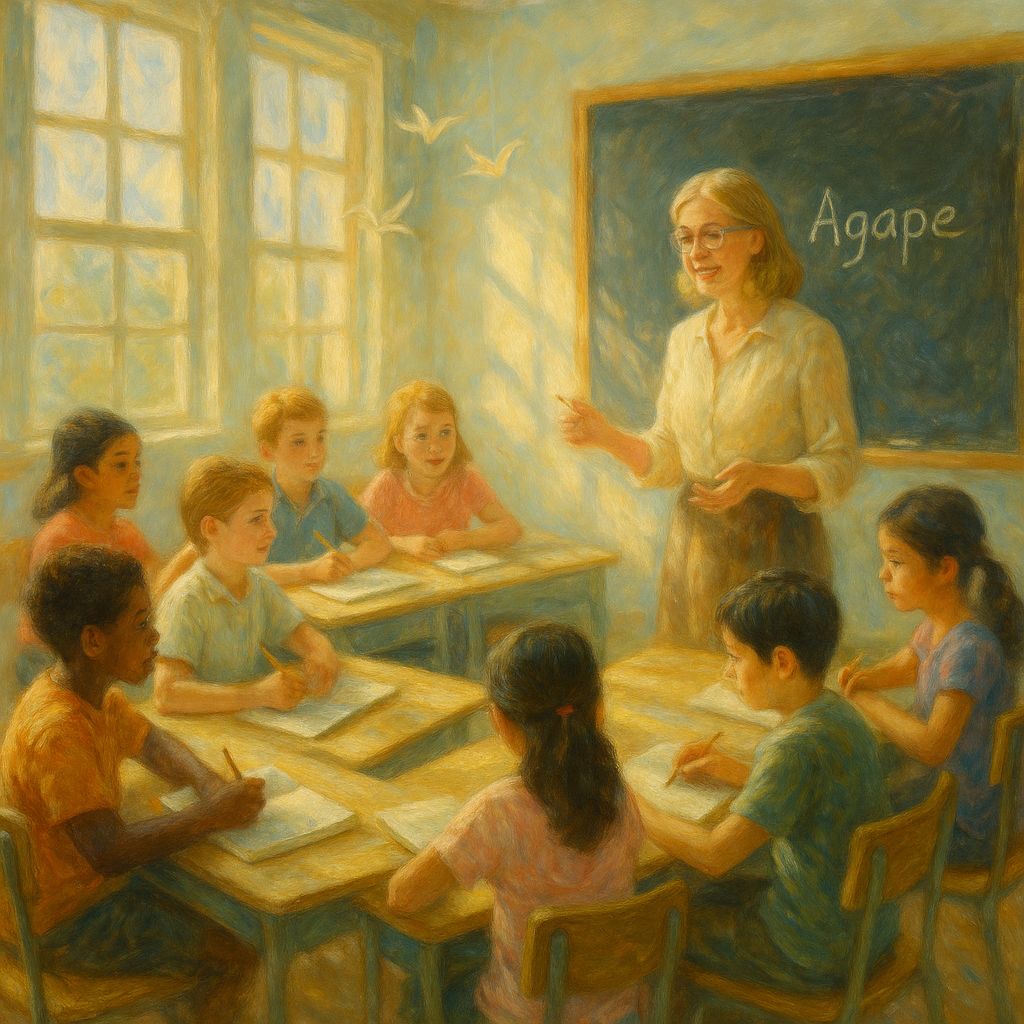
She set her bag on the desk and turned on the small speaker that lived beside the globe. A slow jazz piano wandered into the air, its notes deliberate, its silences generous. She walked to the board, selected a stick of fresh white chalk, and wrote a single word across the dark green surface in her elegant, looping script.

AGAPE.

She stepped back, letting the chalk settle into its own stillness. The word looked both ancient and new, like something the light itself had chosen to illuminate.

When the bell rang, the room filled quickly — chairs scraping, laughter spilling, the small gravity of twenty-four young lives in motion. She greeted each child by name, one of her quiet vows since her first year of teaching. Names, she believed, were sacred poems.

When the last seat was filled and the restless energy had begun to settle, she stood before them with that gentle authority that came from years of repetition made holy.

“Good morning, poets.”

“Good morning, Mrs. C,” they chorused.

“Today,” she said, turning toward the board, “we will learn a word that does not end when you stop saying it.”

They leaned forward, curiosity flickering like light across their faces.

Diego squinted. “A… gape? Like when your mouth’s open?”

Laughter broke out. Adeline joined in. “Yes, Diego, that’s one meaning. But words, like people, often carry more than one story.” She underlined the word slowly. “This one comes from Greek — agape. Say it with me.”

“Ah-GAH-pay,” they echoed, the sound unpolished but earnest.

“Good. It means love — not the easy kind, not the one that expects reward. It means love that keeps giving even when no one is watching. Love that shows up. Love that endures.”

The laughter faded into thoughtfulness. Maya tapped her pencil against her desk. Leila whispered the word to herself, tasting it. Kenji nodded slightly, eyes fixed on the board as though memorizing not just the spelling but the idea.

Adeline smiled. “I want each of you to think of a moment when someone showed you that kind of love. It doesn’t have to be grand. Often, the truest love hides in ordinary things.”

She moved among the desks as they began to write, the whisper of pencils rising like the hush of rain. Her gaze drifted across the words forming in front of her — fragments of tenderness disguised as simplicity.

A grandmother’s humming while stirring a pot.
A father fixing a broken robot at midnight.
A mother’s hand lighting a candle during a storm.
A friend listening without interrupting.

Adeline felt something shift quietly in her chest — that familiar ache of recognition, the one that came when her students unknowingly mirrored her own life back at her.

She stood at the front again and read the word once more in silence. Agape.

Love that gives and keeps giving.

And for the first time that morning, she wondered if she had taught it or simply lived it.

The Cost of Becoming

That night, long after the children’s laughter had dissolved into the hum of crickets, Adeline sat at her kitchen table surrounded by papers. The room was small, softly lit by a lamp with a frayed shade, the kind of imperfect glow that invited thought rather than distraction. She read their poems one by one, her lips moving silently with each line as though prayer and reading had become the same gesture.

Each child’s world opened on the page like a door left ajar. Maya’s words carried rhythm and sorrow, Diego’s heart beat in grease and pride, Leila’s imagery shimmered with faith, and Kenji’s precision sang of invisible courage. Even Sophie, the quietest, had found music in restraint. Adeline read them slowly, absorbing their small certainties and smaller doubts.

When she reached the last poem, she smiled at the smudge of an eraser mark in the corner. It was not a mistake, only proof that someone had dared to revise. She pressed her fingertips lightly to the paper — her way of saying thank you.

Then, almost by habit, she opened the drawer to her right and found it there: the letter. The cream envelope, its edges worn from being opened too often, still carried the faint smell of office ink. She unfolded it again and let her eyes drift over the words, the language of bureaucracy trying its best to sound kind.

Realignment. Budget adjustments. Retirement option. Gratitude for years of dedicated service.

She traced the letters with her thumb. Gratitude — such a beautiful word, wasted in such a cold sentence. She folded the paper again, placed it beside her tea, and stared at it as though it might apologize.

It didn’t.

Instead, she saw herself in its reflection — the young woman she once was, sitting in a different room, thirty-five years earlier.

The scene returned whole, alive, as if memory had simply been waiting for permission.

She was twenty-eight then, newly divorced, raising Claire alone in a two-bedroom apartment above a laundromat. The air smelled perpetually of detergent and determination. She worked mornings as a substitute teacher and took evening classes at the junior college, chasing the degree that always felt just beyond reach.

There were nights she would sit in the back row of her education seminar, still wearing her classroom cardigan, her hands stained faintly with chalk, her mind balancing lesson plans against grocery lists. The professors talked of pedagogy and philosophy, of Bloom and Vygotsky, while her stomach growled and her heart held steady.

After class, she’d walk home under flickering streetlights, passing the same corner store where the owner saved her day-old bread without asking. Her shoes made a soft rhythm against the cracked sidewalk — the sound of someone rewriting her future one weary step at a time.

Claire, then eight, often stayed with her grandmother on those nights, but sometimes, when money was too thin for babysitters, she’d curl up on the couch beside a stack of graded papers and fall asleep before Adeline returned. One night, Adeline found a note on her pillow in a child’s crooked hand:

When you’re tired, I’ll be your teacher.

She kept that scrap of paper folded in her wallet for decades. Even now, it rested between her driver’s license and an old bus ticket, a relic of endurance.

The kettle whistled softly, pulling her back into the present. She poured another cup of tea and let the steam rise against her face. She thought of Claire now — forty-three, capable, busy, carrying her own quiet fatigue. They spoke often but sometimes too carefully, both women guarding tenderness with the same discipline that had saved them.

She wished she could tell her daughter what she finally understood: that perseverance wasn’t the absence of weariness but the decision to keep moving through it.

A faint vibration broke her thoughts. Her phone lit up. Claire’s name.

“Hi, Mom.”

“Evening, sweetheart.”

“You sound tired.”

“A little. It was a good day, though. We started a new word.”

Claire laughed softly. “Only you would measure days in words.”

“Someone has to keep the dictionary alive.”

“I saw the district email,” Claire said, and the warmth in her tone thinned to concern. “They can’t just do that. You’ve given them your life.”

Adeline smiled at the edge in her daughter’s voice. It was the same tone Claire had used at sixteen, defending her mother to a teacher who’d doubted her grades.

“I’ve given them my love,” she said. “Life was always a loan.”

“That’s not fair.”

“It’s not supposed to be. Fairness is a luxury of the young.”

There was silence on the other end, the kind that holds both worry and admiration.

“Come live with us,” Claire said. “We’ll make space. Naomi would love it.”

“I’m thinking about it,” Adeline answered. “But not yet. I still have work to finish.”

“It’s almost the end of the year.”

“Yes. And it deserves to end beautifully.”

Claire sighed, that long, affectionate exhale that only daughters give. “You never stop turning things into lessons.”

Adeline chuckled. “It’s the only magic I know.”

After they hung up, she sat a while longer, listening to the quiet creak of her home settling into night. The letter remained on the table, but its power had dimmed. She wrote something small on its back, her handwriting steady and deliberate.

Love does not retire.

She folded it and placed it back in the drawer.

The next morning arrived with soft rain. The air smelled of wet soil and renewal. She walked to school beneath her umbrella, feeling the cool drops against her face like punctuation.

In Room 104, the children gathered earlier than usual, some still shaking raindrops from their sleeves. She greeted them each with a nod or a word, her eyes carrying more tenderness than usual.

“Today,” she said, “we are going to listen to silence.”

They laughed at first, unsure if she was teasing.

“I mean it,” she continued, smiling. “Poetry is made of what we don’t say as much as what we do.”

She wrote LISTEN on the board beneath AGAPE.

“Think of someone who showed you love not with words, but with actions. Maybe someone who stood quietly beside you when you needed it most.”

The pencils began again, hesitant at first, then sure.

As they wrote, she saw herself in them — every struggle she’d ever faced distilled into smaller, braver versions. Each child was a mirror of her past and a promise for her future.

When the bell rang, they left behind scraps of paper filled with the unspoken made visible.

After class, she lingered, reading fragments aloud under her breath.

He stayed at the hospital even when I fell asleep.
She held my hand and didn’t let go when I lied.
He fixed the window after the storm, and I didn’t ask.

Her throat tightened. These were not children writing assignments; they were souls learning to translate love.

Weeks passed. Spring deepened. The air warmed, and the cranes hanging from the ceiling turned gently in invisible currents. The word Agape faded slightly on the board, its chalk outline soft but persistent.

The students began using it naturally, as if it had entered their vocabulary of living. Maya used it to describe her aunt’s patience. Diego used it when his father picked him up early from school. Sophie whispered it when she lent Leila her notebook without being asked.

Adeline watched it take root. She could feel it spreading — not just through their words, but through their gestures, their pauses, their sudden, surprising kindness. It was like watching seeds sprout after a long drought.

One afternoon, while the class was dismissed to recess, she stood by the window watching them run through puddles. The laughter, the reckless abandon, the innocence — it struck her that perhaps teaching had always been a form of prayer, and that her classroom, with its cluttered desks and mismatched chairs, was a chapel disguised as a room.

She leaned against the windowsill, listening to their laughter echo down the hallway, and thought again of the letter. Realignment. Gratitude. Retirement. Such sterile words for something so alive.

She whispered into the empty room, “I am not done yet.”

And the rain outside, tapping gently against the glass, seemed to agree.

The Lesson Continues

The final weeks of school arrived with that peculiar mixture of anticipation and sorrow known only to teachers. The children, restless from sunlight and possibility, carried summer in their voices. Adeline, meanwhile, carried time — a quiet awareness of endings pressing softly at her ribs.

She noticed herself watching them differently now: Diego’s unguarded laughter, Sophie’s new confidence, Maya’s instinct to encourage the shy ones. They no longer felt like students; they were echoes she had helped tune to their own pitch. Every gesture, every kindness between them, seemed to whisper the word on the fading board — Agape.

One morning, she entered the room to find the blinds half-drawn and the lights off. She hesitated at the doorway. From somewhere inside, a small voice said, “Wait, Mrs. C!”

The lights flickered on.

The room had been transformed. Colorful paper cranes hung in new constellations from the ceiling. A banner stretched across the chalkboard in bold, uneven letters: THANK YOU FOR TEACHING US AGAPE.

She covered her mouth, startled. The children stood in a semicircle, faces glowing with mischief and pride.

Maya stepped forward, holding a folded sheet. “We wrote something. Together.”

The chatter fell into hush as Maya began to read.

“When words fall down
and love forgets its name,
you taught us to find it again —
in silence, in small things,
in holding the world
as gently as we hold a crayon.”

Her voice trembled. Diego took over.

“You said every poem has breath,
and that means every person does too.
So when we see someone falling apart,
we will hand them a poem
and say, Breathe here.”

Then Sophie, almost whispering:

“You said love doesn’t retire.
So when you go home,
take ours with you.
It’s the homework
we’ll never forget.”

When they finished, the room seemed to exhale. The silence afterward was rich, alive, luminous. Adeline blinked, but the tears insisted. She pressed her hand to her chest, feeling the rhythm of her own heart as if rediscovering it.

“Children,” she managed, voice breaking into softness, “this… this is what teaching feels like when it comes back home.”

Leila stepped forward and placed something small in her palm — a single white chalk stick tied with red thread.

“For next time,” she said.

Adeline smiled through her tears. “There’s always a next time.”

They surrounded her in a loose embrace, the way children do — spontaneous, imperfect, wholehearted. For a moment, she thought of every classroom she had ever taught in: the walls that held her laughter, the boards that carried her handwriting, the hundreds of faces that had come and gone. All of them were here, somehow, folded into this one small, impossible moment.

Then the door opened, and two familiar figures stepped inside.

“Grandmama!”

Naomi’s voice pierced the air like sunlight through clouds. She rushed across the room, hair flying, arms outstretched. Adeline caught her and lifted her with effort and joy, spinning once before setting her down. Behind them, Claire stood in the doorway, watching, her eyes already glistening.

“I didn’t think you’d make it,” Adeline said.

“We wanted to surprise you,” Claire replied. “Naomi insisted we be here on your last day.”

Naomi tugged at her grandmother’s sleeve. “Can I show them my poem?”

The class nodded eagerly. Adeline gestured to the front. “Go ahead, sweetheart.”

Naomi unfolded a small paper and began, voice steady, eyes bright.

“When the sun leaves the window,
it’s not gone — it’s resting.
When the voice stops,
the words still hum
inside someone else.”

When she finished, no one moved. Even the restless ones — Diego, Kenji — sat still, reverent.

Adeline knelt and kissed her granddaughter’s forehead. “You’ve learned the oldest truth, my darling.”

Naomi grinned. “That poems don’t end, they just wait?”

“Exactly.”

Claire came closer, her voice low but firm. “Mom, you’ve done enough for a lifetime.”

Adeline looked around the room — the cranes swaying gently, the children whispering, the chalk dust catching light like fine snow. “No, my love,” she said. “Enough isn’t a word love understands.”

The dismissal bell rang, sharp and sudden, slicing the moment into memory. Backpacks zipped, chairs scraped, farewells tumbled out. One by one they hugged her — awkwardly, earnestly — and left, leaving behind a silence full of wings.

When the last child had gone, Adeline remained standing at the board. The word AGAPE had nearly vanished beneath smudges of learning and time. She picked up the chalk Leila had given her, untied the red thread, and traced the letters again — slowly, carefully, each stroke a benediction.

Claire watched her. In that moment she saw her mother differently — not as someone ending, but as someone complete. The strength she’d once mistaken for sacrifice was, she realized, a form of faith.

Naomi climbed onto a chair beside her grandmother and whispered, “Can I write too?”

“Of course.”

Naomi added a small heart beside the word, the chalk squeaking softly. Then, after a pause, she drew a line under it — steady, deliberate — as if to say: this lesson is still being written.

The three of them stood together before the board — three generations linked by dust, light, and something that did not require speech.

Adeline finally turned off the lights. The room dimmed, but the word on the board glowed faintly, as if refusing to vanish.

Outside, the late afternoon shimmered with warmth. The rain had passed; the world smelled of clean pavement and lilac. They walked home slowly — Naomi skipping ahead, Claire beside her mother, Adeline carrying her bag one last time.

Halfway down the block, Naomi looked back at the school. “Do you miss it already?”

Adeline smiled. “No, sweetheart. It’s still with me. The classroom was just a place; the love was the lesson.”

They reached the corner where the crosswalk hummed under the traffic light. Claire took her mother’s arm. “You taught them everything.”

“Not everything,” Adeline said. “Just how to notice.”

They crossed together, moving through golden light, three shadows overlapping and separating, like verses in the same poem.

At home, as twilight brushed the windows, Adeline sat by her desk and opened her drawer. The retirement letter waited where she had left it. She unfolded it once more, then placed the children’s farewell poem on top of it — one act of love covering another.

She reached for her pen and wrote a single line at the bottom of the page.

What we give is what remains.

Then she placed both pages under the weight of a small stone her students had painted years ago — its surface faded but still legible: Hope.

The evening settled around her, neither loud nor lonely. She brewed tea, lit a candle, and sat beside the window watching the last light yield to dusk. In the distance, the faint laughter of children floated through the open air. She could not tell if it was memory or present, but perhaps that no longer mattered.

Somewhere in another house, Naomi would be writing. Somewhere, a child would whisper a new word. Somewhere, love — the kind that does not retire — would begin again.

The Lantern on Sycamore Street

Act I: The Preparation

By late afternoon, sycamores along the block let go of their freckled leaves one by one, slow as careful handwriting. Air cooled after a day that baked the sidewalks pale. Plastic skeletons rattled on porches, not from menace but from the small draft that moves through neighborhoods before dusk. Children rehearsed trick-or-treat voices on stairwells. Someone tested a fog machine; eucalyptus swallowed the hiss.

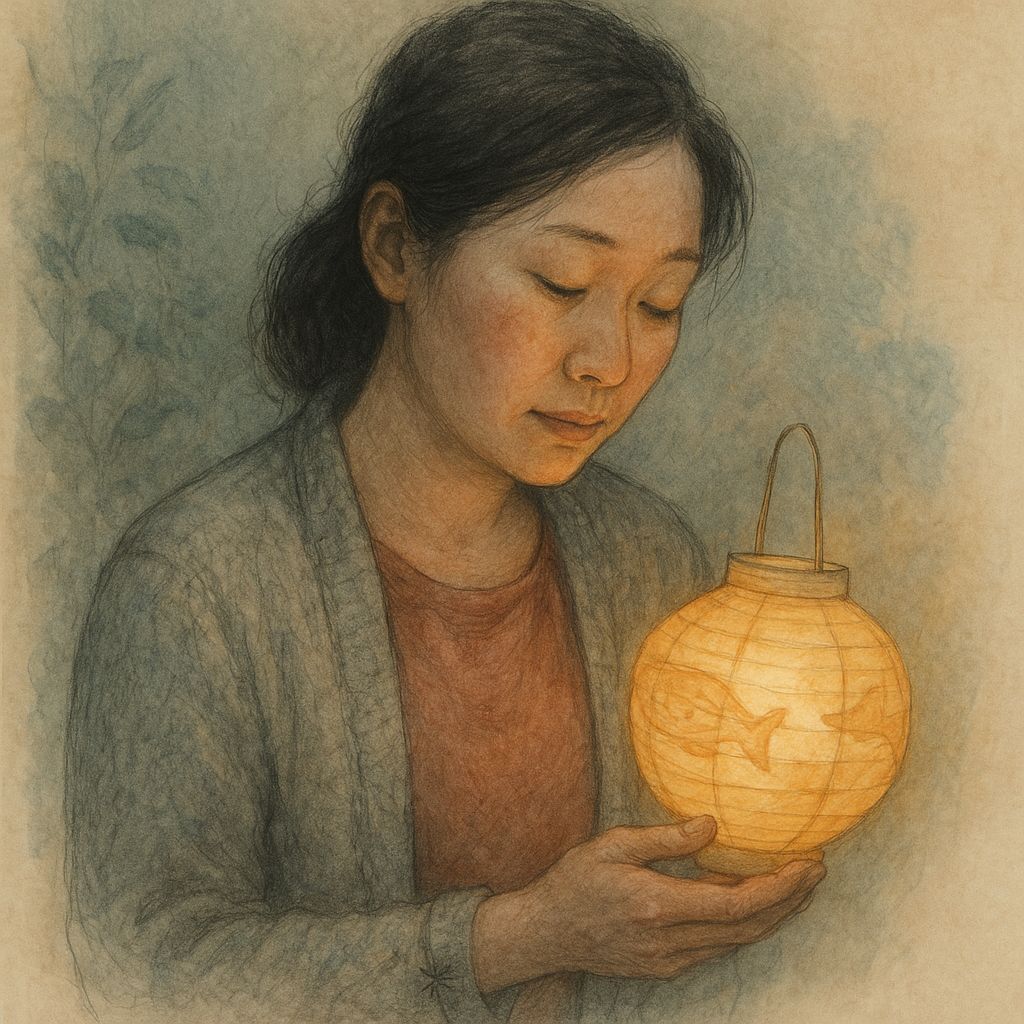
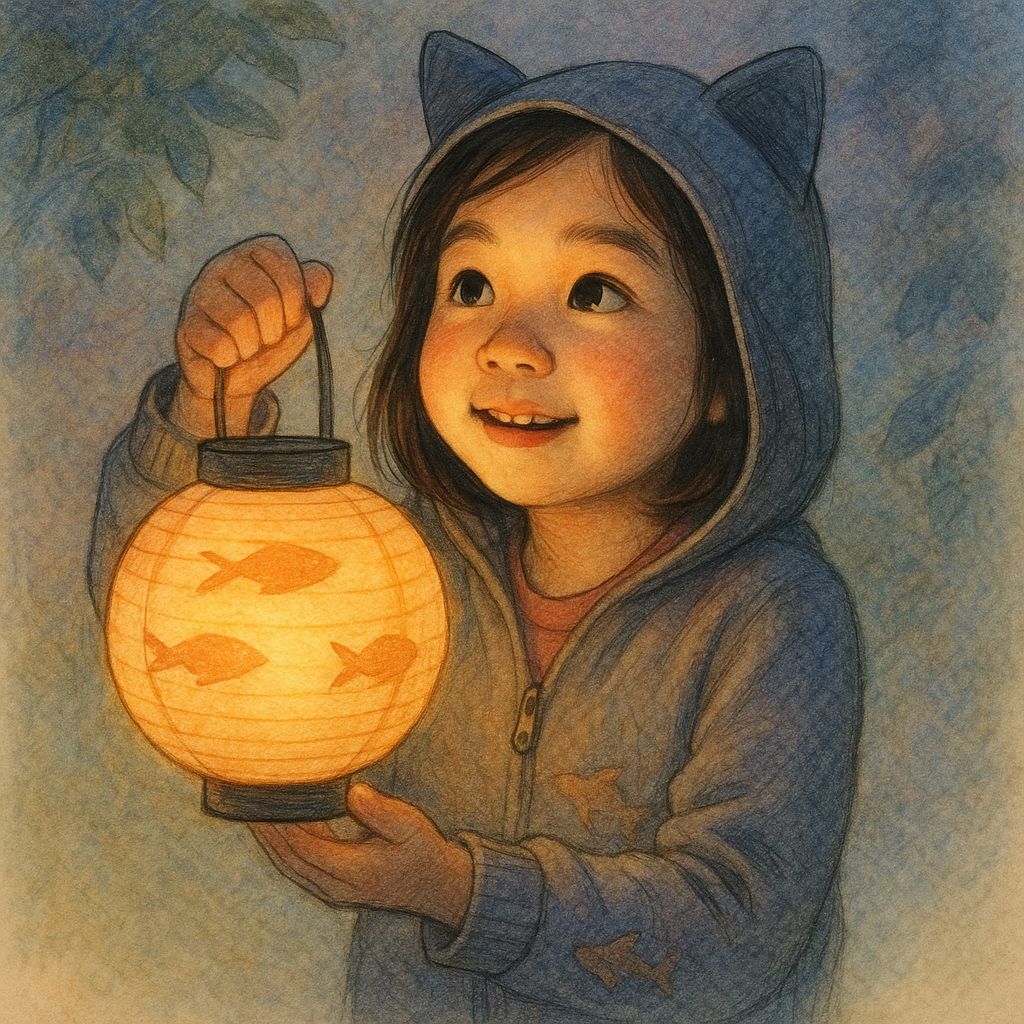
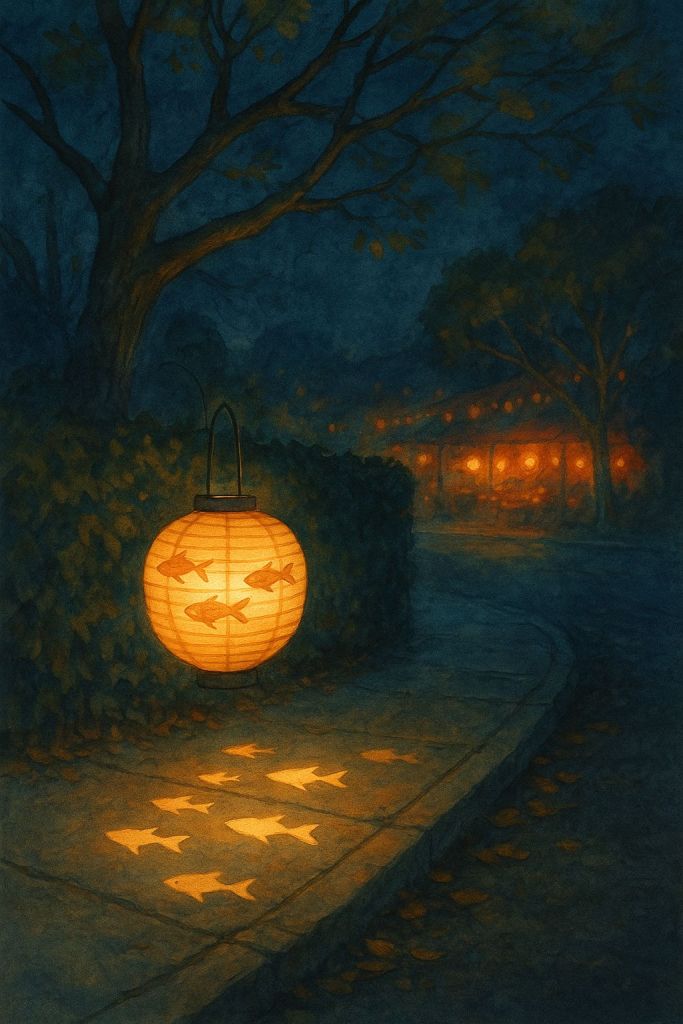
Mei Lin laid a length of orange ribbon on the kitchen table and checked the knot-ends for fray. June’s lantern waited beside a cereal bowl, a hexagon of cardstock stitched with thin wire, windows cut in fish-shapes that swam when the light shifted. June had painted each fish like a comet with a bright eye and a tail that refused to tire. The paint caught whatever light the room offered and made more of it.

You didn’t need to make it so beautiful, Mei Lin said. People hand you candy even if you carry a pillowcase.

Handmade looks happier, June answered, chin up inside a gray hoodie with small cat-ears sewn on. She wiggled a front tooth that had begun to sway; the tooth bobbed like a buoy in a harbor no one could see.

The ribbon threaded the wire handle; Mei Lin pulled through and tied a square knot. The knot held. Good. Things should hold. She turned the lantern once, testing the balance. Solid. A small light would sit inside and breathe like a careful animal.

On the counter, a tray of dumplings rested beneath a dish towel. She had folded them at noon between affidavits, thumbs moving as if they remembered a tune without the sheet music. She meant to pan-fry them before the rounds, eat three, maybe four, and leave the rest for later. Then the office called with a missing signature and the afternoon ran like a dog that slips a leash.

Her gray cardigan snagged on the drawer pull again. That thread kept catching. She clipped the loose end with kitchen scissors and placed the scissors flat, as if metal also needed mercy.

Across the street, Mr. Delgado had planted folding chairs in his driveway like beach flags. A thermos steamed beside a bowl of candy large enough to beach a canoe. He wore his Dodgers cap low, as if October required ritual. Every year he name-checked the cost of chocolate with theatrical outrage and then doubled the quantity anyway. Every year he pretended to scold kids for greedy handfuls and then told them to take one more for the long walk home.

Her phone hummed on the table. Auntie Rui.

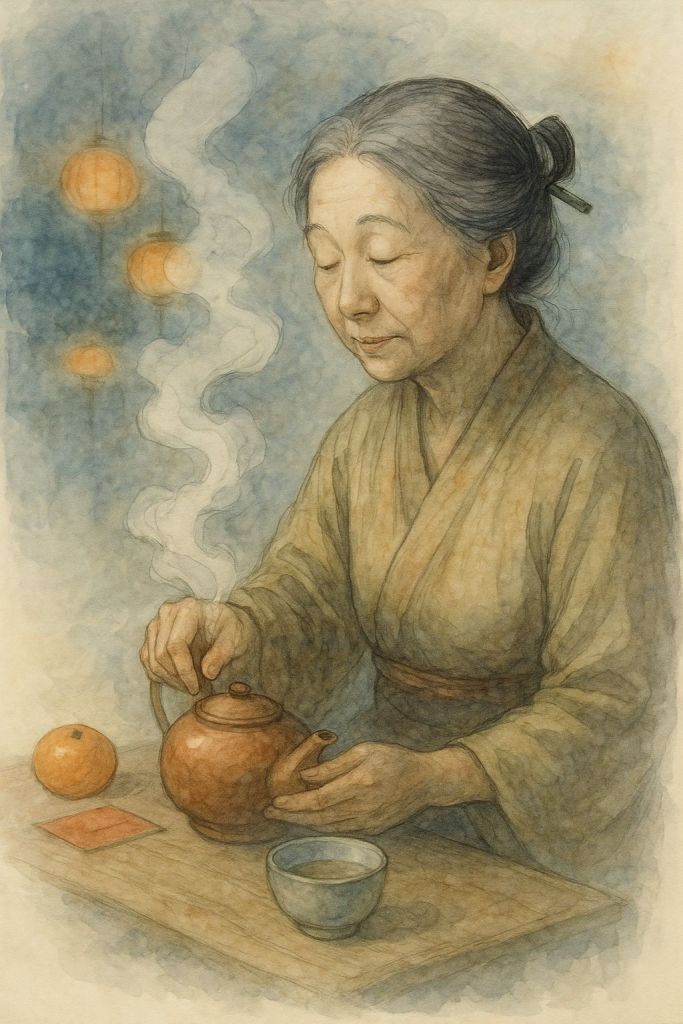
You picked a lucky evening, Auntie said, voice rich from choir practice and old opera days. Hungry month ended, but hunger lingers. Keep an orange on your table. Keep water, too. When you pass a crossroad, don’t turn if the wind calls your name.

We’ll stick to Sycamore and back, Mei Lin said, the practical tone she wore like good shoes. No crossroads. No detours. A little candy. Bed before nine.

Who made the lantern?

June did.

Then listen to me: when you light a lantern, you ask the ones who love you to walk a while. That never harms. That comforts.

Auntie, I have work. We have rules here—cross at corners, look twice, no running. That’s enough magic for one night.

Rules keep the living safe, Auntie said. Ritual keeps the living beloved. Put both on the table and eat.

Mei Lin smiled despite herself. She loved Auntie Rui, loved that voice, loved the warm insistence. She also loved rent paid on time and forms with correct middle initials. She poured two glasses of water anyway and set an orange near the sink. Habit can kneel without drama; kneeling still counts.

June hopped down from the chair. Can we go? My lantern needs night.

You need night. The lantern needs a candle, Mei Lin said, but she softened the tease with a kiss to June’s hoodie ear. She tucked tissues and a flashlight into her tote. She slipped the spare charger beside the bandages and the tiny sewing kit, the kit that saved the day more often than the bandages.

They stepped outside. The courtyard palms waved like friendly stage-hands. Someone on the second floor had taped a paper bat to the railing; the bat pivoted with every draft, a good dancer on a simple hinge. Down on the sidewalk, leaves dragged secrets along concrete. A porch two doors down wore a web spun of white string, neat enough to please a geometry teacher. Across the street, a pirate argued with an astronaut about jurisdiction.

Mei Lin knelt and set a tea light inside the lantern. Wick met flame; flame trembled and took its place. The fish windows filled with copper and gold. June lifted the handle, reverent, and the light changed her face—less cat, more comet.

Pretty, Mr. Delgado called. Start on this side, then cross at me, okay? Less street, more chocolate. And Mei, take one for energy. I’ll pretend I didn’t see.

I’ll trade you a dumpling later, she said.

Trade accepted. The Dodgers won, so I baked, he answered, and he tipped the thermos like a toast.

They walked. First porch: a witch with a smudge of flour on her cheek passed out gummy worms. Second porch: a vampire with a kind mouth offered raisins from the little red box with a forever-smiling girl on it. June said thank you every time, not like a parrot but like a person who understands the precise weight of small gifts. Mei Lin watched curbs, dogs, and drivers—always the drivers—who stared at phones and missed the way children tilt toward joy.

At the fourth lawn, a slip of wind threaded the lantern. The flame bent, not wildly, not in panic, more like a bow. The fish swam toward the hedge as if a river had switched direction.

June whispered, I think the lantern wants to go that way.

Lanterns don’t want. People want, Mei Lin said. We choose the bowls with chocolate, remember? That strategy pays.

Another draft. Sycamore leaves rustled like paper money in a lucky envelope. The flame leaned deeper toward a thin break in the hedge. Mei Lin tightened her grip on the flashlight. Auntie’s words nudged her ear: If it bends, someone breathes with you.

A back door probably opened. A space heater probably stirred air. Maybe memory. Maybe poor insulation. She squeezed June’s shoulder. Mr. Delgado next, she said. We’ll cross to him and circle back.

Can we peek through the gap? June asked. I saw it this morning when we walked to school. It looks like a secret.

No hedge tonight, Mei Lin said. We keep the loop simple.

June drifted toward the gap anyway, drawn by the kind of logic children carry in their pockets: gaps exist because someone should pass through. The lantern wrote a copper line across leaves. The flame leaned close to paper, then corrected itself, as if a whisper steadied it.

Stay with me, Mei Lin said.

I’m right here, June answered, feet already crunching the first dry leaf inside the hedge’s sleeve.

The gap opened onto a garden that didn’t match any yard on the street. Narrow paths crossed like old X’s on a map. Stepping stones wore chipped paint—numbers once, perhaps, now down to ghost colors. A clothesline stepped away from a pole like a thin horizon. A citrus tree leaned toward a low table as if sharing news. The smell of soil rose clean and friendly; a later barbecue rumor hung under it, charcoal and faint sweetness.

The lantern’s light walked ahead and marked the stones. Fish-shapes swam across bark and dirt. At the far end, a small wooden gate showed a latch that belonged in stories with rabbits and cousins. Beyond the slats, something glinted—paper? Glass? Or the sense of a threshold doing its old job.

We stepped into somebody’s garden, Mei Lin said. We say sorry to the air, we go back through the hedge, we knock like decent people next year, and we admire the orange tree from the sidewalk.

She turned toward the way they came. The hedge offered leaf and more leaf. No gap. The flashlight found a web stretched taut between two twigs, silver as a violin string. She moved left, then right. Leaf, leaf. The kind of illusion that shows up in dreams and old stories, then in a mother’s practical field of vision, unwanted but undeniable.

June reached the gate and rested her hand on the latch. She glanced back the way children do when they hear a rule go by: a little apology, a little plea, a little dare.

Please, she said, half to the gate, half to the lantern, half to her mother. The lantern drew itself thin, a breath before a note. Somewhere a dry leaf let go and landed with a sound like a page turned in another room. The citrus tree gave up one fruit with a soft thump, as if punctuation gathered and dropped.

You hear that? June whispered. It sounds like Nai Nai.

June had never heard her grandmother sing in life. That claim reached Mei Lin like a coin slid across a table in a quiet bar—small, definite, heavy. She remembered her mother’s humming—the steam of rice, the low radio in typhoon season, the neat brushwork of a name on red paper. She remembered how her mother distrusted masks and handed out extra candy anyway because children count when you tally a life.

The flame leaned toward the latch again. A small wind pushed against Mei Lin’s cheek, no colder than a sigh. She measured options in the space of three heartbeats—pull June back and fight the hedge with elbows, knock on a stranger’s back door and test the kindness of whoever lived here, or open the gate and walk two steps forward in the confidence of those who mind their manners even in strange places.

Mei Lin placed two fingers under the lantern’s base to keep it level. The flame rose, bowed, steadied. Permission, or imagination dressed as etiquette. June lifted the latch. The wood gave with a dignified groan, old but willing.

Beyond the gate, an alley ran between fences, the kind utility crews use, the kind kids name and own until adults find out. Tonight the alley wore a different skin. Paper awnings leaned from thin poles. Steam drifted from bamboo baskets fat with buns. A small stall showed a tray of candied hawthorns gleaming like rubies. Red squares of paper clung to posts, each brushed with a single character in a hand that trusted ink. A woman at a low table poured tea into cups thin as eggshells. Somewhere a strummed melody threaded the steam and tied a knot in Mei Lin’s throat.

June’s eyes went wider than the hoodie allowed. She lifted the lantern higher. The fish threw comets onto stone and wood. The flame bowed to the tea table, then to the candy, then to the hawthorns. No one looked up at them with surprise. No one pretended to ignore them. The alley simply made room the way a long table makes room when late guests arrive.

We can’t— Mei Lin started, habit reaching for the sentence that rescues order. Then the woman at the tea table lifted a cup and spoke Mei Lin’s name in vowels that came from her mother’s mouth and no other.

Mei Lín, the woman said, as if greeting a girl home from school.

The sound reached into the place under Mei Lin’s sternum where duty sits and loosened a knot she hadn’t named. June’s hand found hers. The lantern warmed her wrist.

We came out for candy, Mei Lin said, voice careful, breath not steady. We should go back. Mr. Delgado waits with chocolate.

Then take a sip first, the woman said, and her smile held sternness and mercy in equal measure. A sip for the road that brought you. A sip for the road that takes you home.

June looked up. Mom, can we sit? The lantern likes her.

Lanterns don’t like— Mei Lin began, then stopped. The words felt thin, like paper left in rain.

She guided June to the low table. She sat. The cup fit her hands. Heat climbed into her wrists, into her forearms, into the part of her that never warmed during office days under humming vents. The tea smelled of stone fruit and an honest smoke. The woman adjusted Mei Lin’s cardigan cuff, tucking the snag where it wouldn’t catch on a drawer again.

You keep too many lists, the woman said, not unkindly. Lists keep you alive. They also keep you from certain corners where blessings wait without appointments.

I have a child, Mei Lin answered. I choose corners with good lighting.

The woman nodded. Good lighting helps. So does a lantern that remembers who loves you.

Steam braided with candle smoke. For a moment the fish windows filled with small faces—cousins, aunties, a neighbor who once loaned sugar and returned the bowl with oranges, a choir friend with a high laugh. The faces flickered and softened and then pulled back like tide.

Mei Lin tasted the tea. Warmth settled the tremor in her hands. June leaned the lantern toward the cup as if offering drink to a shy guest. The flame bowed politely. Somewhere, closer than before, a melody leaned into a phrase Mei Lin knew: the little tune her mother hummed when hems came straight on the first try.

Mr. Delgado waited in his driveway. The street would keep its small safety. Dumplings sat under a towel, patient. Work files waited with their tidy threat. All of that still held.

Here, something else held.

Mei Lin set the cup down and looked at the woman. What do you want from me?

Remember without fear, the woman said. Feed the hungry. Leave water. When the wind bends a small flame, assume breath, not danger.

The lantern’s fish swam their light along the tabletop, then toward the gate again, as if currents turned. June squeezed her mother’s hand, excited but calm, the way children look when wonder finally answers to trust.

Mei Lin stood. She bowed—habit, gratitude, lineage, all in one quiet bend. The woman poured another cup and set it aside, untouched, the way you set a place for someone you love who may or may not arrive.

They followed the lantern’s steady pull back to the wooden gate. The hedge offered the gap again, casual as a yawn. The sidewalk accepted them without comment. Across the street, Mr. Delgado poured from his thermos and lifted it as if to say, Took your time, good. Some walks deserve time.

Where did you vanish? he called.

We met friends, June said, solemn.

Mr. Delgado nodded as if that answer matched a truth he already owned. Take two chocolates, he said. The road home sometimes stops at your door and asks for a tax.

They crossed. The lantern burned like any good candle now—no mischief, no lean, only work. Mei Lin felt the warmth on her palm where the handle pressed. She unlocked their door. Inside, the apartment smelled of vinegar and soy and the faint vanilla of the earlier candle. She reheated the dumplings, crisped the edges in a pan until they sang. June ate three and reached for half of a fourth. Mei Lin set the orange and the water on the table and slid a small wedge near the window. The candle on the sill bowed and straightened, polite.

June fell asleep with the hoodie ears askew, hair charged from dry air, one hand on the lantern handle as if holding a friend’s fingers on a bus. Mei Lin tucked the blanket around her and stood in the doorway and counted the things within reach that mattered: breath, food, a neighbor who bakes, a phone number she can call when superstition demands company, a child whose faith carries light without arrogance.

She set the lantern on the piano bench where red envelopes waited in a neat stack. The fish looked up through their cut windows. Mei Lin touched the handle once.

Rest, she said.

The flame steadied, then settled, as if sleep also comes to those who carry others.


Act II  — The Crossing

The alley did not end.
It curved, the way music curves when it chooses one more note.
Steam lifted from baskets shaped like small moons; the air smelled of sesame and sweet rice, of iron skillets and sugar just past its breaking point.  Lanterns—hundreds of them—hung on invisible strings, swaying as if the night itself inhaled and exhaled.

June walked ahead, fearless, her paper lantern held high among the others.  Its painted fish glowed brighter now, swimming with companions it had never met.  She kept glancing back, checking that her mother still followed.  Mei Lin followed, of course.  Habit could be love in motion.

A seller at the nearest stall spooned out dumplings glistening with broth.
He looked up at Mei Lin and nodded as though she were late for a shift.
“You’ve been gone a while,” he said, voice a rasp of warm wind.
She meant to answer—I don’t know this place—but found herself nodding back.  The dumplings steamed exactly as hers did at home, one edge thicker, the fold a little rushed.  Someone had copied her imperfection and honored it.

June tugged her sleeve.
“Mom, look—fish candy!”
A tray held sugar animals so delicate that breath alone could melt them.  She lifted one, and for a heartbeat Mei Lin feared it would dissolve between her daughter’s fingers.  Instead it shimmered and swam in air, tail flicking.
The vendor winked.  “Every story wants sweetness,” he said, then turned to serve the next invisible customer.

They walked deeper.
The alley widened into a courtyard bordered by paper walls that trembled but did not fall.  A fountain murmured at its center—clear water over smooth stones.  In its ripple Mei Lin saw faces: her mother in a red scarf; her father bending over a typewriter that never came to America; the nurse who held June when she was born; Mr. Delgado smiling through steam from his thermos.  Memory had learned geography.

“Why did they come?” Mei Lin asked under her breath.

“To see who remembers,” the woman at the tea table said behind her, though the woman had not walked.  She simply was there.
The teapot rested where Mei Lin’s shadow ended.
“You feed them, they fade gently.  You fear them, they stay hungry.”

“I’m not afraid,” Mei Lin said, though her heartbeat argued.
“I’m tired.  That’s different.”

The woman smiled.  “Tired hearts hear best.  Sit.”

She poured again.  The liquid shone amber.  Mei Lin sat.
June perched beside her, the lantern between them, light caught in her hair.

“You keep the living alive,” the woman said.  “Let us keep the living whole.”

Mei Lin frowned.  “I don’t understand.”

The woman dipped a fingertip into the tea and drew a circle on the table.  The mark glowed a moment, then faded.
“Whole means remembering even the parts that ache.  Half-memory—what you call practicality—hurts longer.”

June reached across the table, tracing the same circle with her small hand.  “Like closing a story with no ending,” she said.

Her mother looked at her, startled.  The girl’s voice had the calm of someone quoting something ancient.

The woman nodded approval.  “Every child knows.  Adults rehearse forgetting.”

From somewhere beyond the walls came the faint clang of a bell.  One, then another.  The sound rippled through the market like water hitting glass.  Vendors began to pack their stalls without hurry.  The air cooled.

“What happens now?” Mei Lin asked.

“Morning,” the woman said.  “Markets of memory close before dawn.  Go while your light still listens.”

Mei Lin stood.  June stood.  The woman reached out once more and fixed the ribbon on the lantern’s handle—tightened, smoothed, let go.
“Teach her to bow when she thanks the air,” she said.  “That’s all the gods ever asked.”

They walked.  Each stall dimmed as they passed.  Sugar cooled, tea ceased steaming, paper moons folded back into dusk.  The hedge waited ahead, the gap now clear.  As they stepped through, the music behind them gentled into silence, not an ending but an echo finding rest.

Sycamore Street again—quiet, domestic, unchanged except for a hush that understood them.  Mr. Delgado’s thermos gleamed across the way.  The dog two houses down barked once and surrendered to sleep.  A sprinkler ticked faint applause.

Mei Lin looked at the lantern.  The flame behaved itself—ordinary, unpossessed—but its glow felt wiser, like a word learned in two languages.  She exhaled and felt the warmth answer through her palm.

They crossed toward home.  June hummed a melody Mei Lin recognized from her childhood—the same tune the woman had played with silence in the market.  Each note balanced between worlds, a bridge too slender for fear.


Act III — The Bargain

Dawn did not arrive all at once. It slipped in by degrees—first through the thin crack of the blinds, then along the wall where paint had dulled with years of rent, finally into the kitchen where last night’s tea cooled in forgotten cups.

Mei Lin woke before the alarm. Habit, not rest, raised her. For a moment she listened for ordinary sounds: the pipes tapping, a car reversing, the slow rhythm of her daughter’s breath. All accounted for. Yet the silence between each sound carried something else—a patience, a waiting. The same hush that had followed them from the alley.

On the piano bench the lantern still burned, though she had snuffed it. Its paper skin glowed faintly, as if remembering light. She crossed the room, half expecting heat. Instead she felt warmth steady as pulse.

“Dream?” she whispered.

June stirred on the couch, small under the blanket. “They said thank you,” she murmured, not quite awake. “The hungry ones. They liked the orange.”

Mei Lin froze mid-breath. A child’s dream, she told herself. Children dream easily. But a small bowl on the table—empty last night—now held a single orange peel curled like a signature. The water glass had fogged from the inside.

She sat, elbows on knees, staring at her own reflection in the windowpane. The woman who stared back looked the same: cardigan, tired eyes, a forehead that had learned to measure worry in centimeters. Yet behind her reflection flickered the outline of stalls and hanging paper moons, visible only when she didn’t blink.

“What do you want from me?” she said softly to the glass, to the outline, to whatever listened.

The air answered without sound, only a pressure that felt like the touch of her mother’s hand smoothing her hair before school.

“Remember without fear,” the memory voice said. “Feed the living, honor the gone. That balance keeps the bridge open but steady.”

She nodded as if receiving instructions from a foreman. “All right,” she said aloud. “But I have work, a child, deadlines.”

The window gave back her words multiplied and thinner. She imagined the alley beyond the hedge still existing, folding dumplings for ghosts who clocked out at sunrise.

June padded over, rubbing her eyes. “Are we late?”

“Not yet,” Mei Lin said. She poured milk, cracked two eggs into a pan, moved with the choreography of morning. Between clatter and sizzle, she felt the presence quiet but not retreat.

When she set the plates down, June smiled at her. “Mom, we could make a lantern every week. Like a promise.”

Mei Lin almost said no—schedules, time, glue—but stopped. The word promise balanced on the edge of the table like an orange about to roll.

“We could,” she said. “Each one for someone who helped us, maybe.”

“Like Mr. Delgado?” June said.

“Like him. Like Auntie Rui. Like Nai Nai.” Saying the name felt easier this time, like stepping onto familiar ground that no longer shook.

They ate. The eggs vanished quickly; the quiet stayed. Outside, the street returned to its weekday costume—leaf blowers, delivery trucks, a jogger with bright headphones. Nothing eldritch in sight, unless you counted the thin veil of morning mist curling through sycamore branches.

When they finished, Mei Lin carried the plates to the sink and paused. Water ran clear, but steam from the pan rose in shapes that almost—almost—resembled written strokes. The first character for her own name appeared, then dissolved. She touched the counter’s edge to steady herself.

“Okay,” she said, half to the air. “I hear you.”

That night, after work and homework and another round of dumplings, she lit the lantern again. The fish flickered in gold and copper. She set a glass of water beside it, a slice of orange, a folded scrap of paper with a name—her mother’s—written in blue ink. The flame leaned toward the paper and stilled.

This, she understood, was the bargain: not payment, not superstition, but participation. She would keep the small gate open—not to the dead, but to memory. In return, memory would keep her from turning to stone.

Outside, Mr. Delgado played old boleros on a tinny radio while watering his lawn. The sound wandered through the window screen like a lazy guest. Mei Lin smiled. She’d make him extra dumplings tomorrow.

June peeked into the room. “Lantern time?” she asked.

“Yes,” Mei Lin said. “Lantern time.”

They sat together on the floor, cross-legged, faces lit by the trembling light. June whispered names she barely knew; Mei Lin repeated them, one by one, until each syllable felt repaired. The paper fish swam slow circles on the wall.

When the candle sank low, Mei Lin lifted the lantern and whispered something she hadn’t said in years—a line her mother used during power outages: Light doesn’t disappear; it only travels.

And as the wick gave its final breath, Mei Lin felt the room brighten in some deeper register, unseen yet certain, like the first thought before words arrive.

Act IV — The Return

By morning, the neighborhood remembered itself. Trash trucks rumbled. School bells clanged faintly from down the hill.  The air smelled of coffee and the faint perfume of last night’s smoke.

Mei Lin opened the curtains wide.  Light streamed across the piano bench where the lantern rested, now dark and harmless—just paper, glue, and wire.  Yet the way it caught the sun felt deliberate, as if it still considered its old duty.

June shuffled out of her room with a backpack and the sleepy confidence of the newly brave.  “Mom, I told the kids we have a secret lantern.  It keeps good dreams.”

“That so?” Mei Lin asked, tying the last knot in June’s ponytail.  “Then we’ll feed it another good dream tonight.”

The girl grinned, hugged her, and ran down the walkway toward Mr. Delgado’s waiting wave.  The scent of pan dulce rode the air again, folded neatly into the ordinary.

When the door closed, Mei Lin stood a moment, palms on the counter, eyes on the lantern.  In daylight it looked fragile, almost foolish—a craft project that should have sagged overnight.  Yet it held its shape, faintly gold where the paint thickened.

She thought of the market behind the hedge: the steam, the hum, her mother’s voice offering tea.  No terror, only tenderness misfiled under fear.  She understood now that she had not wandered into another world; she had wandered deeper into her own.

She sat at the table and wrote on a scrap torn from yesterday’s affidavit pad:

Eldritch — the moment when the familiar remembers its soul.

Then beneath it:

Not ghost.  Not trick.  Memory in its true clothes.

She pinned the note to the refrigerator beside grocery lists and a dentist reminder.  Let it live among errands; that was where revelation belonged.

Later, she would pick up June, buy new candles, cook rice with orange zest, and text Auntie Rui that the lantern had worked “just fine.”  She would fall asleep to the small sound of wind at the window, no longer dreading it.

For now, she poured herself tea, breathed the steam, and felt the faintest shift in the room—as if unseen hands straightened the snag in her cardigan cuff again.

The light through the blinds flickered once, not with warning but with affection.  The apartment exhaled.


Word Unveiled Reflection

Eldritch, she learned, never meant monstrous or strange.  It named the narrow border where the known leans toward the remembered, where mercy wears the mask of mystery.  To live with such light is not to fear the unseen, but to greet it—head bowed, heart open—as part of one’s own unfinished love.

The Apostles of Figueroa

Read aloud by author

The Apostles of Figueroa


He told people he was looking for her.

That was easier than saying he’d been ruined by her silhouette alone.

Name’s Avery Saroyan. Forty-six. Freelance sleuth, part-time romantic. Full-time coward when it came to anything divine. He hadn’t seen her in six weeks. Not since that Thursday when she’d walked barefoot through his doorway, humming a Baptist hymn that didn’t belong in her hips. Her name—if you trusted what she whispered—was Lorena.

She was, in a word, impossible.

Impossible the way certain jazz notes are—that high wail that breaks your ribs and smiles doing it. She was chest-forward and gospel-shaped, a woman made of crescendos. Her bosom rose like a sculpture under linen, the kind Michelangelo would’ve sinned to carve. Her backside wasn’t round—it was ripe, a fruit gravity dared not bruise.

But the real story was the walk—that holy cadence of hip and hush, hips that moved not in invitation, but in absolute control of space. Wherever she went, time forgot to tick.

Avery said he’d been hired to find her. What he meant was: he was trying to re-enter the room she left behind.


He started at Café Figaro, a tired corner haunt off 5th—red leather booths, clinking spoons, fogged windows that never cleared. They’d once argued there about Sartre, she sipping horchata spiked with mezcal.

Now, the same waitress still worked the counter.

“You look for her,” she said, sliding him a bitter coffee, “but she’s not lost. You are. She told me once—‘Avery doesn’t love women. He loves ache dressed in a woman’s dress.’”

He laughed, too tightly. “Did she say where she went?”

The waitress shook her head. “Only said she had to unbutton the parts of herself she kept covered too long.”


At a botanica on 7th, he met a woman with pale gold teeth who read cards and burned amber.

“She bought three red candles,” the woman said. “And left this behind.”

Avery opened the envelope she offered. Inside, a page torn from Song of Songs. Scrawled in Lorena’s hand:

“Let him kiss me with the kisses of his mouth—for your love is better than wine.”

Underneath: Stop looking for me in scripture. I’m in your skin.


The last place he checked was the rooftop of a Koreatown building where they once danced barefoot to Sam Cooke.

He stood there now, the city below him loud with strangers. The air smelled of asphalt and hibiscus. And for a moment, he swore he felt her.


Lorena was never sweet. She was sensuality sharpened to a point. Her skin bore the glow of cinnamon and sunlit honey. Her laugh ended in a throat tremor. When she drank, she let a single drop of wine fall from her lower lip to her collarbone, just to watch him shudder.

Once, she whispered against his ear:

“You think wanting me is the same as knowing me. But want’s not knowing—it’s worship with the lights off.”


Then she rolled over, pulled the sheets tight, and slept like someone who feared no ghosts.


At a storefront church off Figueroa and 11th, he encountered an old man sweeping cigarette butts off the steps.

“She came here once,” the man said. “Sat in the back. Stayed through the sermon and most of the silence.”

“Did she say anything?”

“No,” the man said. “But I’ve been alive long enough to know this: Some women aren’t running. They’re letting men walk in circles ‘til they realize they were chasing themselves.”


Back home, he lay on the floor. No lights. Just the weight of everything she wasn’t and everything he had mistaken for her.

He played the memories like a record:

Her perfume: cardamom, rose, and forgiveness withheld.

Her touch: not gentle, not rough—just earned.

Her silence: always placed with intention, like incense in a cathedral.


And her walk.
Always, the walk.
The hips—poetry without punctuation.

He found a photo of her tucked in an old book—her eyes half-lidded, her lips parted, her hand on her own chest. Not for him. For herself.

She had never belonged to him.

He hadn’t been trying to find her.

He had been trying to locate the last place where he could still pretend he wasn’t possessed.


And now, the surrender. Quiet. Complete.

What he was after, all along, was permission.

To ache. To hunger. To stop cloaking desire in doctrine. To admit that his entire life had been a negotiation with one trembling word: Concupiscence.


Concupiscence is not simply lust—it is desire stripped of shame, devotion ungoverned. It is the holy ache to possess and be possessed, and the terror of admitting that we were designed to long. We do not chase the beloved. We chase the part of ourselves that trembles in her presence.

Randy Sydnor

Agrestic Dignity

Read aloud by author


He stood six feet, six inches tall, and children said he blocked the sun. A man like that could have loomed, but he never needed to. His size was softened by a laugh that carried across porches, by hands that always seemed to be giving—lifting a bag, steadying a rail, patting a back. He was called a gentle giant, and for once the cliché fit.

For more than fifty years he was married to the same woman, their life a long steady partnership stitched together by meals, prayers, and inside jokes that only they understood. He had a son and a daughter, both inheritors of his good humor, though neither reached his height. At the table he always passed dishes before serving himself. He loved to eat—every kind of food, from ribs slow on the grill to peach cobbler still steaming. Eating wasn’t excess; it was joy. He treated food as fellowship, a rustic communion that brought people close.

He loved sports as much as supper. Not one game, but all of them. Baseball, basketball, football—his eyes lit up at every season. Yet his true reverence belonged to the heroes of the past: Jackie Robinson breaking barriers with a stolen base, Wilt Chamberlain bending physics, Bill Russell commanding both court and respect. He spoke their names with awe, as if they were prophets as much as players. When the news came, one by one, that they were gone, a shadow touched his spirit. He would shake his head and murmur, “They don’t make them like that anymore.” It was grief as much as admiration, a recognition that the titans of his youth had stepped off the field forever.

Still, he kept cheering. Sports gave him a language for life: teamwork, persistence, second chances. He coached kids at the park, teaching them to pass the ball as naturally as passing bread at the table. He believed in showing up, in sweating for the team, in laughing even after a loss. “Work hard. Be kind. Share the ball,” he told them. Simple sentences, but they stuck.

In the neighborhood he became a quiet anchor. He fixed porches for widows, drove neighbors to appointments, pressed folded bills into palms without announcing it. His presence was large, but his ego wasn’t. He wore work shirts, not polished suits. He had one jacket for weddings and funerals, and when he wore it he looked less like wealth and more like meaning. People trusted him because he asked for nothing in return. He was agrestic in manner—plain, unpolished, without ceremony. But his dignity was undeniable.

Time did its trimming. His stride shortened. His back stiffened. He measured days not by quarters and innings but by pill bottles and appointments. Yet his passion for games remained. He would sit in his chair, watching grainy footage of Robinson or Russell, whispering their names as if they were old friends. Sometimes he laughed; sometimes his eyes grew wet. Memory, for him, was its own league where the greats never retired.

When his final days came, he did not flinch. He called his children near, asking real questions—how are you, what do you need. He told his wife the house still held the sound of their first laughter. He made one last grocery run for a neighbor too proud to ask for help, leaving the receipt with a note that said “paid in full.” Even as his steps slowed, his giving did not.

The funeral was crowded. Not by numbers alone, but by stories. The pastor spoke warmly, though he had his details wrong; the community filled in the truth. A boy he once coached said the giant taught him not just to set a pick but to keep a promise. A woman recalled the night he drove her across town so she could keep her job. A neighbor pointed to the porch rail he had repaired and said it had never creaked since. His children spoke last, describing him not as flawless but as faithful. “He was good,” they said. “He was stubborn. He loved too much food. He loved us more.”

There was laughter, there were tears, and in both was dignity. Not the polished kind, but the agrestic kind—dignity born of rough edges, hearty meals, honest work, steady presence.

Afterward, the neighborhood carried him on in small acts. Someone repainted his porch. Someone planted tomatoes by his steps. Children played ball at the park, shouting names they only half knew—Russell, Wilt, Jackie—as if calling those legends back to life. And on certain evenings, a laugh rose across the block, deep and rolling, and for a moment you could almost believe he was still there.

Agrestic dignity. The phrase fit him like a well-worn coat. He was not refined by the world’s standards. He was refined by his own: eat well, laugh loud, help often. He lived large but simple, rough but radiant. He touched the sky without ever leaving the ground.

And when the ground received him back, the sky remembered.

Short Story ✍🏾 Second Baptism


The stairs don’t care who you were. They take the same tax, one rise at a time, a toll in breath and balance. Rashad climbs with the rope looped around his neck like an amen, the plastic handles knocking his chest in a slow, hollow rhythm. The gym’s heat is stingy. Winter presses against the high windows; each pane holds a tender frost that never quite melts.

Samira is waiting near the ring with a tablet that blinks a metronome and a stopwatch. Her scarf is tucked into the collar of her hoodie, the color a quiet plum that makes her look older than nineteen. She taps the screen. The metronome begins its soft clicking, the sound of a patient cricket in the walls.

“Bismillah,” she says.

He lifts the rope and gives it a ceremonial snap. The first turn sings. The second catches a shoe and slaps his ankle. He grimaces and chuckles at the same time. There’s an art to laughing at your own betrayal, to greeting it before it names you.

“Again,” she says.

He nods. Again.

The rope’s arc begins to settle into a figure eight. His breath chases the clicks, never quite on time. It’s not the pain that angers him; pain is honest. It’s the stammering foot, the late hand, the left side that feels like someone else’s stubborn cousin. He corrects posture as if addressing the cousin with respect. Stumble. Reset. Count.

On the far wall the posters fade in layers. Regional belts. Promotions for men long retired or long forgotten. His poster is somewhere under all that, a corner of his name trapped beneath a younger, louder man’s grin. He used to think the ring was a sermon and he was its most convincing preacher. Now he thinks about cadence. He thinks about mercy.

Samira moves when he moves. She does not touch the rope or the rhythm; she touches time. Thirty seconds and she nods. A minute and she lifts her hand. He stops, chest barking. She wipes his forehead, a mothering motion he pretends is purely athletic.

“Heart rate?” she asks.

“Like a man in a hurry.”

“Let it be like a man who knows where he’s going,” she says, and taps a new font. The metronome ticks again.

He loves her for the way she holds him without holding him. She learned the names of each thing that broke and the ways those names might heal. In the hospital, when words slid off his tongue and ran away from his mouth like shy cats, she sat and read the same paragraph aloud until it stayed. The paragraph was about breath. Inhale. Pause. Exhale. The kind of arithmetic even a frightened brain can count.

He thinks about the exhibition in five weeks, the flyer his old coach texted with a string of fire emojis he pretended not to see. Not a fight, just a walk back under the lights. A round of shadowboxing aloud. A minute to nod to the canvas and to the ghost of the man who once strutted there. He told himself he didn’t care if he stumbled. Then he caught himself practicing not to stumble.

“Hands,” Samira says, “quiet.” She taps the screen. “Listen.”

He listens. Rope, air, rope. Click, click. His shoulders soften. His gaze finds a point in the middle distance between the faded posters and the window where the weather changes the glass. He breathes the way she taught him. He misses the old arrogance the way a man misses a bad habit that made him feel interesting. He misses the version of himself who could talk his way through fear. He doesn’t miss the way that man left rooms when people needed him to stay.

Two minutes. She touches the screen as gently as if she were testing an infant’s temperature. He lets the rope fall and doesn’t curse when the handle ricochets off his shin.

“Good,” she says.

“I want great.”

“Then collect good until it becomes great,” she says, and writes something on the tablet in a neat, small hand.

He peels the tape from his right wrist and retapes it, slower this time, coaching his fingers through the small tyranny of fine motor skills. A buddy from the old days comes up the stairs, sees him, tries to bless him with nostalgia. Rashad smiles, the quick smile that says I will not be dragged into that prayer today. The buddy drifts to the heavy bag and begins to wail on it as if it insulted his mother.

Samira catches her father’s eye and crooks a smile: delicate, precise, conspiratorial. He realizes they have private weather now, a climate that lives between them. It isn’t the climate of pity. It is the climate of inventory, of careful gains, of keeping.


He used to measure days in bell strikes. He had learned to anchor his temper to rounds, to hide his joy in jabs. The first time he held a regional belt, he slept with it on his chest like a warm animal. He told reporters he was devout because he thought devotion might cut a cleaner silhouette in the photos. The older he got, the truer the words became. That happens sometimes. You lie your way into the truth and then the truth refuses to leave.

He remembers the night before the stroke: a late plate of ribs, the salty pleasure of it, the flame-licked fat like a joke he thought he got away with. He remembers the morning after, the simple act of convincing his left foot that socks open like mouths. In the hospital a young nurse with glitter on her eyelids said he was lucky and he wanted to throw the word across the room. He wasn’t lucky. He was alive, which is different. Luck is the cover a man uses when he’s cheating the numbers. Aliveness is a long arithmetic of breath and food and sleep and surrender.

He remembers a small thing. Not the monitors or the IV. A plastic pitcher with a flimsy lid. The way it squeaked when Samira poured water for him. The patience in the sound. He remembers deciding to live the way a man decides to stop lying to himself. He remembers saying God, and meaning it without show.


The routine takes root. The gym becomes a second home to the new hours, the ones that require him to respect the minute hand. He learns to love the hum of fluorescent lights because they keep him from pretending this is a movie. Movies skip weeks with a smash cut and a montage. Fluorescents are stubborn, unromantic witnesses.

Samira’s training log grows like a careful garden. Date. Time. Rope arcs. Footwork drills. Heart rate. Notes. She draws little boxes for days and colors them when he meets them. She prints out the pages every Sunday because paper keeps a promise in a way the cloud does not. She keeps the pages in a slim, black binder, the kind a choir might tuck under an arm. He tries not to watch her hands when she turns the pages. He finds himself watching anyway.

They fight, because they are alive. He salts the eggs and she lowers her brow like a gate. He says he doesn’t need help down the stairs and she says she’s not offering help, she’s offering company. He says he’ll never be pitied and she says she’s not a fool. He curses once when the rope trips his ankle for the seventh time in a minute and her mouth flickers, the smallest flinch. That night he stands in the kitchen and whispers an apology into the sink. In the morning he finds the metronome app already open on the tablet. She has named the file: Father’s breath.

They train through small winters. He learns to tap his chest where a glitch of rhythm sometimes winks, a warning blink his cardiologist calls benign but important. He learns to treat the warning as he used to treat a feint: not panic, but respect. He learns to tie his left shoe with his left hand again, slowly, then quickly, then without looking. He shows no one the small fist-pump he gives himself the first time the loop of the lace locks on the first pass.

His friends drift in and out of the gym like weather. Some pretend nothing happened. Some turn his story into a parable about grit, which makes him tired. Grit is a seasoning. It is not a meal. He prefers the company of the tired men who never stopped coming here, who learned their limits and made furniture out of them. He likes the way they nod at him, the way they refuse to narrate his life for him.

“Shadow,” Samira says, and he steps into the ring the way he once stepped into a late-afternoon room when he was young and handsome and pretended to be bored by his own reflection. The canvas meets the sole of his shoe like a question. He taps his chest once, twice, then forgets himself and begins to move. The small pop of glove on glove. The old muscle memory takes his arm in its mouth and tries to run. He lets it tug and then he calls it back. The metronome’s click is low, steady, the hinge that keeps the door from swinging free.

He tells himself he will not touch a moving bag yet because the bag does not love you back and cannot tell when you are being foolish. He tells himself this and then one day he places a hand on the bag just to feel its friendly weight, the false promise that it will never hit you. He leans his head against the leather. There is a smell in its seams like rain, like history.

“Dad.” Samira’s voice. “We’re not dating the bag.”

“I’m just saying hello.”

“Say hello and walk away.”

“I can walk away from anything,” he says, and then he walks away to prove it, and then he grimaces because proving a thing is often a sign you still doubt it.


The day comes when Coach K insists on a light round of controlled sparring. K is a small, square man with the implacable patience of a mechanic and the eyes of a librarian. He sets rules in a bored tone: one minute. Touch, don’t test. Pull your power. No bravado. K glances at Samira. She lifts a shoulder. Her eyes say I trust him more than I fear the risk.

Rashad’s sparring partner is a twenty-four-year-old with long arms and a kind soul who tries too hard to look unserious. They tap gloves. The bell snaps the air into a shape. Rashad steps and his body lags a beat behind, a ghost of time that refuses to close. The young man flicks a jab like someone trying to shoo a moth. Rashad parries late, heat rising under his skin, and the embarrassment tastes like pennies. He wants to be angry at the kid for being kind, and then he catches himself: pride, the old thief, sneaking in with a fake ID.

Half a minute. The rhythm finds his feet the way a stream finds its banks after a storm. He can feel it assembling: breath, knee, shoulder, fist, unison. He moves his head because he remembers what stillness costs. Perhaps the kid sees the old music catch for a second and offers a real punch in respect. It lands. Not hard, but honest. Rashad steps back and the ring tilts five degrees. He swallows. He looks at Samira.

Her hand lifts, palm open, not a stop but a here. She is counting under her breath. He can read the count in the flex of her thumb. That, more than the number, steadies him. He nods. He taps his glove to his chest once and steps in again. The last ten seconds gather like a small choir. The bell rings. The minute ends. He stops.

The kid hugs him without asking permission. K clears his throat in a way that says he approves and also that everyone should pretend he doesn’t. Samira’s palm lands on her father’s sternum and he does not cry, which in this moment feels like a small injustice. The body chooses its ceremonies and sometimes your face is not invited.

Shoelace. He kneels to tie it. The loop holds on the first pass. He grins at the stripe of tape stuck to his forearm and feels suddenly enormous for no good reason at all.


The exhibition arrives in February when the light in Detroit is lean and the air punishes vanity. The gym packs for the fundraiser. Men in coats that remember better winters. Women with laughter that masks long workdays. Kids whose eyes sprint. Local radio sets up a shaky banner and a microphone that pops every third word. Coach K looks almost festive; the corners of his mouth keep attempting a smile and failing, as if the muscles forgot the move and need a refresher course.

There is a refreshment table with cookies baked by someone who understands the thirst of a crowd. There are paper cups, the generous kind. Samira is not wearing her hoodie; she is wearing a plain black sweater that makes her look like a conductor who will accept no excuses from the brass section. She has her binder. The binder is calmer than anyone in the room.

When Rashad’s name is read, the room makes a sound that is less like applause and more like a held breath easing. He steps between the ropes the way a man steps onto a porch he built himself. The canvas feels the same as ever: a little cruel, a little forgiving. The lights are warmer than he remembered. He taps the nearest turnbuckle, an old habit with no theology. He shadows. The count in his ears is not the clock; it is the sound of his daughter’s thumb ticking through a line only she can see.

He stumbles once, only enough to remind the floor that he respects it. He moves through the pattern they built: head, hand, hand, small step, breath. It is a choreography of lowered expectations that turns, half a minute in, into something far less embarrassed. He hears a man call his name the way men call to old friends across a street. The minute clicks shut. He bows to the canvas as if it were an elder in a doorway and steps out. There is no speech. He has made enough speeches in his life that said less than this minute says.

Outside, the snow is beginning, the fine kind that writes in cursive on car hoods. Samira threads her arm through his. The cold instructs his lungs. He obeys.


He wakes in the night to the sound of the radiator ticking like a cautious metronome. Down the hall, a soft light leaks from the kitchen where Samira keeps her schoolwork and her training things. He gets up and walks slowly past the mirror, pauses, then goes back. He watches his own face in the patient light, the lines revisioned by winter. He mouths words to test clarity. They hold.

On the table is the binder. He opens it as if it might startle. Inside, rows of dates and tiny graphs. The days of failure are not erased; they are circled. The wins are ordinary, which is to say abundant. At the back there is a page where she has written a single heading in small letters and underlined it twice, a scientist’s mercy for a boxer’s vow. He traces the underline with his thumb. He says the heading aloud before the mirror, the name for lives that keep flowering, and feels his breath catch the count: iteroparous.

🤔 Story Analysis