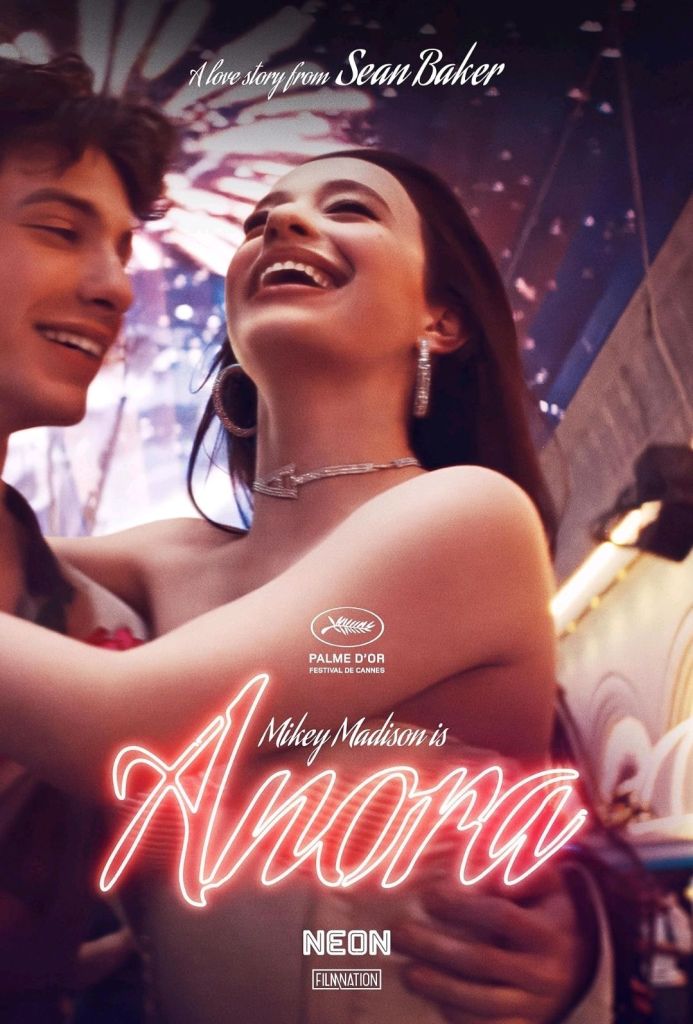
Sean Baker’s Anora is a kinetic, unfiltered portrait of a young woman navigating the chaos of her own making. The film follows the titular Anora, played with reckless brilliance by Mickey Madison, a Brooklyn stripper who finds herself entangled in a whirlwind marriage to Vanya (Mark Eydelshteyn), the son of a Russian oligarch. What begins as an impulsive, fairy-tale escape quickly spirals into something more perilous, as forces beyond her control—namely Vanya’s disapproving, ultra-powerful parents—close in on her newfound autonomy.
This is a film about freedom—what it means, who gets to have it, and the cost of chasing it. Baker, known for his deep dives into the lives of the marginalized (The Florida Project, Red Rocket), once again crafts a world that feels lived-in, volatile, and achingly real. With cinematography by Drew Daniels and a screenplay penned by Baker himself, Anora isn’t just a chaotic ride—it’s an exploration of what happens when a character who thrives on impulse collides with the unmovable forces of wealth, power, and tradition.
But does the film transcend its energetic surface, or does it ultimately leave its protagonist (and its audience) stranded in the wreckage?
Directorial Vision & Style
Sean Baker has made a career out of illuminating unseen corners of American life, and Anora is no exception. His signature guerrilla-style filmmaking, reliance on non-professional actors, and ability to extract authenticity from his environments remain on full display. The film is fast, loose, and exhilaratingly unpredictable, much like its lead character.
Baker’s choice to shoot on 16mm film adds a grainy, tactile quality that enhances the film’s immediacy. The camera is often in motion, mirroring Anora’s restless energy, while longer takes allow moments of quiet devastation to land without manipulation. The result is an immersive experience, though at times, Anora seems so committed to its protagonist’s momentum that it resists deeper introspection.
While Baker’s vérité style is a natural fit for the material, there are moments where Anora could benefit from stillness. The film thrives in its unscripted feel, yet certain emotional beats feel like they pass by too quickly, barely registering before the next rush of energy takes over.
Performance: Mickey Madison’s Unfiltered Brilliance
Mickey Madison’s portrayal of Anora is nothing short of revelatory. In a role that demands both manic exuberance and raw vulnerability, Madison delivers a performance that is as exhausting as it is exhilarating. She is the beating heart of the film, commanding attention even in her character’s most self-destructive moments.
Her Anora is a paradox: a woman who exerts control through chaos, who thrives on impulse yet drowns in its consequences. Madison’s ability to balance the character’s infectious energy with glimpses of deep-rooted insecurity makes Anora feel startlingly real. She is, in many ways, a survivor—but survival, in her case, is a process of constant reinvention, not stability.
The supporting cast, including Mark Eydelshteyn as her impulsive billionaire husband and Yuriy Borisov as a more grounded but equally dangerous presence, serve their roles well, though the film is undeniably Madison’s show. However, one of Anora’s notable weaknesses is that its secondary characters remain just that—secondary. They orbit Anora without fully stepping into their own, leaving the film feeling more like a one-woman symphony than a fully realized ensemble.
Themes & Narrative Depth
Baker is not interested in hand-holding. He lets the audience sit with Anora’s choices without moralizing, crafting a character study rather than a traditional narrative arc. The film touches on themes of power, class, and exploitation, but rather than offering a direct critique, it embeds them into the fabric of Anora’s story.
At its best, Anora captures the intoxicating allure of reckless freedom—the thrill of acting without consequence, the illusion of control in a world dictated by forces beyond one’s grasp. But while this thematic tension is ever-present, the film’s refusal to fully interrogate its own implications can be frustrating. Anora’s journey is compelling, but does it reveal anything new about the intersection of power and personal agency?
Unlike The Florida Project, which found profound depth in its child’s-eye perspective on poverty, Anora is content to exist in the moment. The film revels in its protagonist’s chaos but doesn’t always push beyond its surface, leaving certain emotional stakes underdeveloped.
Cinematography & Aesthetic Choices
Drew Daniels’ cinematography is a character in itself, infusing Anora with a raw, unvarnished beauty. The film’s visual language oscillates between neon-lit euphoria and harsh daylight realities, mirroring the highs and lows of its protagonist.
The decision to shoot on 16mm lends the film a grainy, immediate texture, placing the audience within Anora’s chaotic existence. Handheld camerawork enhances the sense of unpredictability, though at times, the frenetic style borders on overwhelming.
Baker and Daniels excel in crafting a world that feels both intimate and expansive, but the lack of visual restraint in key emotional moments sometimes works against the film’s depth. The cinematography captures movement beautifully, but it is in stillness that we truly understand a character—and Anora resists stillness at almost every turn.
Screenwriting & Dialogue
Baker’s script is sharp, fast-paced, and frequently darkly comedic. The dialogue feels lived-in rather than scripted, with exchanges that capture the unpredictability of real conversation.
However, while the moment-to-moment writing is strong, Anora occasionally suffers from structural looseness. The film thrives in individual scenes but doesn’t always cohere into a fully realized narrative. The result is a film that feels alive but sometimes directionless—much like its protagonist.
This may be intentional. Anora’s journey is not one of clear resolutions or redemptive arcs; it is a series of choices, each leading to another, none offering real closure. But in prioritizing this structure, the film sacrifices some of the emotional depth that could have elevated it.
Production Design & Costumes
The film’s world is meticulously realized, from dingy motel rooms to opulent yet soulless penthouses. Each environment reflects Anora’s transient existence, reinforcing the idea that she is perpetually out of place.
Costume design plays a crucial role in character development. Anora’s wardrobe is a chaotic blend of aspiration and necessity—flashy but haphazard, signaling both her adaptability and her lack of stability.
These details, while subtle, contribute to the film’s immersive quality, ensuring that even as the narrative meanders, the world remains engrossing.
Comparative Analysis
Anora fits into the lineage of films centered on self-destructive protagonists, drawing comparisons to Uncut Gems and Good Time. Like the Safdie brothers’ work, Baker crafts a relentless, tension-filled experience. However, Anora is looser in its construction, more interested in character than plot propulsion.
Compared to The Florida Project, Anora lacks the same emotional gut-punch. While both films explore characters on the margins, The Florida Project found poetry in its sadness. Anora, by contrast, revels in its protagonist’s chaos without always grounding it in deeper meaning.
That said, the film’s singular energy sets it apart. It is less concerned with genre or expectation and more interested in capturing the raw essence of its lead character.
Verdict
Sean Baker’s Anora is a raw, electrifying character study that thrives on chaos and spontaneity. Mickey Madison’s performance is a revelation, carrying a film that is as frustrating as it is fascinating.
While its loose narrative and relentless pacing may alienate some viewers, Anora remains a visceral, hypnotic experience—one that lingers in memory even when its meaning feels elusive.
Final Score: 3.3/4.0 (B+, 86%)
RM Sydnor

