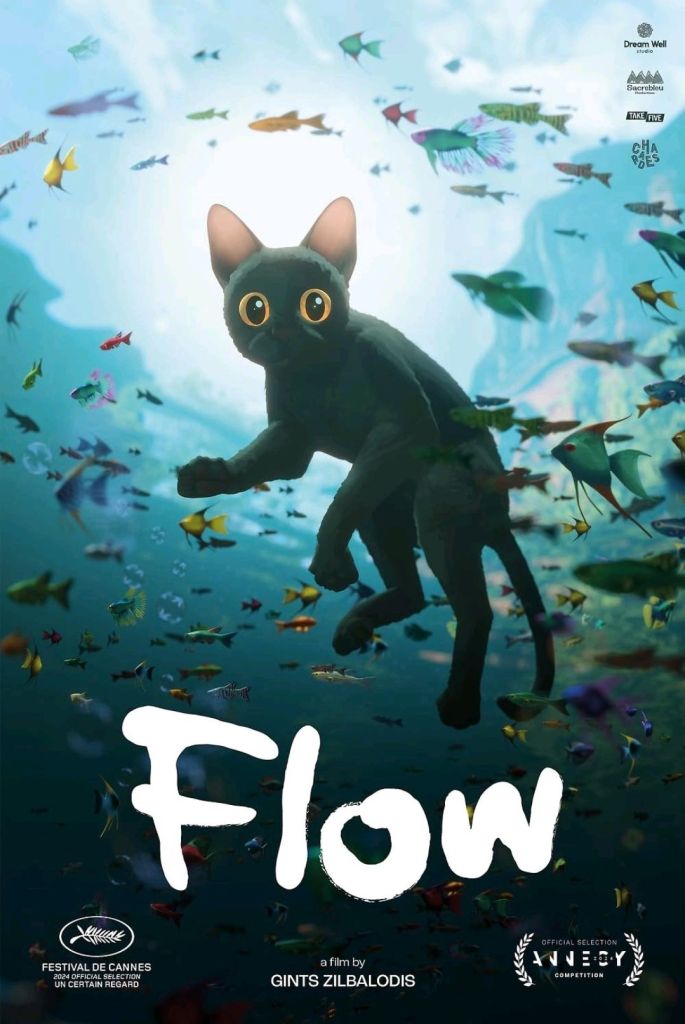
Animation at its best transcends mere storytelling, transforming into an experience that lingers in the subconscious. Flow, directed by Gints Zilbalodis, exemplifies this approach—an immersive, meditative journey where the absence of dialogue heightens the power of movement, sound, and light. Winning the 2024 Oscar for Best Animated Feature, the film is not just a visual marvel but a statement on animation’s ability to evoke emotion without words.
Zilbalodis, already known for his solo-animated Away, expands on his signature dreamlike aesthetic. Flow plays like a spiritual cousin to The Red Turtle, La Planète Sauvage, and The Tale of the Princess Kaguya—films that reject traditional narrative in favor of pure cinematic poetry. Yet, while its ambition is undeniable, does Flow offer more than an aesthetic exercise? Or does it, like its protagonist, simply drift?
Storyline and Themes
A lone cat finds itself navigating a vast, flooded world, forming uneasy alliances with other animals while confronting the overwhelming force of nature. Flow is less concerned with conventional plot than with the interplay of movement and survival. Each encounter—whether with a hesitant ally or an indifferent current—contributes to an existential meditation on solitude and instinct.
The film refuses traditional cause-and-effect storytelling, embracing a fluid, almost stream-of-consciousness structure. Moments unfold with an organic, hypnotic rhythm, demanding patience but rewarding those willing to surrender to its quiet allure.
Thematic Depth and Subtext
Beneath its tranquil aesthetic, Flow contemplates adaptation, isolation, and the relentless passage of time. The cat, neither protagonist nor traditional hero, embodies the struggle for agency in a world shaped by forces beyond control. The floodwaters, ever-present and inescapable, act as both antagonist and silent narrator—a force that gives and takes with equal indifference.
The absence of dialogue forces the audience into a state of pure observation. Is the film an allegory for displacement? A meditation on nature’s indifference? Or simply a visceral experience to be felt rather than analyzed? Much like the water it depicts, Flow allows meaning to shift with the viewer’s perception.
Strengths and Weaknesses
Directorial Vision
Zilbalodis’s singular approach makes Flow a rare kind of animated film: contemplative, atmospheric, and almost spiritual in tone. The film’s commitment to pure visual storytelling is both its strength and its challenge.
Cinematography
The minimalist character designs contrast with the meticulously crafted environments. Water, light, and motion are rendered with an almost painterly sensibility, reinforcing the film’s hypnotic atmosphere.
Animation Style and CGI
Unlike traditional hand-drawn animation or hyper-stylized CGI, Flow employs a painterly 3D animation technique that prioritizes fluidity and atmosphere over intricate detail. Zilbalodis, who famously animated Away as a solo endeavor, continues his signature one-man animation approach, blending real-time rendering with impressionistic visuals.
The film’s animation style straddles the line between minimalism and immersion, favoring soft lighting, weighty movement, and seamless transitions over hyper-detailed textures. This independent, single-artist approach allows for a singular vision, though at times, it results in slightly stiff character movement, a common trait in real-time-rendered animation.
Unlike the frenetic stylization of Spider-Verse or the hand-painted delicacy of The Tale of the Princess Kaguya, Flow operates in a quasi-realistic dreamscape, where movement is deliberate, and the environment dictates the pace. This choice enhances the film’s meditative tone, reinforcing the idea that it is not just about action but about observation.
Sound Design and Score
In a film without dialogue, sound becomes a language of its own. The orchestral score, paired with the ambient hum of water and wind, constructs an emotional landscape that words could never capture.
Pacing and Accessibility
Flow requires patience. Its refusal to adhere to traditional narrative beats may alienate viewers expecting a structured adventure. For some, its beauty will be mesmerizing; for others, frustrating.
Character Connection – The film operates at a remove, keeping its protagonist at an almost symbolic distance. While thematically appropriate, this lack of intimacy may prevent emotional investment.
Repetition and Minimalism – While the film’s restraint is admirable, its commitment to ambient storytelling sometimes veers into monotony. The absence of conventional escalation means certain sequences blur together, making its 80-minute runtime feel longer than expected.
Production Design and Costumes
World-Building – The flooded landscape is a character in itself, rendered with quiet grandeur. Every ripple, shadow, and distant silhouette contributes to an atmosphere of melancholy beauty.
Aesthetic Choices – Light shifts from warm, golden hues to eerie, desaturated blues, mirroring the protagonist’s shifting emotional state. The use of negative space and horizon lines emphasizes solitude, reinforcing the film’s meditative tone.
Character Design – Eschewing exaggerated expressions, Flow opts for naturalistic animal movement. The cat and its companions are rendered with restrained realism, their emotions conveyed through posture, hesitation, and gaze rather than overt animation.
Comparative Analysis
Similar Works – Flow shares DNA with The Red Turtle and La Planète Sauvage, films that prioritize image-driven storytelling over dialogue.
Genre Impact – While it may not redefine animation, it challenges expectations, proving that silence can be just as powerful as spectacle.
Longevity – Will Flow be widely discussed in five years? Likely only in cinephile circles. But its quiet influence may ripple through future independent animation.
Verdict
Overall Impression – A film of immense visual poetry and quiet power, Flow will resonate with those who embrace its meditative pace. For others, it may drift too far into abstraction.
Final Score – 3.8/4.0 | A- | 91%
Legacy Factor – Flow may not shape mainstream animation, but it affirms the boundless possibilities of the medium—reminding us that sometimes, the most profound stories are told in silence.
 RMS INSIGHTS ✍🏾